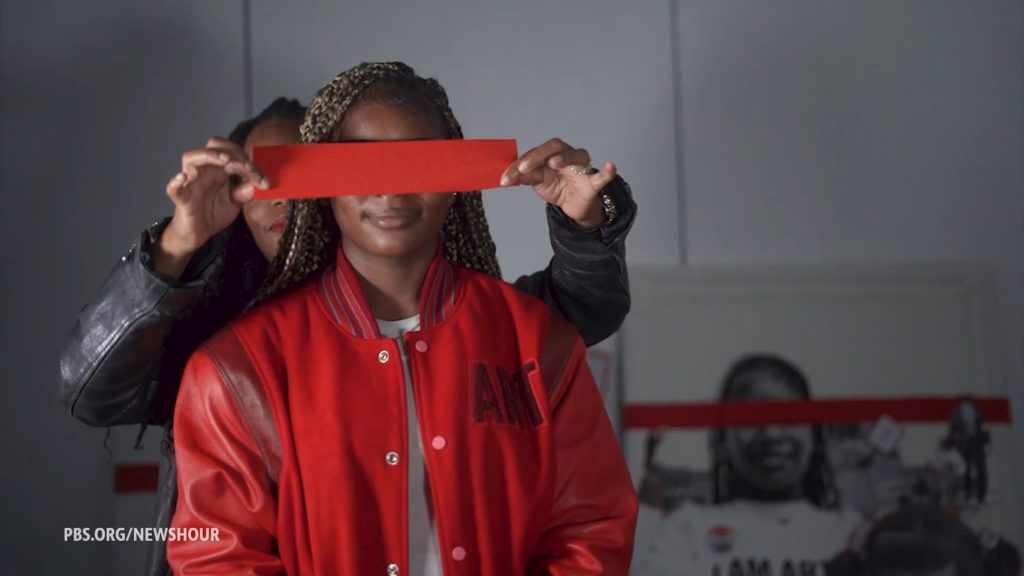
An artist and educator in Washington, D.C., is using her work to celebrate her students while confronting the lasting effects of redlining. Blu Murphy is helping young people see themselves and their communities as works of art. Shane Mukasa of our journalism training program, PBS News Student Reporting Labs, has the story.
William Brangham:
Finally tonight, a story from PBS News Student Reporting Labs, which is our national high school journalism training program.
In this story, reporter Shane Mukasa meets an artist and educator here in Washington, D.C., who shares her passion for empowering students through art.
Blu Murphy, Artist and Educator: Put your white gloves on before you touch any of my babies, right, because they deserve that level of respect.
I am a photographer. I am a mixed media visual artist. But before anything, I am an educator. I’ve been teaching for 15 years.
Shane Mukasa:
Blu Murphy’s works often feature her students, who attend Perry Street Prep, a tuition-free public charter school in Washington, D.C.
Blu Murphy:
I try to instill in my students that, like, you are the art. Seeing brown skin, dark brown skin, beautiful coily hair in art galleries makes you value that even more. You’re like, oh, yes, my skin is beautiful. My hair is amazing. It’s a literal work of art.
That core memory can change you, right? It can create some type of self-esteem to be like, you know what, I am that girl. I am the main character, right? I am art.
Londyn Evans, Student of Blu Murphy: When I see Ms. Murphy’s art, I feel, like, really honored. Seeing how her art has progressed and the meaning behind her art, as I have gotten older, how I interpret it and understand it, it makes me proud. Everybody is drawn to what her art means.
Shane Mukasa:
Murphy’s art is unique and empowering, and it’s designed to celebrate her students like Londyn, who still remembers the day they first met.
Londyn Evans:
I think I was in fourth grade, and I was coming inside from recess, and we were in the lobby, and she stopped me. She said: “Let me take a photo of you.”
Blu Murphy:
So then I did a series of portraits. She was one — Londyn was one of them, where the students look angels.
Shane Mukasa:
Some of her most striking pieces come from what she calls her Redline Series.
Blu Murphy:
So, redlining actually started in 1930s, where the U.S. government and financial institutions took maps and literally drew red lines to determine which areas will be considered hazardous, undervalued, which usually meant poverty, which usually meant Black or urban communities.
I started creating the Redline Series from that, this idea of, like, your eyes are covered to the fact that the red line is surrounding you all the time. For me, I think my students and teachers, we got so used to having less that they were so blinded by the fact that it always existed.
Londyn Evans:
I feel the schools that are in redline districts that have less funding are at a disadvantage when it comes to those things. When I see the progression and how her art has changed over the years, it makes me proud.
Just because we’re in this district or this area, or we live in this zip code, doesn’t mean we’re any less important.
Blu Murphy:
I want people to see redline people, right? So if you live in a redline area, urban area, low poverty area, whatever you want to call it, I want people to see them as valuable. Every single one of them are valuable. And they should be treated as such.
Shane Mukasa:
For PBS News Student Reporting Labs, I’m Shane Mukasa in Washington, D.C.