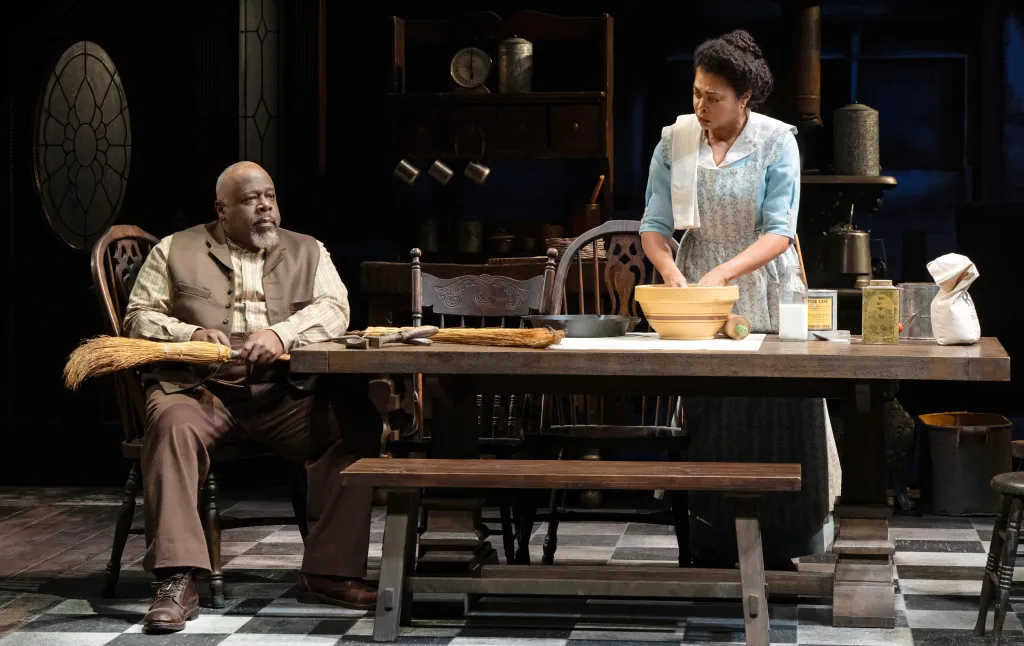
Rare is the Broadway season that hasn’t been bettered by an August Wilson revival, and this very busy spring is no exception. Joe Turner’s Come and Gone, lovingly and astutely directed by Debbie Allen with a no-weak-link cast headed by Taraji P. Henson (in a superb Broadway debut), Cedric The Entertainer and Ruben Santiago-Hudson, is nothing less than a full-on reminder of Wilson’s singular genius for blending naturalism with more-things-in-heaven-and-earth marvels.
This play, the second chronologically in the author’s incredible 10-play Century Cycle, is set in Pittsburgh yet inhabits the collective memory of Africa, the American South and some ancient, still-felt netherworld. Ryan Coogler’s Sinners couldn’t exist without Wilson’s cartography.
With its exemplary cast that includes an intense Joshua Boone, and a creative team filled with top-of-their-game designers Paul Tazewell (costumes), David Gallo (sets), Stacey Derosier (lighting) and Justin Ellington (sound), Joe Turner’s Come and Gone is an unfailing glimpse into that phenomenon described by William Falkner as the past never being dead, never even being past. Ghosts – or haints or “shiny men” or “bones people” – are forever felt, if not ever-present.
The “today” of Joe Turner’s Come and Gone is 1911, an era when Wilson’s Pittsburgh was growing with the steady arrivals of Southern Black migrants – some formerly enslaved, some young enough to have never been forced to pick cotton (though no one, young or old, can shed its cruel legacy). One character – a troubled traveling man named Herald Loomis (Boone) – remains in the torturous mental chains of a post-slavery enslavement: He was abducted and forced into seven years of hard labor by the based-on-history man who gives this play its title.
Loomis, given to speaking in tongues and suffering harrowing apocalyptic visions, arrives with his 12-year-old daughter Zonia (Savannah Commodore at the reviewed performance) at the boarding house of Seth and Bertha Holly (Cedric the Entertainer and Henson). There, he joins the just-passing-through community of Jeremy Furlow (Tripp Taylor), a callow guitar-playing young man newly arrived from the South; Mattie Campbell (Nimene Sierra Wureh), a dejected, lovesick young woman who has taken up with Jeremy to get over a recent heartbreak; and Molly Cunningham (Maya Boyd), a fancy-dressed young woman disillusioned with love and now just looking for the next good time (which might be the naive Jeremy).
And then there’s Bynum Walker (a stand-out Santiago-Hudson), an aging “conjure man” who claims to have met a supernatural “shiny man” who gave him the secret of life and instilled a gift for binding people to other people, rescuing the “binded” from the loneliness that haunts people like Jeremy, Mattie, Molly and, most of all, the tormented Herald and his motherless daughter.
Joshua Boone, Ruben Santiago-Hudson
Julieta Cervantes
It is through Bynum – a nickname reflecting the power to “bind them” – that the play derives much of its aura of the otherworldly, or at least the mysterious worldly, what Seth disdainfully dismisses as outdated “heebie-jeebie” stuff. Rituals involving the blood of dead pigeons, incantations and circles drawn in the dirt – all conducted off-stage – might be little more than holdovers from deep country roots, but it’s only Bynum who can bring the “possessed” Herald (note the name and the spelling) out of his violent, terrifying spells.
“You shining like new money,” Bynum is given to say when he senses the sort of spiritual breakthrough that gave his own once-misspent life a newfound purpose.
The household is visited weekly by traveling salesman Rutherford Selig (Bradley Stryker), the play’s sole white character who does business with the pots-and-pans-making Seth. More importantly, Selig is what Bynam calls a “People Finder”: For a fee, Selig will keep an eye out while on his sales routes for whatever missing person the payer seeks. Bynam wants to reunite with his “Shiny Man,” while the somber, black-clad Herald wants only to find the wife he believes abandoned him during his forced servitude to Joe Turner.
Seth is pretty sure he knows who and where the missing wife is, but he’s not inclined to share the information with the “mean”-looking Herald for fear of what the dangerous man might do.
It doesn’t spoil the play’s stunning ending to note that the missing wife, Martha (Abigail Onwunali), does indeed turn up, though she certainly isn’t the cheating betrayer that has kept the obsessed Herald searching for years. There’s a chance Bynum will have yet another opportunity to work his magic.

The cast of ‘Joe Turner’s Come and Gone’
Julieta Cervantes
One of the things Wilson seems to be getting at here is an exploration of migration and the tolls it carries. The rewards – newfound identities, left-behind burdens and, always, the hope for something better – is chained to the costs. No one, young or old, the playwright suggests, is ever entirely free, neither of the past or of themselves.
Director Allen paces the reveals and developments – whether noxious or as sweet as the first blush of love in little Zonia and neighbor boy Reuben (Jackson Edward Davis at the review performance) – with an artful sense of the narrative’s timings and rhythms.
When the threat of violence erupts, as we sense all along it will, it comes not only as physical violation but spiritual, an assault on the peace and stability that Seth, Bertha and their thrown-together family have worked so hard to maintain. It is a credit to Wilson’s monumental talent, and the astuteness of this production, that we’re left at the end with the sense of a past that won’t fade and a future that might never know what to make of it.
Title: Joe Turner’s Come and Gone
Venue: Broadway’s Ethel Barrymore Theater
Written By: August Wilson
Directed By: Debbie Allen
Cast: Taraji P. Henson, Cedric The Entertainer, Ruben Santiago-Hudson, Joshua Boone, Maya Boyd, Savannah Commodore/Dominique Skye Turner, Abigail Onwunali, Bradley Stryker, Tripp Taylor, Christopher Woodley/Jackson Edward Davis, Nimene Sierra Wureh
Running Time: 2 Hrs 20 Min (including intermission)