Geoff Bennett:
Voters head to the polls tomorrow in six states.
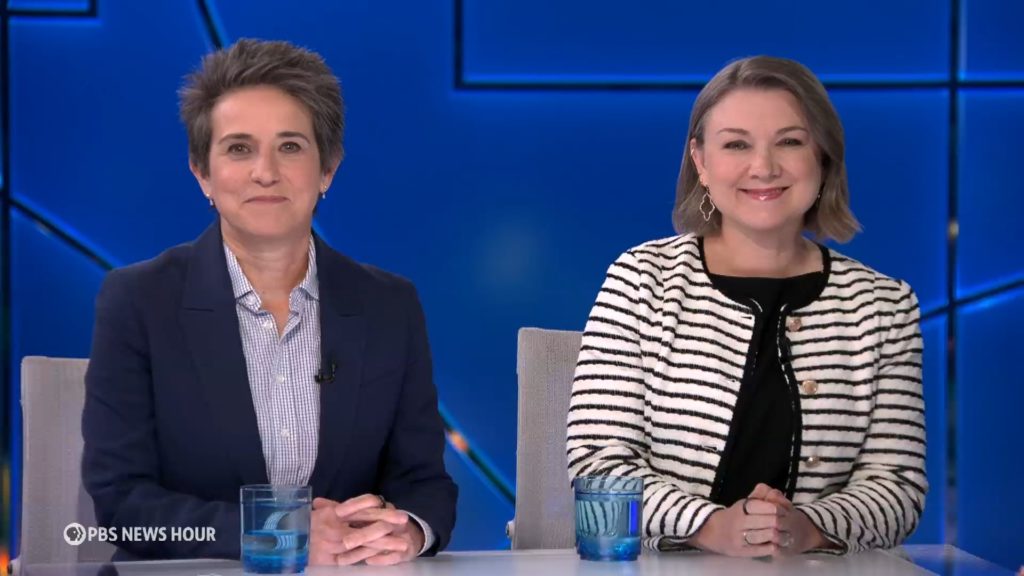
For more on the races to watch this week, we turn now to our Politics Monday duo. That’s Amy Walter of The Cook Political Report With Amy Walter and Tamara Keith of NPR.
It’s always great to see you both.
So, Amy, I will start with you, because Michigan Democrats, they spent the weekend trying to mend fences after a bruising Senate primary. Now you have Michigan — or, rather Minnesota, and we were talking earlier about how hard it is to keep all this straight.
Now you have Minnesota and Wisconsin Democrats. They might soon have to do the same after a tough primary to come.
Amy Walter, The Cook Political Report:
Yes.
Geoff Bennett:
The question is, how much do these tough primaries matter once you get to the general?
Amy Walter:
Well, I think for bringing the Democratic base together, no one is better and more helpful to Democrats than Donald Trump. He is the great unifier and organizer of the disparate factions within the Democratic Party.
I think the challenge, especially in a state like Michigan or Wisconsin, which are swing states — now, they are bluer today, in part because Donald Trump is much less popular in those states today than he was in 2024, let’s say. But if the election in those races is about Donald Trump, and that’s the focus of the election and the economy and frustration about it, that’s beneficial to Democrats.
The challenge with Michigan and potentially Wisconsin is that the conversation is also going to be about the liabilities of the Democrat. So it’s no longer just a referendum on an unpopular president.
Geoff Bennett:
And, Tam, Wisconsin might be a revealing test on that front because you have Francesca Hong. She’s a Democratic Socialist. She’s the Democratic front-runner for governor, despite concerns among many folks in the party about whether or not she’s electable. What would a Hong victory tell us about where Democratic primary voters are right now?
Tamara Keith, National Public Radio:
Yes, I think this is a really interesting case.
Bernie Sanders, who has endorsed a lot of the progressive candidates, hasn’t actually endorsed in this race, which I think is somewhat telling, in that sort of the progressive wing is not necessarily always pushing this forward as the perfect example of what they can do in a swing state.
It is also the case that the establishment lane has been a multicar pile-up in this race. There were a number of more establishment candidates. There have been dramatic issues, people dropping out. One of the people who dropped out got back in, and that’s David Crowley, who is now endorsed by Governor Evers, who was trying to push him over the finish line.
It has been — it has been quite the dramatic series of events. Meanwhile, Francesca Hong has been powering forward, though, recently, having several interviews where she has said some pretty wild things that could end up being problematic as there were a lot of undecided voters out there.
Amy Walter:
You know, I think what we’re going to see, and that’s the difference of these cases, in Michigan, the establishment said, oh, no, that we’re splitting the establishment vote. Somebody has to drop out, we’re going to all unite around one candidate. They did that around Haley Stevens. She still came up short.
In Wisconsin, the establishment lane got really messy, as Tam pointed out, and they were unable to quickly coalesce around a candidate. But in either case, if Hong wins, whether they were coalesced or not, it just goes to show that, at least for now, in some of these Democratic primaries, there’s enough energy behind this these outsider candidates, whether they’re DSA-backed or not, who are seen as being against whoever the establishment, in this case, the sitting governors and in some cases the sitting senators have endorsed.
Tamara Keith:
And I will just add that Francesca Hong has had a very strong focus on A.I. data centers, which is a sleeper issue that is starting to show up in all kinds of races all over the country, sort of capturing that voter backlash against these centers.
And that — talking to swing voters in Wisconsin, they were like, oh, all I know is that she’s against data centers.
Amy Walter:
Right.
Geoff Bennett:
And on the Republican side, in Minnesota, President Trump is backing Mike Lindell for governor. He’s a close ally, prominent figure in efforts to overturn the overturn the 2020 election. And his candidacy has divided Republicans in Minnesota.
If Lindell wins, what does that tell us about President Trump’s continued ability to shape the Republican Party?
Amy Walter:
Yes, we’re going to have two tests of that tomorrow night in South Carolina, where he’s endorsed Senator Lindsey Graham — the late Senator Lindsey Graham’s sister to replace him, and then here in Minnesota.
In both cases, it’s not a total given that his endorsement will be enough, but it’s also such a reflection of where Donald Trump’s interests are, right? His interests are really with, who’s going to be the most supportive of me, who’s been the most loyal to me? The issue of whether this candidate is electable or not becomes less important, though I will say, regardless of who came out of and who comes out of the Republican primary in Minnesota, that is a very, very tough race for a Republican to win.
And, in South Carolina, it’s going to be a very tough race for a Democrat to win, regardless who comes out of that primary. So it doesn’t have as much impact as, say, Trump’s endorsement in Texas, where he endorsed Paxton, and that has helped to make this a very, very tough race for Republicans in the fall.
Geoff Bennett:
Yes.
In South Carolina, Darline Graham, known quantity, she shares the same last name, President Trump has endorsed her, and yet that hasn’t cleared the field on the Republican side. Why not?
Tamara Keith:
Yes, he endorsed very quickly, I think before the field was even clear, and he didn’t clear the field.
I think that there are a lot of people who are like, yes, we know Lindsey Graham, but we’re not sure we know Darline Graham. And we have already seen negative campaign ads and all kinds of other things. I will just point out that, in South Carolina, President Trump endorsed a candidate for governor who made it to the run-off, but then the president, seeing the writing on the wall, endorsed the other candidate also and said, I endorse them both. Whoever wins will be a great Republican.
So, he has shown that with this sort of run-off system that is in South Carolina, he maybe doesn’t have all the juice that he would like. And so I think I’m watching that closely and to see whether he does another double endorsement come the run-off.
Geoff Bennett:
And then there are the two Republican incumbents who are creating problems for House leaders. You have got Max Miller. He’s staying in his Ohio race, despite calls for him to step aside.
And then you have got Cory Mills. He’s facing a DOJ inquiry and a House Ethics investigation. And now two fellow Florida Republicans are backing his primary opponent. These are Republican-leaning districts. How much does candidate trouble change the political math here?
Amy Walter:
Well, as a matter of fact, it changes it so much that The Cook Political Report actually changed the rating in the Max Miller seat that’s in an Ohio district that Trump won by 10 points from one that was likely Republican to one that is now a toss-up.
In both cases, what you have are Republicans who believe that, like Donald Trump, they can withstand whatever is thrown at them. They believe that they have been maligned. They believe that they’re standing up against the swamp or the system, and that they are going to follow the Donald Trump playbook of deny and change the subject and win a race.
I think it’s a lot harder to do that when you’re not named Donald Trump than they think. And both of these races are going to be — again, these are races that should be safer. I do think character does matter in these congressional races, and it’s going to make it very difficult for Republicans to be able to make the race about anything other than the character issues.
Tamara Keith:
And I have said for a long time that shamelessness is a superpower. It gets you pretty far, and we will see just how far it gets these candidates.
But the only person who is truly wrapped in Teflon, it seems, is President Trump and others in his party don’t have quite the same shield.
Geoff Bennett:
Tamara Keith, Amy Walter, thank you both.
Amy Walter:
You’re welcome.
Tamara Keith:
You’re welcome.