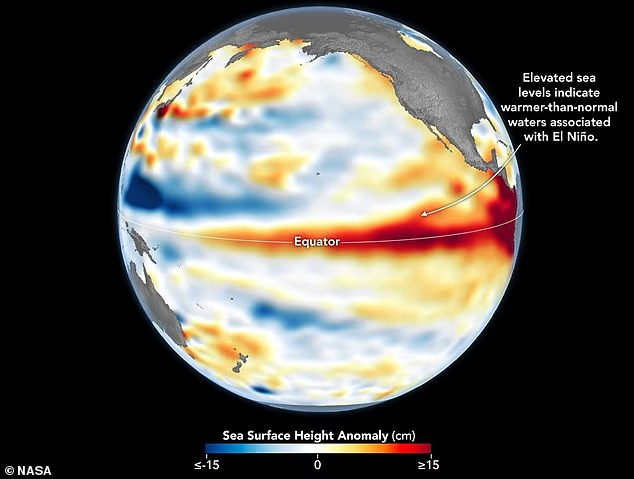
The Super El Niño is ‘underway’, NASA has confirmed, following satellite observations of sea surface height across the Pacific.
Measurements taken by the Sentinel–6 Michael Freilich satellite show that sea levels across parts of the equatorial Pacific are elevated.
‘When ocean water warms, it expands in volume and causes the sea surface to rise—making the water’s height a reliable indicator of ocean temperatures,’ NASA explained.
‘Warmer–than–normal temperatures, hence higher sea surface heights, in parts of the equatorial Pacific Ocean are associated with El Niño.’
While the NOAA declared the El Niño on June 11, NASA says its latest observations are a ‘complementary sign’ of the climate event.
Worryingly, the space agency predicts this El Niño will have ‘widespread effects’.
This includes wetter conditions to the US Southwest, and drought to countries in the western Pacific, such as Indonesia and Australia.
What’s more, experts say we can expert extreme heat ‘almost everywhere’ – including the UK.
The Super El Niño is ‘underway’, NASA has confirmed, following satellite observations of sea surface height across the Pacific
To create the map, NASA’s Jet Propulsion Laboratory processed data collected by the Sentinel–6 Michael Freilich – a satellite led by the European Space Agency (ESA) – on 8 June.
Red areas indicate sea levels that were higher than average, while white areas are normal, and blue areas are low.
‘Signals related to seasonal cycles and long–term trends have been removed to highlight sea level anomalies associated with El Niño and other short–term natural phenomena,’ NASA explained.
Back in early spring, the satellite started to detect swells of warm water hundreds of miles wide moving from the western Pacific to the eastern Pacific.
Known as Kelvin waves, these are known to be a key precursor to El Niño.
‘[Kelvin waves] happen when trade winds in the western equatorial Pacific weaken and then temporarily reverse to blow from the west,’ NASA explained.
‘Warm water piles up in the east, deepening the warm surface layer, lowering the thermocline, and suppressing the upwelling that usually keeps waters along the Pacific coasts of the Americas cooler.
‘This buildup of heat beneath the water’s surface is what sea surface height observations capture.
‘It goes beyond surface temperature measurements to indicate how much heat is stored in the subsurface.
‘That’s important because a shallow warm layer might not have much impact on climate and weather, while a large reservoir of heat below the surface can matter more.’
According to Dr Severine Fournier, deputy project scientist for the Sentinel–6 Michael Freilich satellite, conditions in the western Pacific on June 8 looked similar to those from the same time in 1997 – a year when an exceptionally strong El Niño emerged.
Dr Fournier said: ‘For now, it looks like it’s going to be a big one – more so than I would have said last week – but we still need more observations to know what’s going to happen.’
According to the World Meteorological Organisation, we can expect above-normal temperatures in ‘nearly all parts of the globe’.
The strongest heat signals are forecast across southern and western North America, Central America, the Caribbean, Europe, North Africa, and much of Asia.
Northern parts of Asia may also be warmer than usual, although the forecast there is less certain.
In the Southern Hemisphere, warmer-than-normal conditions are also expected across many areas.
Northern South America is likely to see the strongest warming, while Southern Africa is forecast to experience widespread above-normal temperatures.
In Australia, warmer conditions are mainly expected along the western, southern, and eastern coasts, with no clear trend in the north.
Tropical regions around the world are also forecast to be hotter than normal, especially Equatorial Africa and parts of Southeast Asia and the Maritime Continent.
El Niño will also impact rainfall around the world.
The event is typically associated with increased rainfall in parts of southern South America, the southern United States, parts of the Horn of Africa and central Asia, and drier conditions over Central America, northern South America, the Caribbean, Australia, Indonesia, and parts of southern Asia.
What’s more, during Boreal summer (summer in the Northern Hemisphere), experts warn that El Niño’s warm water can fuel hurricanes in the central/eastern Pacific Ocean, while it hinders hurricane formation in the Atlantic Basin.