There’s nobody quite as brutally honest as a 10–year–old child.
And a new study proves they really don’t hold back – especially when it comes to describing old people.
Researchers asked a group of 25 young children to draw a picture of an elderly person they knew and then interviewed them about it afterwards.
Some were quite complimentary, drawing an older person underneath a rainbow or picking apples in a field.
But others are hilariously merciless, including a depiction of one man with his false teeth in a cup of water.
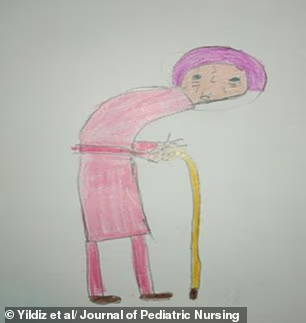
Another, drawn by a 10–year–old boy, shows an elderly woman hunched dramatically over a walking stick.
Meanwhile one alarming example depicts an old woman with green–tinged skin and countless wrinkles across her face and neck.
‘These findings indicate that children predominantly conceptualize aging as a process marked by bodily change, functional decline, and illness,’ the researchers wrote in the Journal of Pediatric Nursing.

One image shows an elderly woman hunched dramatically over a walking stick, while another shows an old man with his false teeth in a cup of water
The researchers, from the Department of Health Care Services in Turkey, said overarching themes emerged from both the drawings and interviews.
‘Children expressed their perceptions of aging through visual elements such as altered posture, assistive devices like glasses and canes, and bodily signs like wrinkles,’ they wrote.
‘Elderly figures were often drawn smaller and positioned at the bottom of the page. Details related to physical disability and illness were commonly depicted and mentioned in interviews.’
One child said during the study: ‘All elderly people are tired. They are always sick.’ Another commented: ‘Old people have no teeth and their faces are wrinkled.’
While one youngster added: ‘They’re always sick, they walk with canes, their hands tremble, they can’t walk fast. They stay home all the time, take lots of pills, get tired easily, and sleep early.’
The depictions also showed emotional deprivation, loneliness and the need for social support from family members.
‘They feel very sad because their children left them and never visited,’ one child said, while another added: ‘They’re afraid of dying alone.’
The slightly older children in the study explicitly associated ageing with mortality, loss and fear of death, the researchers explained.


Elderly figures were often drawn smaller and positioned at the bottom of the page, the researchers said. One alarming example depicts an old woman with green–tinged skin and countless wrinkles across her face and neck
Despite the brutal depictions, the children also reported close and frequent interactions with grandparents.
‘This demonstrates that children also hold affectionate and compassionate views of older adults, portraying them as loving, supportive and emotionally significant figures,’ the study reads.
It adds that the drawings reflect warm intergenerational bonds and position older adults as sources of comfort, guidance, and relational closeness.
‘While children’s perceptions of older adults were generally positive, their views on the aging period were predominantly negative,’ the study concludes.
‘Children described older individuals as compassionate, wise, and lovable, but also associated aging with loneliness, illness, disability, experiences and fears of death, suffering, and fear of loss.’
According to a recent survey of more than 2,000 Brits, you’re seen as old from the age of 69.
The results will come as bad news to 69–year–old celebrities including Tom Hanks , Kim Catrall and Steve Harvey.
For the survey, Seven Seas quizzed thousands of British adults about when they think ageing really starts.

Despite the merciless drawings, some were more complimentary and depicted an older person underneath a rainbow or picking apples in a field
Previous studies have suggested that old age begins as early as 62. However, the new findings indicate that Brits’ attitudes to age are shifting.
‘While we may be pushing the idea of ‘old’ further into the future, the data suggests many of us are still putting off the habits that help us age well,’ explained Donna Bartoli, Wellness Expert & Health Coach.
‘And if 69 really is the new ‘old’, then the time to look after our future health isn’t later, it’s now.’
Katherine Crawshaw, co–head of the Age Without Limits campaign, said: ‘What we often see with beliefs around age and ageing is real concern at becoming older, of reaching a certain age, from quite early on in our adult lives.
‘And then as we reach those milestones, for many the fears and worries about reaching that age dissipate somewhat with the reality. Being subjected to a barrage of ageist messaging throughout our lives, with children as young as ten wanting to buy anti–ageing make–up for example, gives people an unduly pessimistic view of what getting older will be like.’