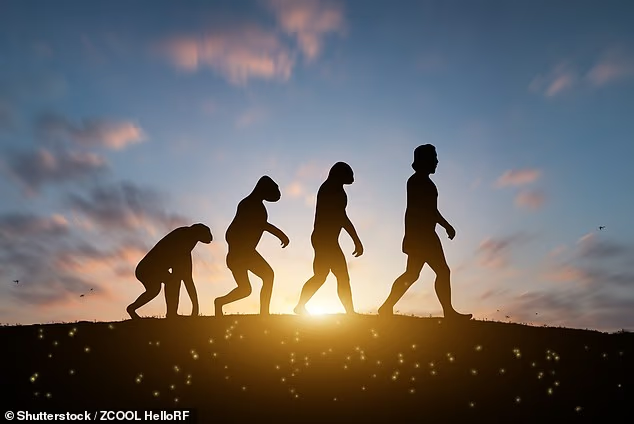
Natural selection has long been considered the driving force behind human evolution.
But a landmark study of 87 fossil skulls spanning the past two million years suggests the story is far more complex than scientists once thought.
Researchers found that the evolution of larger brains and smaller faces in the human lineage cannot be explained by natural selection alone.
Instead, they say random genetic variation, biological constraints and cultural innovations all played key roles, with some of the biggest evolutionary leaps occurring when those constraints were lifted.
The team believes advances such as improved tool use, greater reliance on animal foods and eventually cooking may have helped make larger brains possible by providing the energy needed to support them.
To reach their conclusions, the researchers analyzed 87 fossil skulls representing nearly every major Homo species and compared the findings with six competing models of evolution.
They found that chance and long periods of evolutionary stability often explained the fossil record better than continuous natural selection.
Instead of a slow, steady march driven by natural selection, the researchers said human evolution unfolded through natural selection, random genetic variation, biological and developmental constraints, periods of evolutionary stability and major cultural innovations.
Natural selection has long been considered the driving force behind human evolution. But a landmark study of 87 fossil skulls spanning the past two million years suggests the story is far more complex than scientists once thought
Rather than constantly evolving in one direction, humans experienced long periods of little change, punctuated by bursts of evolution when biological limits were eased by cultural advances such as improved tools and cooking.
The researchers, led by Greek paleoanthropologist Katerina Harvati at the University of Tübingen in Germany, examined 63 fossil skulls from extinct members of the genus Homo alongside 24 skulls from modern humans, creating one of the most comprehensive datasets ever assembled to study the evolution of the human skull.
To test their theory, they divided the fossils into two evolutionary branches, one leading to modern humans and the other to Neanderthals, and compared each against six different models of evolution.
These included gradual natural selection, random genetic change, evolutionary stability, punctuated equilibrium and evolution toward an adaptive peak, according to the study published in Nature.
Rather than focusing solely on skull size, the team analyzed both the braincase and the face, measuring dozens of anatomical landmarks in three dimensions to track how each changed over time.
The researchers found that the fossil evidence most often matched models based on random genetic change and evolutionary stability, rather than continuous natural selection.
They concluded that many of the defining features of the human skull accumulated through long periods of little change, interrupted by occasional evolutionary shifts.
The pattern held true for both brain size and facial structure, as while the skulls clearly show that humans evolved larger brains and smaller, flatter faces over millions of years, the study found little evidence that these trends were driven by a constant, directional push from natural selection alone.

Instead of a slow, steady march driven by natural selection, the researchers said human evolution unfolded through natural selection, random genetic variation, biological and developmental constraints, periods of evolutionary stability and major cultural innovations (stock)
Instead, the authors argued that human evolution was shaped by a combination of evolutionary constraints and chance, with major anatomical changes occurring when those constraints were relaxed.
They suggested that these shifts may have coincided with important cultural developments, including greater reliance on animal foods, improved tool use and, eventually, cooking, which increased the amount of energy available to support larger brains.
The researchers stressed that their findings do not rule out natural selection but suggest scientists have placed too much emphasis on it as the primary driver of human evolution.
‘Our results are consistent with previous work suggesting a limited role for gradual directional selection in human evolution,’ the authors wrote.
Instead, they ‘underscore the importance of stabilizing selection and constraints’ in shaping the evolution of the genus Homo.
They concluded that future research should focus less on identifying a single selective pressure and more on understanding when and why evolutionary constraints were lifted, allowing major leaps in human evolution to occur.
According to the authors, cultural behaviors may have helped Homo populations ‘evade the evolutionary limits constraining their potential to evolve new phenotypes.’
Join the discussion
How do YOU think humans evolved?