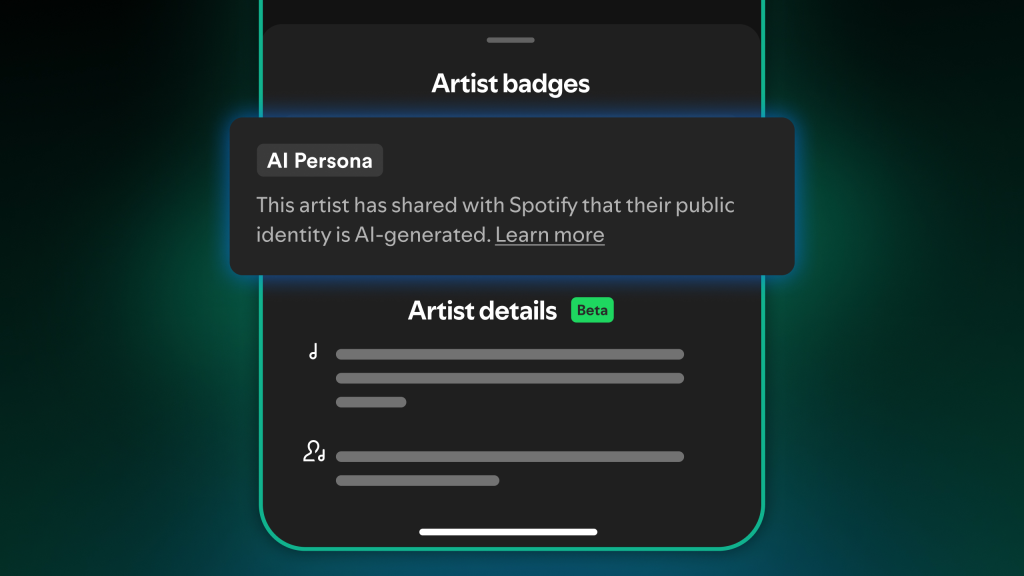
Music streaming giant Spotify will soon introduce an AI Persona badge on profiles of artists that have been flagged, or self-identified, as not human.
“True artist-fan connection can only be built on a foundation of trust and authenticity. In music, that means listeners need to be able to trust that the artist behind the music is who they say they are. That’s more essential than ever in the age of generative AI,” the company said, unveiling the new badge set to roll out in mid-September.
“Spotify’s programming is focused on elevating music from authentic artists building careers in music,” it said. “Listeners have been clear in telling us that they don’t like seeing an artist profile that seems human, only to find out that the persona is AI-generated.” The new badge “signals to listeners that an artist’s identity may be AI-generated and does not represent a real person.”
The streamer won’t include the AI Personas in any editorial or algorithmic recommendations unless they are specifically followed by a user.
Starting today (Aug. 11), artists can share that their profile represents an AI Persona through Spotify for Artists. “We hope artists will be transparent, so we are giving them the opportunity to disclose, but we won’t rely on self-disclosure alone,” the streamer said. It will review artist profiles for anything, including name and imagery, that “appears to represent photorealistic AI-generated identities. We’ll start with artists who have met defined audience thresholds, so the labels cover the vast majority of artist profiles that users visit.”
The AI Persona badge will appear starting next month on artist profiles, in the banner and “About” section, in Search, and on track rows across playlists. When listeners tap the badge, they’ll also be able to see whether the artist transparently shared that they’re an AI Persona, “or if Spotify had to review and make an informed determination.”
To help avoid false positives, every Spotify-applied AI Persona badge is reviewed by a human before it is applied. For artist profiles where Spotify’s review team have applied the badge, artists will be notified and given the opportunity to self-disclose or appeal.
Spotify clarified that the new badge is focused on the artist’s public identity, not how human artists use AI as a creative tool. Other features it offers like AI Credits and SongDNA provide information about how the music was made. “We have seen that people are eager to take the opportunity to be transparent and share how they used AI as part of their song’s creative process. We’re hoping for a similar level of self disclosure for AI Personas.”
In the coming months, the streamer will also give listeners the ability to report artist profiles they believe represent AI Personas.
AI-generated artists and music, which can divert income from human musicians, has become a contentious issue for the Spotify community. A site called Slop Tracker now lets users to paste a Spotify track link or audio URL to check if a song is AI-generated, saying its instant audio analysis detects AI music with high accuracy.
Last September, the streamer said it had removed over 75 million “spammy” tracks from its platform in the previous 12 months, a period marked by the explosion of generative AI tools. It announced a new music spam filter, a new impersonation policy clarifying how it handles claims about AI voice clones, and a new industry standard for AI disclosures in music credits.