Spirit Airlines reshaped aviation in the United States by stripping down flying to its essentials and selling what were often the cheapest tickets around. But the airline shut down for good on Saturday, a victim of the rising costs it once excelled at controlling.
In a statement just after 2 a.m., Spirit said it had canceled all flights and told passengers not to go to the airport. On the airline’s homepage, a bright yellow banner declared that the airline was “winding down all operations.”
The budget airline had lost billions of dollars in recent years as it struggled with intense competition at its most important airports — Las Vegas, Florida and New York among them — and rising labor and aircraft maintenance costs.
As a result, Spirit filed for bankruptcy in 2024 and again in 2025. It had aimed to emerge from the second bankruptcy this summer as a smaller company, but those plans fell apart as jet fuel prices rose dramatically in recent weeks, a consequence of the U.S. and Israeli war with Iran. The Trump administration started an 11th-hour effort to provide Spirit a lifeline, but government officials and the airline’s creditors could not reach a deal in time to save the company.
The shutdown leaves 17,000 full- and part-time Spirit employees without work and tens of thousands of customers without flights. Spirit said it would automatically issue refunds for tickets purchased on credit or debit cards and was working to get more than 1,300 flight crew members home.
Many other airlines said they would offer affected travelers discounted prices on flights to and from the airports that Spirit served. Some said that they would help stranded Spirit employees get home and United Airlines invited them to apply for jobs.
Spirit said it safely flew more than 50,000 passengers on Friday. Spirit flight 1833, the airline’s last, departed from Detroit late in the evening and landed in Dallas after midnight, local time.
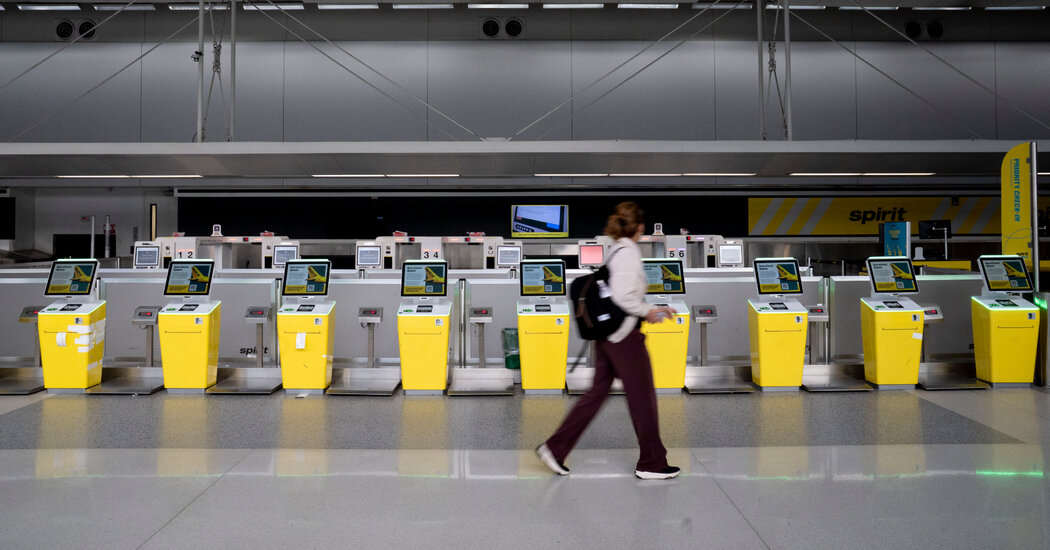
LaGuardia Airport’s Terminal A, where Spirit was the only commercial airline, was quiet on Saturday morning save for television crews and a handful of passengers who showed up for their flights not realizing the airline had shut down.
Danny Nuñez, 50, was headed home to Orlando for a pre-commencement ceremony for his M.B.A. program on Saturday afternoon. He made it past the signs on the terminal doors announcing that Spirit had shut down and to a check-in kiosk, which let him enter his flight information, before he realized something was amiss. Instead of his boarding pass, the kiosk printed an error message: “Please bring to an agent.”
But there were no agents. Notices posted around the terminal alerted passengers that “customer service is no longer available.”
“Now I don’t know, I might miss my ceremony,” said Mr. Nuñez, who had checked on Friday night that his flight was on time. He planned to try his luck with another airline.
At Chicago O’Hare International Airport, Spirit’s customers appeared to have received the message: The airline’s check-in area was deserted.
Spirit has been widely credited with democratizing air travel in the United States by keeping costs and ticket prices very low. The approach served Spirit well for years, generating huge profits. But competition from larger airlines and rising costs, particularly for pilots and other professionals, hobbled the company after the pandemic. It also suffered disproportionately from industrywide engine problems.
“Spirit Airlines played an important role in expanding access to affordable travel and bringing more low fares to more people,” Bobby Schroeter, the chief commercial officer of a rival, Frontier Airlines, said in a statement announcing discounted fares for affected travelers.
In an interview this past week, Scott Kirby, the chief executive of United Airlines, said Spirit’s problems predated the current rise in fuel prices. “They were in trouble well before this, and well-run airlines are able to be profitable even in this environment,” he said. He also criticized Spirit’s business model, saying it was fundamentally flawed because it was based on treating customers poorly.
While Spirit was particularly affected by rising competition and costs, other budget airlines have also struggled financially in recent years. This past week, the Association of Value Airlines, a trade group representing low-cost airlines including Spirit and Frontier, asked the Trump administration for $2.5 billion in aid to offset higher jet fuel costs, which have risen by about 65 percent since the war in Iran began.
Airlines for America, which represents larger carriers, said in a statement that such aid “would punish other airlines that have engaged in self-help.”
Spirit was founded in Michigan in the 1960s as a trucking company. In the 1990s, it started offering charter flights. Then, in the next decade, it started to upend the airline business.
In 2006, Indigo Partners, a private equity fund that specializes in budget airlines, acquired a majority stake in Spirit. The airline adopted the business model made famous by Ryanair, the European carrier, and focused on reducing costs, selling cheap tickets and offering bare-bones services. The industry calls airlines that use that business model “ultra-low-cost carriers” to distinguish them from an earlier generation of low-cost carriers like Southwest Airlines.
One of the main proponents of that strategy was Ben Baldanza, who spent a decade as Spirit’s chief executive. During his tenure, the airline generated big profits. Mr. Baldanza, who died in 2024, was proud of Spirit’s no-frills approach, which the airline highlighted in sometimes provocative advertising.
Spirit became the subject of jokes on late-night talk shows and frustrated many travelers by charging fees for services that other airlines provided for free, such as printed boarding passes, carry-on bags and the ability to choose a seat. But Spirit’s approach worked and forced other airlines to make big changes.
Experts in aviation and economics say Spirit’s low fares helped to make air travel accessible to more people. Its decision to fly to an airport often prompted other carriers operating there to quickly lower prices. That was one of the main reasons that a federal judge sided with the Biden administration’s Justice Department in blocking Spirit’s plan to merge with JetBlue Airways in 2024.
“In eliminating Spirit from the marketplace, the proposed transaction would, by definition, dampen Spirit’s disruptive force,” the judge, William G. Young, wrote in his ruling.
Some have criticized the Biden administration for thwarting the merger. But JetBlue has also struggled to turn a profit for years, and aviation experts say there is no guarantee that a combination of the two airlines would have been profitable. Airline mergers are hard to pull off well and are often marred by major problems. Even successful combinations can lose the companies money for years.
As Spirit grew, it expanded into airports served by major airlines, which, in turn, adopted some of Spirit’s tactics to compete with it.
In 2012, Delta Air Lines introduced lower but restrictive “basic economy” fares that were in the same ballpark as the fares that Spirit and other budget airlines offered. Later, United Airlines and American Airlines rolled out similar basic tickets.
As a result, many people who previously flew on Spirit began to book tickets on larger airlines, which could also lure them with more frequent service, shorter waits between connecting flights and more alternatives if flights were canceled.
Gabe Castro-Root and Kim Bellware contributed reporting.