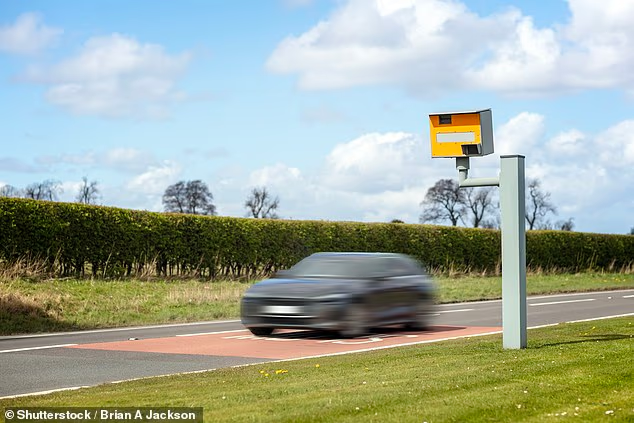
Whether you’re running late for work, in a rush to pick up the kids, or simply feeling impatient, there are often times you’re tempted to speed in your car.
But a new study suggests that speeding really isn’t worth it.
According to researchers from the University of Minnesota, breaking the speed limit barely saves you any time.
In their study, the team analysed 120 million vehicle trips across the US in 2021.
They found that across an average day of driving, driving at or below the posted limit corresponds only to about 54 seconds longer per day.
That works out to just 6.3 minutes per week, or around 27 minutes per month.
‘If your goal is to shave one minute off your time, then you’ve got to drive fast,’ said Professor William Northrop, co–author of the study.
‘If your objective is to get to your destination safely and to save fuel, then you might drive slower than the speed limit.’
Whether you’re running late for work, in a rush to pick up the kids, or simply feeling impatient, there are often times you’re tempted to speed in your car. But a new study suggests that speeding really isn’t worth
In their study, the team set out to understand the impact speeding has on fuel use, emissions, and time.
Using driving data on national road networks, speed limits and US Geological elevation data, the team analysed 120 million journeys on roads with speed limits of at least 45mph (72kph).
Almost half (43 per cent) of the trips included at least one instance of speeding, while drivers spent nearly 12 per cent of their driving time going faster than the speed limit.
However, the results revealed that driving too fast can cost you in fuel, emissions, and time.
Sticking to the speed limit was found to save drivers 2.4 to three per cent on fuel, at a cost of just 54 seconds per day.
‘While internal combustion engine–powered vehicles have become significantly more efficient in the past decades, they have also become much more powerful. Driving fast is easier than ever,’ said William Northrop, corresponding author on the paper.
‘Our study examines an obvious yet difficult–to–implement intervention for major fuel savings that can be achieved without replacing our cars: driving slower.’
According to the UK government, speeding is hugely prevalent in the UK.

In 2024, 43 per cent of drivers exceeded the speed limit on 30mph roads, while 44 per cent did so on motorways
In 2024, 43 per cent of drivers exceeded the speed limit on 30mph roads, while 44 per cent did so on motorways.
However, drivers who exceed the speed limit are more likely to be involved in a collision.
‘Exceeding the speed limit was assigned by police officers as contributing to 20 per cent of all fatal collisions in Great Britain in 2024,’ said The Royal Society for the Prevention of Accidents.
’29 per cent of fatal collisions were also linked to the driver travelling too fast for the conditions.
‘In 2024, 4,952 people were injured in collisions involving someone exceeding the speed limit – 185 of which sadly lost their lives.
‘Inappropriate speed also magnifies other driver errors, such as driving too close or driving when tired or distracted, increasing the chances of these types of behaviour causing a collision.’