The Sea of Galilee was the setting for some of Jesus’ most famous miracles, including calming a violent storm and walking across the water.
On its northern shore stood Capernaum, the ancient fishing village that became the center of his ministry after he left Nazareth and where he met several of the apostles.
The Bible describes Jesus preaching in the town, healing the sick and repeatedly crossing the lake by boat.
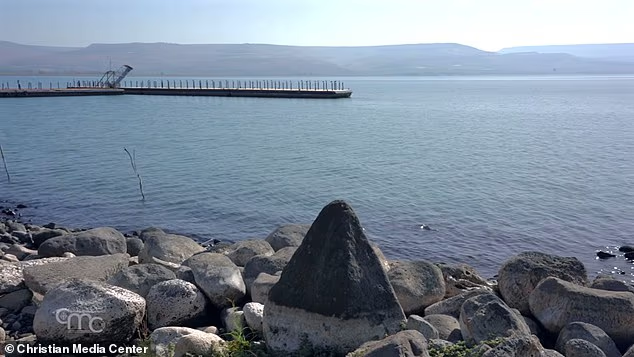
Now, archaeologists have uncovered part of the port that once connected the biblical town to the lake, including a pyramid-shaped stone that served as an entrance marker to guide boats in safely.
Falling water levels exposed a section of an ancient Roman pier built from rows of enormous stones and divided into recessed berths where fishing boats could dock.
The Israel Nature and Parks Authority said the discovery offers a rare glimpse of the maritime world in which Jesus and his fisherman disciples lived and traveled.
Dr Hagay Dvir, the tourist product manager with a degree in archaeology, said: ‘For the first time, we can speak of Jesus’ maritime activity on the Sea of Galilee, and not only of His works on land.’
Although no evidence proves Jesus used this particular pier, experts believe the harbor may have served boats like those described throughout the New Testament.
Archaeologists have uncovered part of the port that once connected the biblical town to the lake, including a pyramid-shaped stone that served as an entrance marker to guide boats in safely
According to the New Testament, Capernaum was the scene of several of Jesus’ best-known miracles.
The Gospels say he cast an evil spirit from a man inside the town’s synagogue before healing Peter’s mother-in-law of a severe fever and curing crowds of sick and possessed people brought to him after sunset.
Jesus was also said to have healed a paralyzed man whose friends lowered him through the roof of a crowded house, as well as the gravely ill servant of a Roman centurion.
Matthew’s Gospel recounts another miracle in which Peter caught a fish with a coin inside its mouth after returning to Capernaum, allowing him and Jesus to pay the temple tax.
The town is also closely connected to Jesus’ walk on water. John’s Gospel says the disciples were sailing toward Capernaum when they saw Jesus approaching their boat across the turbulent lake. However, the Bible does not identify the precise place where he stepped onto the water or reached the shore.
Falling water levels in the Sea of Galilee helped expose the ancient pier in November 2025, bringing more of the structure into view.
The find is now attracting fresh attention after footage resurfaced online, astonishing viewers with its connection to the biblical world of Jesus.
Researchers were not entirely unaware of its existence, however, as preliminary surveys of the lake’s ancient waterfront were conducted decades ago. Unlike modern piers, which typically form one continuous platform, Roman ports were divided into recessed docking areas for boats.

Falling water levels exposed a section of an ancient Roman pier built from rows of enormous stones and divided into recessed berths where fishing boats could dock

According to the New Testament, Capernaum was the scene of several of Jesus’ best-known miracles
Excavators uncovered two parallel rows of large stones standing roughly 10 to 13 feet apart.
The space between them formed a sheltered berth capable of holding two vessels at once.
‘It is logical to think that these moorings, constantly used by those entering and leaving the port, also included a docking spot specifically for the boat of Jesus,’ Dvir told the Christian Media Center.
‘It is therefore possible that His name, or that of one of the apostles, was inscribed on it.’
Dvir noted that a large row of stones forming one side of the pier had also emerged, and no more than 13 feet away was a second row marking the opposite side, which he explained could accommodate two boats.
Archaeologist Father Eugenio Alliata said vessels using the harbor could have carried a group the size of Jesus and his apostles.
He compared them to an ancient fishing boat discovered near Kibbutz Ginosar, which measured approximately 27 feet long and was propelled by both a sail and oars.
Biblical archaeology expert Danny Herman previously told the Daily Mail: ‘It’s a 2,000-year-old boat from the Sea of Galilee, the type mentioned in the Gospels, and sized for about 12 people.

Archaeologists said large boats once docked at the port, such as a first-century vessel discovered in the 1980s that is now called the ‘Jesus boat’
‘You can actually connect it to one of the most famous stories every Christian knows, the account of Jesus walking on water and calming the storm on the lake.’
The boat was discovered in 1986 during a severe drought that exposed the Sea of Galilee’s shoreline near Magdala.
Brothers Moshe and Yuval Lufan, amateur archaeologists from Kibbutz Ginosar, spotted iron nails in the mud with a metal detector. As they dug, an oval wooden shape emerged, buried for nearly 2,000 years.
Maritime archaeologists confirmed its Roman-era construction, with carbon-14 dating placing it in the first century.