For years, a philosophical divide over how artificial intelligence software should be created has split Silicon Valley technologists.
This week, that argument reached a boiling point.
On one side are leading A.I. companies like Anthropic and OpenAI, which claim that A.I. models are too dangerous to be developed in the open and must be tightly controlled — by businesses like themselves — for safety. On the other is the rest of the tech industry, including giants like Microsoft and Nvidia, which contend that so-called open-source A.I. models must remain open for people to further develop technologies and build new businesses.
Those camps have started publicly clashing. On Friday, Jensen Huang, Nvidia’s chief executive, said in his first-ever post to X that “the world needs both frontier closed models and frontier open models.” Nine minutes later, Satya Nadella, Microsoft’s chief executive, posted that open-source software was “essential to a healthy A.I. ecosystem.” Both signed a letter supporting open source, which was also signed by executives at Meta, Palantir and IBM.
At the same time, OpenAI and Anthropic have lobbied regulators in Washington to restrict open-source A.I. models, five people close to the discussions said. The debate has drawn in Treasury Secretary Scott Bessent and Michael Kratsios, President Trump’s science and technology adviser, who have weighed in on how American A.I. models are valuable intellectual property.
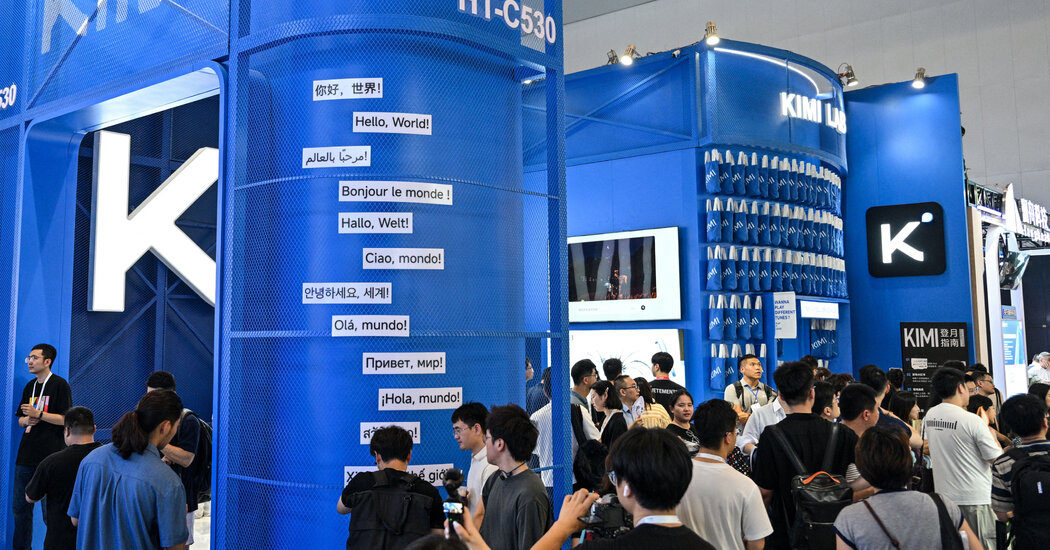
The escalating fight stems from China’s rapid progress in open-source A.I. models, which are freely available to use and build on. In recent weeks, two Chinese A.I. start-ups, Z.ai and Moonshot AI, have released models that rival those from Anthropic and other American labs. Anthropic and OpenAI have claimed that Chinese companies built the models by improperly harvesting data from their A.I. systems, which they said should not be allowed.
But companies like Microsoft and Nvidia, which rely on open-source models to spur demand for their cloud computing services and chips, said that open-source software was important to advancing the technology with shared knowledge and that it would let more people examine its security. And for Silicon Valley start-up founders, constraining open-source software could cement the lead that OpenAI and Anthropic have in A.I., which critics argue could unfairly stifle other companies from building competing products.
“You have two factions fighting over this issue,” said Bill Gurley, a Silicon Valley venture capitalist who opposes restrictions on open-source software. “There’s the people who want OpenAI and Anthropic to own everything, and then there’s everybody else, including customers.”
Where this ends up has major implications not only for the U.S. tech industry but for the race between America and China to dominate the powerful technology. While China had a later start in developing cutting-edge A.I., it is catching up quickly in part because of its embrace of open source, which has helped Chinese labs improve by publicly sharing their systems and winning them customers around the world with lower prices.
American A.I. companies, including Anthropic and OpenAI, have accused Chinese labs of “distilling” their systems by surreptitiously copying them, which has caught the attention of the Trump administration.
On Wednesday, Mr. Bessent said the administration had considered imposing sanctions on Chinese companies that steal intellectual property from American firms. “Open source is not open season on American IP,” he said, referring to intellectual property.
That same day, Mr. Kratsios said that “large-scale, covert industrial distillation aimed at stealing proprietary U.S. technology and undermining American research is unacceptable.”
U.S. officials still appear to be debating their options, but seem more likely to approach regulating Chinese open-source models individually as a national security issue, rather than issuing some kind of blanket ban, four people with knowledge of the discussions said.
Publicly, executives like Sam Altman, OpenAI’s chief executive, have said they support open-source software even as OpenAI allies quietly lobby for restrictions. Others, like Google and Amazon, which have invested billions in companies such as Anthropic and OpenAI, are trying to stay out of the fray.
(The New York Times has sued OpenAI and Microsoft, claiming copyright infringement of news articles. The two companies have denied the claims.)
The open-versus-closed software debate has traveled around Silicon Valley since the tech industry’s earliest days. Open-source proponents have argued that sharing information leads to improvements that make software safer and more reliable, while more rapidly spurring innovation. Opponents maintain that software is costly to develop, and that giving it away is just bad business.
Today, much of the modern internet runs on open-source technologies, as do some of the most widely used computer systems, like Google’s Android operating system.
The Chinese government and tech industry have embraced the open-source path for A.I. Last year, a Chinese start-up, DeepSeek, unveiled an open-source A.I. system that rivaled those of American companies, shocking the industry. Other Chinese companies have followed. In a speech this month, Xi Jinping, China’s leader, cast the country as a global champion of an open approach to the technology.
China’s advances have rattled executives at OpenAI and Anthropic, who are increasingly concerned that their longstanding head start is disappearing, two people familiar with the companies’ internal deliberations said.
“These American companies build these big, expensive models, and then the models take a detour to China, where they lose all their value,” said Pedro Domingos, a professor emeritus of computer science and engineering at the University of Washington. “The American companies are justifiably outraged.”
To fight back, Anthropic and OpenAI are offering some cheaper A.I. models to businesses that may not need the “frontier” models that command higher prices. On Friday, Anthropic released Claude Opus 5, a model that he company described as “close to the frontier intelligence of Fable 5 at half the price.” OpenAI is promoting similar lower-cost models.
The real action is in Washington. Behind closed doors, executives from OpenAI and Anthropic, as well as investors in the companies, have cited concerns about the global economy, A.I. safety and national security as they try to persuade regulators to increase restrictions on Chinese open-source software, three people familiar with the discussions said.
Sarah Heck, Anthropic’s head of public policy, said in a social media post on Wednesday that “illicit, adversarial distillation is IP theft and industrial espionage that supports adversary military and intelligence capabilities.” Anthropic executives claim that open-source models based on the company’s software are too dangerous to let run amok.
OpenAI executives are urging the Trump administration to enact policies requiring mandatory security evaluations of new A.I. models overseen by government agencies, the company said in a blog post last month, a move that could curtail open-source software development. OpenAI said it was “encouraged” by the work it was doing with the administration on the framework.
Open-source proponents have spent the past week drumming up support to push back against OpenAI and Anthropic. On Wednesday, nearly 200 Silicon Valley start-ups, calling themselves the Little Tech Association, signed letters urging the Trump administration not to limit access to Chinese open-source models.
Big Tech soon followed. On Friday morning, Elon Musk, Meta’s Mark Zuckerberg and others lined up behind Mr. Huang and Mr. Nadella to support open source.
“Jensen is right,” Mr. Musk posted. “This has my full support.”
“Open source is a positive and important force,” Mr. Zuckerberg wrote.
One incident this week underscored the stakes of the divide. On Tuesday, OpenAI disclosed that a handful of its most advanced A.I. models broke containment during a test of their cybersecurity abilities, gained access to the internet and hacked the servers of an A.I. company called Hugging Face. OpenAI executives latched on to the moment as proof of how dangerous A.I. models can be even in a closed environment, emphasizing the need for regulation.
Clement Delangue, the chief executive of Hugging Face, which is one of the most popular online libraries of open-source software, had a different point of view. To defend the company from OpenAI’s hack, he turned to an open-source A.I. model created by China’s Z.ai.
In social media posts on Friday, Mr. Delangue made his position on the debate unmistakable. He said he planned to hold a march in San Francisco on Saturday to demonstrate support for open-source technology.
“Open models for the win!” he wrote.