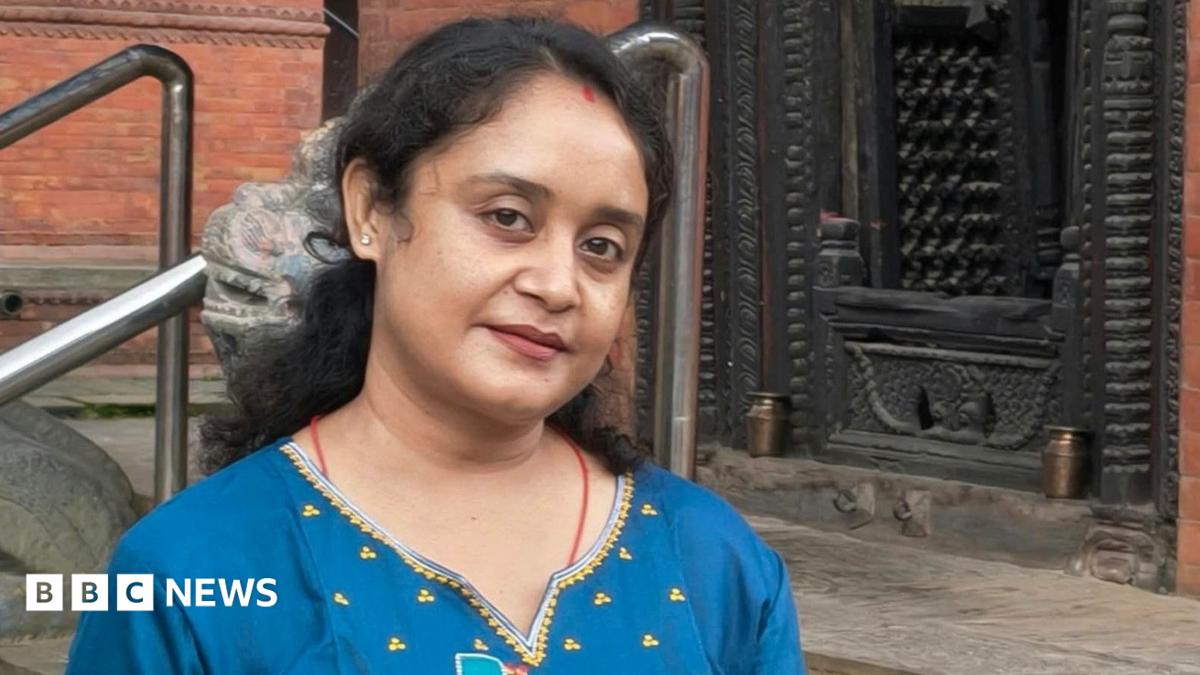
Early on Wednesday, Sudipto Bhattacharya received what would be the last message from his wife.
It showed a departure stamp in her passport: immigration at the Nepal border was done. We are waiting to enter China, she wrote, at 07:57 (02:27 GMT).
Six minutes later, at 08:03 local time, the messages stopped.
Subhrasree Chakraborty and the group she was travelling with had been waiting to cross into Tibet for the next stage of their pilgrimage to Mount Kailash, the sacred Himalayan home of Hindu god Shiva that Subhrasree had dreamed of visiting for years.
The 43-year-old is now among at least 290 Indians reported missing after deadly flash floods struck along Nepal’s border with Tibet. Many of those unaccounted for were on the pilgrimage, which resumed last year after being disrupted by the pandemic and then by tensions between India and China. Several thousand Indians have been making their way to Mount Kailash for years.
Subhashree was travelling without her family, as part of a group of about 30 people. A medical technologist working in critical care at a city hospital, Subhrasree was used to emergencies. She knew CPR and intensive-care procedures and, according to her husband, was physically fit.
But none of that has brought her husband Sudipto Bhattacharya any closer to knowing what happened after that final message.
“After 08:03am, what happened? We don’t know anything,” he says.
Subhrasree had been looking forward to the journey for years.
The photographs she sent home from Kathmandu, taken just days before she went missing, capture something of that excitement.
In one, she stands in a blue tunic in the ornate courtyard of a temple, smiling gently at the camera. In others, she is dressed in red, posing amid the ancient brick-and-carved-wood architecture of Kathmandu valley’s historic Durbar Square.
She told her husband that the countryside was beautiful.
“She was very excited,” says Bhattacharya, a government officer. “This was her dream tour.”
The journey had begun on Friday, 21 August.
She took the Mithila Express from Kolkata and reached Raxaul on 22 August. From there she crossed into Birgunj and travelled by bus to Kathmandu, arriving that night.
She stayed in Kathmandu for three nights, sightseeing.
Then, on the morning of 25 August, the group left Kathmandu by bus for Syabrubesi, a small mountain settlement roughly 122km north of Kathmandu and a gateway to the trekking hub of Langtang region. The journey took almost 12 hours – and was not entirely a smooth one.
A landslide blocked their route for about four hours before the army cleared the road. But when Subhrasree spoke to her husband, she told him the skies were clear.
There was little to suggest what was coming.