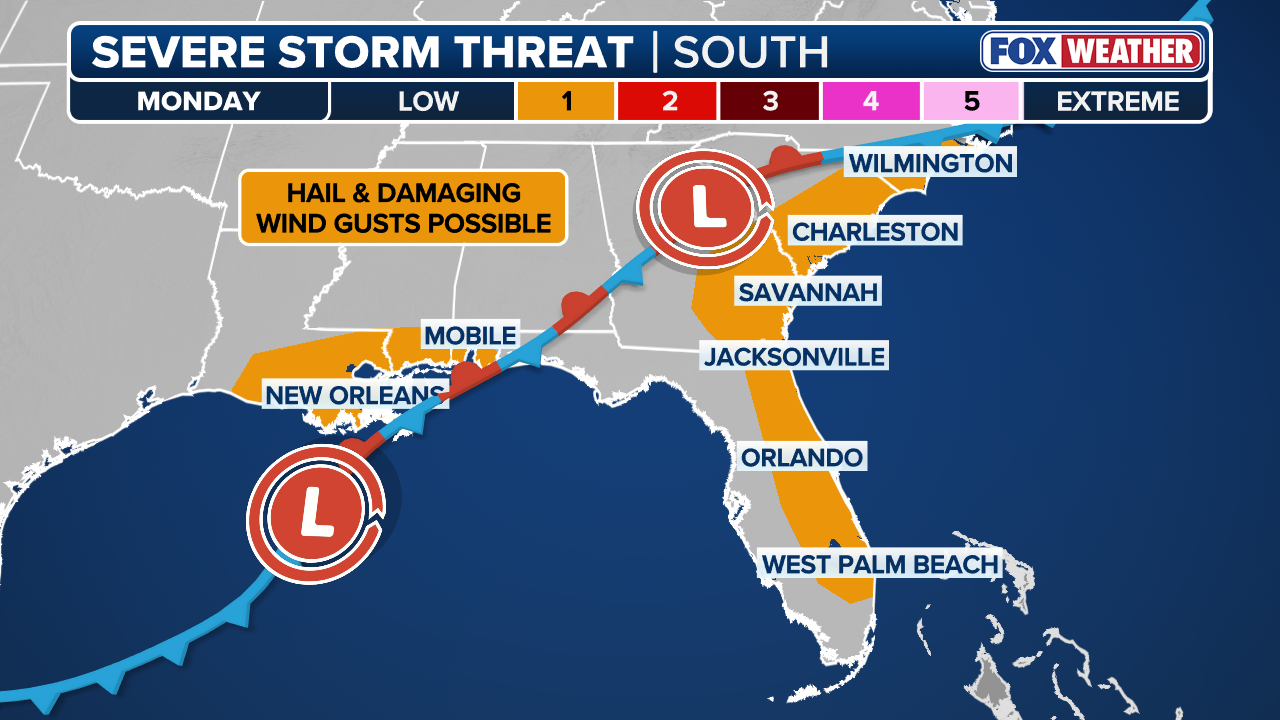
Heavy rain and severe weather will continue across the Gulf Coast and Southeast, where a Level 1 out of 5 threat for severe storms is in place due to the potential for damaging winds and hail. According to the FOX Forecast Center, the greatest concentration of storms will likely develop along the I-10 corridor from New Orleans to Jacksonville, Florida.
More severe weather is on the way for the Gulf Coast and the Southeast, bringing heavy rain, possible damaging winds and large hail through Tuesday morning.
The greatest concentration of storms will likely be along the I-10 corridor from New Orleans to Jacksonville, Florida.
The Weather Prediction Center has issued a Level 1 out of 5 threat for severe storms due to the potential for destructive winds and extremely large hail.
This comes after significant severe weather erupted across the southern Plains and Lower Mississippi Valley on Mother’s Day, producing giant hail and destructive winds.
On top of that, the region has been experiencing an exceptionally wet stretch, with many areas from Louisiana through Alabama and Georgia already seeing widespread rainfall totals of 3 to 6 inches.
(FOX Weather)
As additional severe weather develops, more rain is expected. The FOX Forecast Center is monitoring a secondary area of low pressure to determine whether it will form off the coast. If that occurs, it could enhance rainfall totals closer to the coastline as the system shifts east along the front.
As a result, the Weather Prediction Center has also issued a Level 1 out of 4 threat for flash flooding, encompassing most of southern Louisiana through the Mobile area.
According to the FOX Forecast Center, as a cold front from Sunday’s system pushes through, it will clash with warm, humid Gulf moisture, creating the perfect environment for another round of severe thunderstorms.
SEE IT: MISSISSIPPI DRONE VIDEO REVEALS DEVASTATION LEFT BEHIND BY TORNADO IN BOGUE CHITTO
By Tuesday, the front will shift into Florida. However, these storms are expected to be less intense, while the rainfall could help ease ongoing drought conditions. Some scattered downpours are still possible.
This weather pattern is typical for the month of May, as these regions are often hotspots for severe storms and tornadoes.

(FOX Weather)
Additionally, May also averages the highest number of tornadoes of any month during the year, which has not been the case so far this season. However, conditions may change toward the end of the month.
Long-range forecasts suggest the atmospheric pattern will shift, bringing a return of troughing to the West.
Stay with FOX Weather as the severe weather threat continues to unfold.