It’s a rather grisly topic for a Monday – how will the world end?
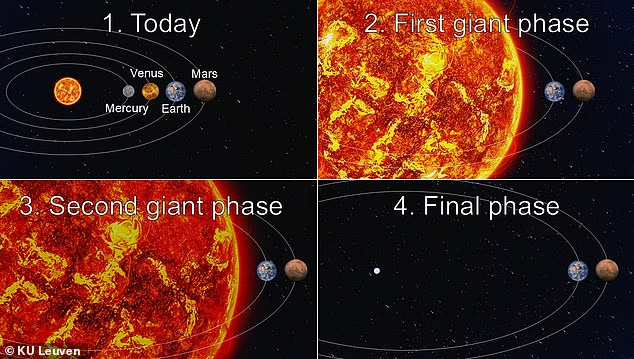
For years, it’s been believed that the sun will start to expand in around five billion years, swallowing our planet in the process.
However, a new study suggests that this might not be the case after all.
Instead, scientists think that the sun’s death throes will push Earth out into space, narrowly avoiding destruction.
Mars will also be spared from a fiery fate, scientists say, but Mercury and Venus won’t be so lucky, as the two innermost planets will inevitably be swallowed by the sun.
Lead author Mats Esseldeurs, a PhD student at the University of Leuven, explains that Earth’s fate ‘depends on a delicate balance’ between two forces.
These are the ‘tidal’ forces of gravity that will pull the Earth into the sun and the outward push of enormous solar winds caused by the sun losing mass as it expands.
‘If tidal interactions predominate, Earth is engulfed by the sun,’ says Mr Esseldeurs.
‘If the sun’s mass loss predominates, Earth escapes into an orbit larger than the radius of its star.’
Scientists have predicted that the Earth will not be swallowed by the sun as it expands into a red giant in five billion years

Using computer simulations, researchers found that Earth (red line) will be pushed just beyond the edge of the expanding sun (blue line)
Stars like our sun can only remain stable for as long as they have a steady supply of hydrogen to burn as fuel.
When hydrogen is abundant, the immense force of gravity is held in check by the outward push from nuclear fusion in their core.
But when the hydrogen starts to run out at the end of a star’s lifetime, that balance is upset, and the star begins to collapse.
This collapse makes the core hot enough to fuse helium atoms into carbon, releasing a surge of energy that kickstarts nuclear fusion in the outer layers, which then expand and cool.
The expanding star will then grow into a red giant, becoming anywhere from 100 to 1,000 times larger.
Scientists don’t know exactly how big the sun will become, but even if it doesn’t expand beyond Earth’s current orbit, many researchers believe we are doomed.
This is due to an effect called tidal dissipation that will slowly drag our planet down into the sun.
As the sun expands, Earth’s gravitational tug will raise a small bump or wave on the solar surface – just as the moon causes Earth’s oceans to swell with the tides.

Scientists previously believed that a gravitational effect called tidal dissipation would slowly pull the Earth out of orbit, until it was swallowed by the sun (artist’s impression)
This wave will lag behind the planet like a brake on its orbit, slowly draining its energy and dissipating it into the sun.
Until very recently, scientists assumed that these tidal forces would overwhelm the outward push of stellar wind from the sun’s mass loss, leading to the Earth being engulfed.
However, Mr Esseldeurs and his co–authors now argue that this is based on a poor understanding of tidal dissipation in stars.
Using advanced models, the researchers show that the tug of these tidal effects is actually a lot smaller than previously expected.
They combined these gravitational predictions with observations of mass loss in a nearby star called L2 Puppis, which they describe as the sun’s ‘old cousin’.
That allowed the scientists to estimate how much solar wind our own sun might produce as it transitions into a red giant.
By comparing the push and pull of these competing forces, the researchers now believe that the Earth may well survive.
Co–author Dr Stephane Mathis, of the CEA Paris–Saclay centre in France, says: ‘A better understanding of tidal physics and the most advanced constraints we have on mass loss allow us to say that—in the current state of knowledge—Earth could move away from the sun, contrary to what was predicted before.’

Scientists now think the solar wind created as the sun loses mass during its expansion will push the Earth away, counteracting the gravitational pull. Pictured: Artist’s impression of the Earth in 5.7 billion years
However, the researchers warn that Earth’s fate is still not entirely certain.
They point out that the difference between survival and fiery annihilation is extremely dependent on the fine balance of gravitational dissipation and mass loss.
In simulations, even a small change in these estimates was enough to send the planet tumbling into the sun or soaring safely out into space.
In their paper, published in Astronomy & Astrophysics, the researchers warn: ‘Given the current observational uncertainties in AGB mass–loss rates, the ultimate fate of the Earth remains uncertain.’
Likewise, even if Earth does survive the initial transformation, life on the planet may not be able to last much longer.
After becoming a red giant, the sun will gradually burn through the last of its fuel and shrink into an extremely dense star called a white dwarf.
No longer capable of fusion reactions, it will slowly become dimmer and cooler over time, and Earth will be left as a freezing, lifeless husk.
The good news is that this won’t be for at least seven or eight billion years from today.
WHAT WILL HAPPEN TO EARTH WHEN THE SUN DIES?
Five billion years from now, it’s said the Sun will have grown into a red giant star, more than a hundred times larger than its current size.
Eventually, it will eject gas and dust to create an ‘envelope’ accounting for as much as half its mass.
The core will become a tiny white dwarf star. This will shine for thousands of years, illuminating the envelope to create a ring-shaped planetary nebula.

Five billion years from now, it’s said the Sun will have grown into a red giant star, more than a hundred times larger than its current size
While this metamorphosis will change the solar system, scientists are unsure what will happen to the third rock from the Sun.
We already know that our Sun will be bigger and brighter, so that it will probably destroy any form of life on our planet.
But whether the Earth’s rocky core will survive is uncertain.