A local diver captured a rare glimpse of an elusive blue-ringed octopus carrying her eggs off Australia’s Victoria coast. The diver said these stunning creatures typically remain hidden away, making this encounter incredibly special.
Marine biologists have observed an Arctic bobtail squid in its natural habitat for the first time, marking a rare discovery that shows the species can survive and reproduce in one of Earth’s most extreme marine environments.
OCTOPUS WRAPS ITSELF AROUND DIVER’S CAMERA
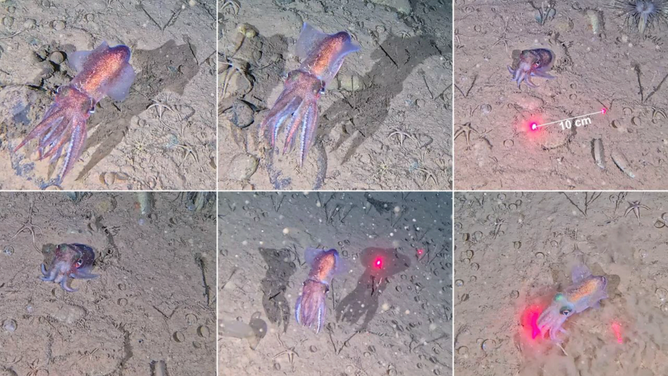
In a recently published study, scientists from the University of Western Australia’s School of Biological Sciences recorded a female Arctic bobtail squid, called a Rossia muelleri, alongside multiple egg masses in Northeast Greenland National Park.
Scientists recorded a female Arctic bobtail squid alongside multiple egg masses for the first time.
(Polar Biology / FOX Weather)
According to the researchers, Northeast Greenland National Park is one of the largest national parks in the world, but remains one of the least-studied regions of the Arctic.
The discovery was made at a depth of more than 164 feet in water measuring about 29 degrees Fahrenheit.
The observation provides the first direct evidence that cephalopods, including squids and octopuses, can reproduce in sub-zero Arctic waters.
Researchers said cephalopods are highly sensitive to environmental change and play a critical role in marine ecosystems as both predators and prey.
The finding highlights just how adaptable these animals are in some of the planet’s harshest conditions.
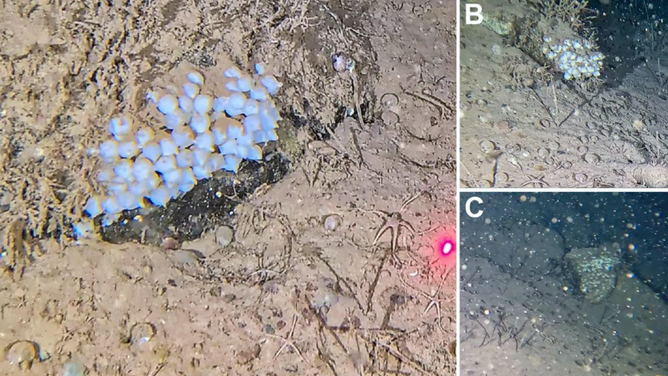
This discovery shows that the Arctic bobtail squid can survive and reproduce in one of Earth’s most extreme marine environments.
(Polar Biology / FOX Weather)
Scientists said the discovery provides a valuable baseline for tracking ecological change in the rapidly warming Arctic. It also helps understand how the ecosystem functions as climate change accelerates.
The researchers used a lightweight remotely operated underwater vehicle during the expedition aboard a Secret Atlas Micro Cruise Expedition vessel, with support from Yachts for Science.
The team said the findings demonstrate how low-impact scientific research and expedition tourism can help fill major biodiversity gaps in some of the world’s most remote polar regions.
The study was published in the journal Polar Biology.