Scientists have discovered the male version of the G-spot, an area which supposedly gives mind-blowing orgasms, is far from the place sex experts had suspected for decades.
Researchers from Spain found that the prostate, a walnut-sized organ inside the body, is not the ultimate pleasure-inducing area of the male body.
Instead, it turned out that the frenular delta, a small triangular area on the underside of the penis, is packed with specialized nerve endings that create intense pleasure.
The G-spot has mostly been associated with women and refers to the Gräfenberg spot, a sensitive erogenous zone that can produce strong sexual pleasure or intense orgasms when stimulated.
For years, scientists, and many men attempting to please their partners, had been unable to prove the G-spot existed. However, researchers in Turkey recently claimed they could prove it was real by studying orgasms after surgery on the area in women.
For men, popular sexual health literature, sex education resources and even medical articles have been claiming that the prostate gland was the male equivalent since the 2000s.
Until now, however, scientists never had a complete picture of how these nerves form in the womb or exactly how they were arranged in grown men. This study filled in those gaps using modern lab techniques.
Study authors described the frenular delta as a V-shaped or Y-shaped area on the underside where the foreskin meets the head of the penis, also called the glans.
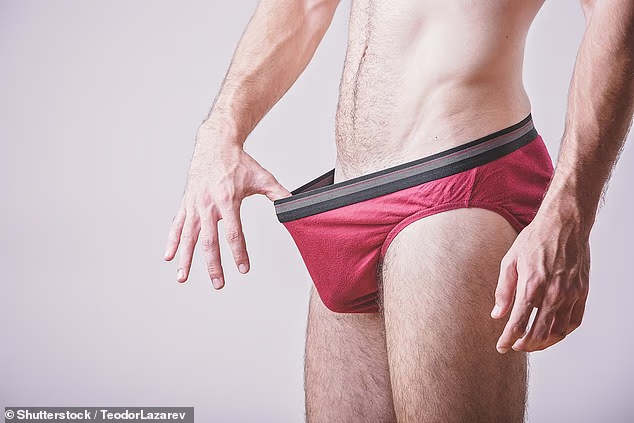
Scientists have uncovered an area of the penis they believe is the equivalent of the female G-spot. Sex experts had previously claimed it was the prostate gland (Stock Image)
The Spanish researchers carefully examined thin slices of penis tissue taken from 30 developing fetuses and 14 adult men who had donated their bodies to science after death.
The team from the University of Santiago de Compostela used special chemical stains and markers that made nerves and tiny sensory structures light up under a microscope.
By looking at these magnified sections from many different angles, the team created the most detailed map ever made of the nerves and pleasure-sensing receptors inside the penis.
This led them to the triangular patch near the head, on the underside of the penis.
The study showed this area had far more nerve bundles and clusters of sensitive receptors than any other area, including the head of the penis itself – which had also been previously discussed as the male erogenous zone.
For decades, medical textbooks and sex-education classes claimed the glans was the main source of male sexual sensation.
The new study flipped that idea upside down, with researchers explaining that the frenular delta had been almost completely ignored by medical experts, even though it was right there on the outside of the body and plays a major role in pleasure during sex.
Writing in the journal Andrology, the researchers said: ‘That the “female G-spot” has inspired decades of controversy whereas the penile erotogenic center – so evident in structure and sensation – has remained underexamined in the scientific literature underscores persistent blind spots in sexual medicine and urology.’

Previous medical and sexual health guidance has claimed that both the prostate and the head of the penis were more likely to be the most sensitive erogenous zone (Stock Image)
In some spots inside the frenular delta, scientists counted up to 17 tiny pleasure receptors packed closely together, creating a real ‘sensory hotspot.’
Eric Chung from the University of Queensland in Australia told New Scientist: ‘It is one of the most pleasurable spots for male sexual stimulation.’
Chung added that the new research should be considered scientific proof that the frenular delta was the true male G-spot.
The prostate, while capable of producing strong sensations when stimulated internally, typically through the anus, is a separate internal gland and was not part of the new nerve-mapping study.
For years, health-related websites such as Healthline, Medical News Today and WebMD have referred to the prostate as the male G-spot and even provided readers with tips on how to stimulate it – internally and externally.