If you’re finding it harder to breathe in Britain, you’re not imagining things.
A new study has warned that Saharan dust has driven up pollution in the UK by 50 per cent over the last decade.
Scientists from the Paul Scherrer Institute used AI to analyse the desert dust in the air over Europe.
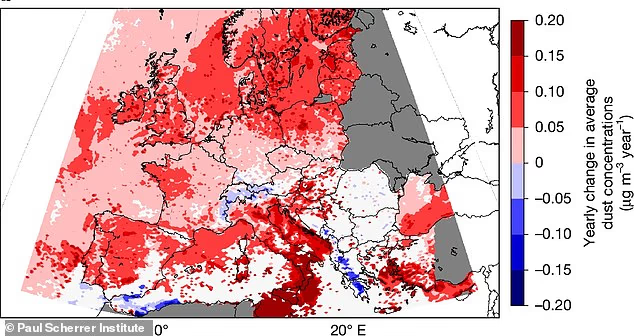
The results showed that dust concentrations have increased consistently across much of the continent between 2012 and 2021.
Here in the UK, concentrations increased by at least 50 per cent over this time period.
This dust travels to the UK all the way from the Sahara, and can have wide–reaching consequences.
Not only can it cause ominous ‘blood rain’, but it can wreak havoc on your respiratory health.
‘Saharan dust storms, which originate from the Sahara desert, have a significant impact on global health, especially on respiratory conditions of populations exposed to fine particulate matter that travels across continents,’ a previous study warned.
If you’re finding it harder to breathe in Britain, you’re not imagining things. A new study has warned that Saharan dust has driven up pollution in the UK by 50 per cent over the last decade

St. Paul’s Cathedral and Tower Bridge visible through orange hues, as blood rain hit the capital in 2022
Mineral desert dust is a major component of airborne particular matter, and is known to harm human health.
However, exactly how levels across Europe have changed, and why, have remained unclear until now.
To get to the bottom of it, the researchers analysed 18,500 daily measurements of dust–related metals from 103 rural and urban sites across Europe between 2012 and 2021.
Their analysis revealed that dust concentrations increased across most of Europe, with some of the largest increases in Italy, the Adriatic Sea, and the Aegean Sea.
As for what’s behind this surge in dust, the researchers say that the increasing desiccation of the Sahara in North Africa is the leading cause.
‘The number of storms carrying desert dust to us from the Sahara and the Arabian Desert has not actually increased,’ explained study author Petros Vasilakos.
‘But they have become more intense over the ten years studied, and as a result they are now transporting more dust to Europe than they did before.’
Dust made up of sand and mineral particles can be blown from the Sahara Desert and transported thousands of miles towards the UK.

This dust travels to the UK all the way from the Sahara, and can have wide–reaching consequences. Not only can it cause ominous ‘blood rain’, but it can wreak havoc on your respiratory health. Pictured: sediment left on a car in London in 2022

Residential buildings in Wimbledon, southwest London, covered in a haze at sunrise thanks to the dust plume
These plumes bring fiery sunsets and hazy skies to parts of the country, and if there’s rain, the dust can fall to the ground as bright orange ‘blood rain’.
Dr Claire Ryder, Associate Professor in Mineral Dust Processes at the University of Reading, previously explained: ‘As rain falls through air thick with Saharan dust, it picks up tiny particles of reddish–brown sand, leaving rusty orange smears on cars, windows and garden furniture.
‘If your car looks like it’s been lightly coated in mud after a shower, this is why.’
Beyond dirtying your car and garden furniture, Saharan dust can have a range of concerning health effects.
These include coughing, chest tightness and pain, difficulty breathing, eye, nose and throat irritation and worsening of asthma symptoms.
Dust can also trigger the worsening of heart–related symptoms, such as heart palpitations, and worsening of chronic obstructive pulmonary disease (COPD) symptoms.
Looking ahead, the experts warn that dust pollution is set to get even worse – thanks to climate change.
Writing in their study, published in Nature, the team warned: ‘With climate change accelerating desertification and altering atmospheric circulation, dust pollution will increasingly threaten public health and hinder efforts to meet WHO and European Union air quality targets—a direct feedback of climate change on air quality.’