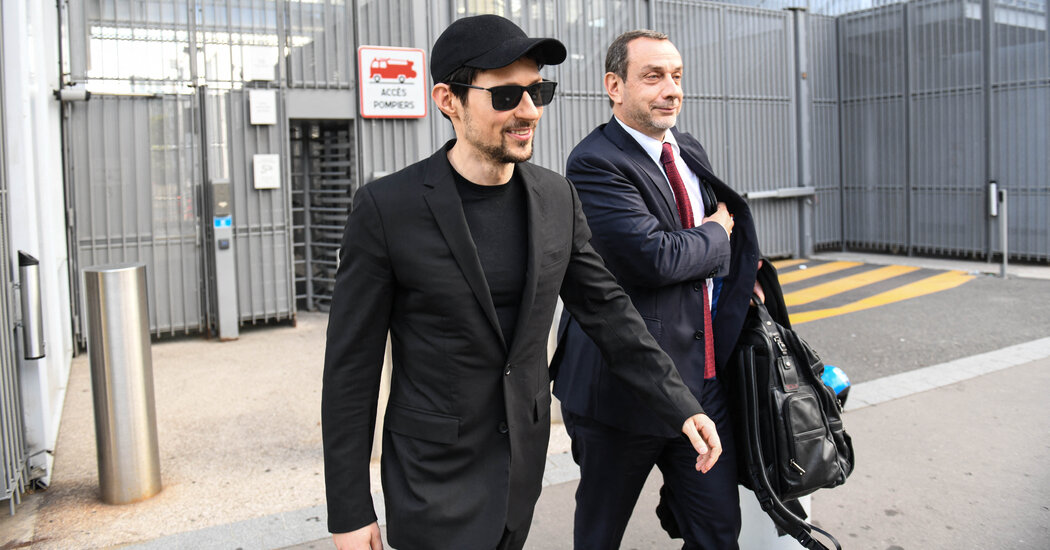
Russia’s main security service said on Wednesday that it had charged the founder of Telegram, one of the most popular messaging apps in the country and around the world, with facilitating terrorism, escalating the Kremlin’s efforts to restrict all means of communication not under its direct control.
The security service, the F.S.B., said in a statement that it had issued an international warrant to arrest the Telegram founder, Pavel Durov, 41, who is Russian-born.
The service accused Telegram of failing to remove information “actively used by Ukrainian special services, terrorist organizations and extremist organizations to prepare and coordinate sabotage and terrorist acts, mass killings and cyber fraud activities” in Russia.
This year, the Kremlin restricted the use of Telegram in Russia and promoted an alternative, MAX, a state-backed messaging app. In the past, the Kremlin has used various methods to try to restrict access to Telegram. In 2018, the authorities made a first attempt to block the app but it remained widely used, ultimately forcing the authorities to admit defeat two years later.
The announcement about the charges against Mr. Durov came days after Dmitri S. Peskov, the Kremlin’s spokesman, told the Russian news agency Interfax that the authorities had been in touch with Telegram’s leadership to discuss lifting restrictions on the app.
Some Kremlin analysts suggested that the timing of Mr. Peskov’s comment and the subsequent announcement of the charges against Mr. Durov reflected an internal battle in the Russian government over whether to allow more freedom for the app or to limit its use.
Ilya Grashchenkov, a Moscow-based political analyst, wrote on his Telegram channel, “For now, this appears less like the final chapter for Telegram in Russia than another round in the ongoing battle over its control.”
Despite the restrictions imposed last year, Telegram is widely used in Russia through virtual private networks, or VPNs, not only for direct communication but also by media outlets to relay news and other information not sanctioned by the Kremlin. The service is also popular among the military on both sides of the Russia-Ukraine war.
Telegram says it has more than a billion active users around the world. In April, Mr. Durov said that even with the restrictions, 65 million Russians still used Telegram on a daily basis.
Mr. Durov, who also regularly criticizes Western and other governments for what he says are their efforts to restrict internet freedom, did not directly comment on the charges. Shortly after they were announced, however, Telegram’s account on the social media site X posted an old image of him raising his middle finger.
Mr. Durov was born in St. Petersburg and helped create Vkontakte, a Russian equivalent of Facebook, at the age of 21. The platform’s success led Mr. Durov to be compared to Mark Zuckerberg and other young Silicon Valley entrepreneurs gaining fame in the early years of social media.
At the time, Russia’s internet was more open and free, and start-ups were seen as exciting places to work. Mr. Durov gained attention for stunts including throwing money from a window of the company’s offices in St. Petersburg.
The mood soured as the platform’s popularity grew in Russia, according to Mr. Durov. He has said that he left the country after a disagreement with the Russian authorities over sharing data about users who were using Vkontakte to organize protests. Mr. Durov said he refused, which ultimately led to him being forced to sell the platform and leave the country. Vkontakte then came under the control of a Kremlin-aligned company.
Mr. Durov now holds Emirati and French citizenship and permanently resides in Dubai.
Since starting Telegram in 2013, Mr. Durov has operated the messaging app like a stateless organization, driven by a guiding idea that communication should be uncensored. That ethos, which Mr. Durov has said was inspired in part by his experience under Russia’s authoritarian government, has helped make Telegram popular with activists and other privacy-conscious users.
But it has also made it a gathering ground for criminal activity, disinformation and hateful content.
In 2024, Mr. Durov was arrested on arrival in France and later charged with facilitating criminal activity on Telegram. After being held in custody for four days, he was released and ordered to stay in France by the authorities there. His travel ban was later revoked.
In a statement at the time about the arrest in France, Mr. Durov said, “Claims in some media that Telegram is some sort of anarchic paradise are absolutely untrue.”
In its statement on Wednesday announcing the arrest warrant, the F.S.B. cited a specific case in which it said a dating chat on Telegram was used by Ukrainian special services to recruit Russians and engage them in “sabotage and terrorist activities through deception and psychological manipulation.”
The F.S.B. said that it had detained 46 people, including minors, across Russia who had been recruited through the app and “committed armed attacks on law enforcement officers, set fire to transport, energy, communications, and credit and financial system facilities.”