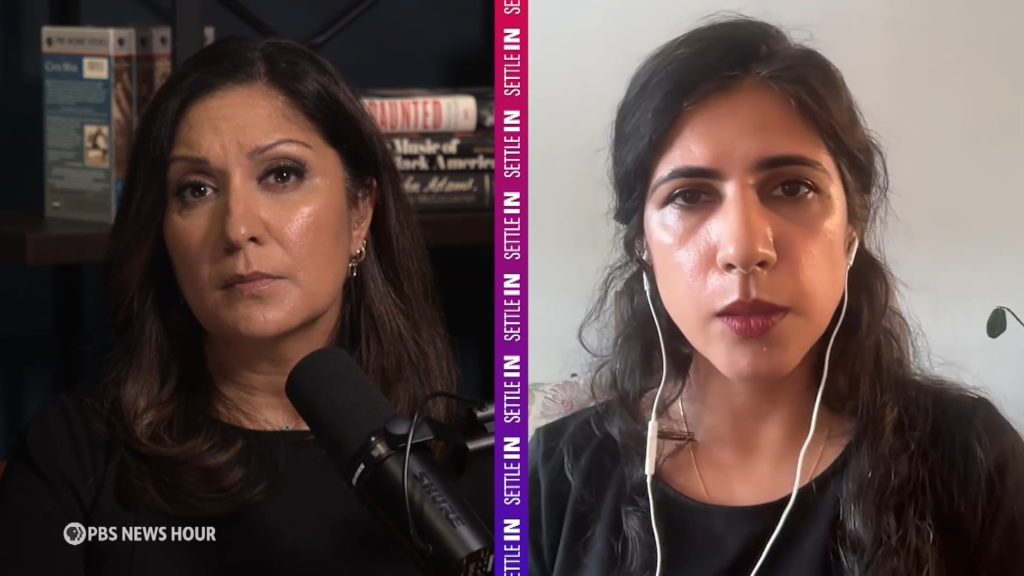
The history of Islamophobia in the U.S. dates back decades, from FBI surveillance of Muslim and Arab communities in the 1960s to the sweeping surveillance programs launched after 9/11. Journalist Rozina Ali traces that history in her new book, “Seasons of Fury: Four Families and the Rise of Islamophobia in America.” Ali joined Amna Nawaz to discuss more on our PBS news podcast, “Settle In.”
Amna Nawaz:
In her new book, “Seasons of Fury,” journalist Rozina Ali traces the history of Islamophobia in the U.S., from FBI monitoring of Muslim and Arab communities in the 1960s to the sweeping surveillance programs launched after 9/11.
I recently spoke with her for our PBS News podcast “Settle In.”
I’m curious how you look at America today contextually on this, because, yes, on the one hand, you have the kind of commonplace anti-Muslim rhetoric that you see from the president of the United States, from some of his closest advisers, from sitting members of Congress.
But then you also have Muslim Americans who’ve risen to very powerful positions. They have been elected to Congress, people like Ilhan Omar, Rashida Tlaib. You have got the first Muslim mayor in New York City. You have another candidate for the Senate in Michigan.
How do you look at the context of where we are today and what it means for this?
Rozina Ali:
Four Families and the Rise of Islamophobia in America”: It is remarkable the rise of Muslim politicians in this country.
But I also think it was inevitable, only because Muslims are a growing population in the country. That said, they’re still about just 1.5 percent of the American population. But what is different since 9/11 is, a lot more Muslims have protection, in the sense that they were either born here or they were naturalized.
Unlike Muslims who were mostly immigrants after 9/11, a lot of the Muslims we see today who are rising up in political circles do have a sense of security. But what has also happened after — in the last 25 years is a cohering of a political Muslim voice that in a sense is a reaction, ironically, to 9/11.
Before 9/11, there were disparate Muslim voices, but mostly people really considered themselves, again, South Asian or immigrant or so forth. But 9/11 really started cohering a Muslim social political identity. And so when we see the rise of people like Zohran Mamdani or Abdul El-Sayed or Rashida Tlaib or Ilhan Omar, they do talk about themselves as being Muslim.
That said, there is a level of Islamophobia that we see today that I have not seen in my lifetime. It is a level of acceptance of Islamophobia. The ways in which senior officials, policymakers, Laura Loomer, for example, the adviser to the president, speaking about Muslims and Islam as if they are second-class citizens, calling for a complete ban on Muslims, calling for a complete ban on anything that is related to Islam in the United States.
And, to me, what that says is not so much about the Muslim American community. It says a lot more about the American community as a whole.
Amna Nawaz:
What do you mean by that?
Rozina Ali:
I think what we have done is, we have reached a point where — tolerance of religion and freedom of religion was a founding tenet of this country.
And what we see now is a society that is actually OK with dismantling that very pillar of the United States. We are now openly calling for Islam not to be part of the United States or part of its social and political fabric. And I think what we’re doing is actually changing ourselves as a society in really damning and worrying ways.
This is not a problem just for the Muslim community. It’s actually a problem for American society as a whole, and it’s changing the face of what we think of as the values of American society.
Amna Nawaz:
And you can watch that full conversation and more episodes of “Settle In” on YouTube or wherever you get your podcasts.