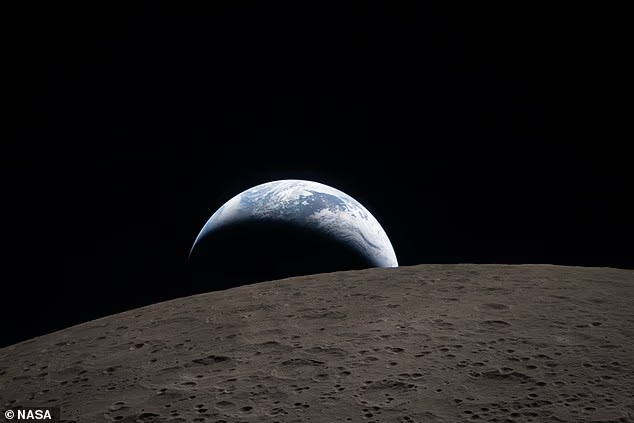
Among the stunning photos from NASA‘s Artemis II crew, the spectacular ‘Earthset’ image stands out as the most jaw–dropping.
This image shows the bright blue Earth setting over the lunar surface as the bulk of the moon eclipses our home planet.
The Artemis II crew – Reid Wiseman, Victor Glover, Christina Koch, and Jeremy Hansen – captured the photo as they began their six–hour lunar flyby.
While it looks as if the Earth is setting, this effect is actually caused by the Orion crew capsule drifting over the moon’s far side out of the view of Earth.
As the capsule drifted around the moon, the four astronauts took turns photographing the lunar surface, sketching, and recording audio descriptions of what they saw.
Many of the features they witnessed had not been seen by human eyes since the last Apollo mission half a decade prior.
The Earthset image reveals swirling clouds over Oceania and Australia, the peaks of ancient craters, and the wreckage of meteor impacts.
Here are 10 things that you might not have known about NASA’s new ‘Earthset’ photo.
This image, titled ‘Earthset’, was taken from the far side of the moon and shows the Earth dipping beyond the lunar horizon. Here are 10 things you might not have spotted
1. A nod to the Apollo missions
The Artemis II Earthset image is actually a nod back to NASA’s earliest moon missions, mirroring the iconic ‘Earthrise’ photo.
This earlier image, showing a distant Earth rising over the moon’s horizon, was taken by the crew of the Apollo 8 mission.
In 1968, Apollo 8 became the first crewed spacecraft to leave Earth’s gravitational influence and the first time that humans had reached the moon.
Just like the Artemis II mission, the crew of Apollo 8 travelled around the moon and back to Earth, paving the way for future lunar landings.
During their trip, Apollo 8 astronaut Bill Anders managed to snap an image of the Earth just as their craft emerged from behind the moon.
However, Apollo 8 had a much easier time getting this stunning shot since they orbited the moon 10 times before returning home, while Artemis II only had one opportunity.
2. Record–breaking distance

The Earthset image is a nod to the iconic ‘Earthrise’ photo taken by NASA astronaut Bill Anders during the Apollo 8 mission in 1968
The Earthset photo was taken while the Artemis II crew made its record–breaking lunar flyby.
The Orion crew capsule travelled at a height of 41,072 miles (66,098 km) above the lunar surface.
From this distance, the moon looked about as large as a basketball held at arm’s length, so the crew had to use zoom lenses to capture this unique photo.
This flyby also carried the crew to a staggering 252,756 miles (406,771 km) from Earth.
This surpassed the distance achieved by the Apollo missions, meaning the crew of Artemis II reached the furthest from Earth any human has ever been.
3. Lucky timing
This photo was taken at 18:41 EDT (23:41 BST) on Monday, April 6.
This was only three minutes before the Orion crew capsule slipped behind the bulk of the moon, entering a planned communications blackout.

The image of the Earth setting behind the moon was taken just three minutes before the Orion crew capsule lost connection to Mission Control during a planned radio blackout
With the moon blocking any radio signals from Earth, the astronauts continued along their pre–programmed flight path without real–time guidance from Mission Control, relying entirely on onboard systems.
After 40 minutes of nerve–wracking silence, Christina Koch reestablished contact with Earth and confirmed that all was well.
This meant that the stunning image captured by the Artemis II crew could only be sent back to Earth after they had passed all the way around the moon.
4. A crescent Earth and crescent moon
In the image, you can see that the Earth is covered by a curved shadow, with half the planet experiencing day and the other half night.
What is harder to see in this image is that the Artemis II crew were also seeing a crescent moon.
As they passed around the moon’s far side, only 20 per cent of the lunar surface was illuminated by the sun.
This meant that large parts of the moon were still hidden from view and extremely difficult for the astronauts to observe.

From this unique perspective, the daytime side of the Earth appears as a thin crescent silhouetted against the blackness of space. What these pictures don’t show is that only 20 per cent of the moon was illuminated at this time
5. Meteor craters
Without any atmosphere to protect it, the moon is constantly battered by a bombardment of meteor impacts.
This is a massive boon for geologists since, without any wind to erode them, these craters record a detailed history of the moon’s evolution.
In the Earthrise image, you can see the 38–mile–wide (62 km) Ohm crater.
This crater features distinctive terraced edges and a central peak, formed by a meteor impact that melted the surface, causing it to splash and rebound.
The image is so clear that you can even make out the system of ‘ray’ impacts stretching out from the Ohm crater.
These rays are straight lines of smaller craters, created by enormous chunks of moon rock shot out over the surface by the original impact.
6. Bumpy horizon

In the Earthset image, you can see the Ohm crater (pictured). This is a 38–mile–wide (62 km) depression formed by an ancient meteorite impact
In this image, you can see the smooth, clean edge of the Earth’s horizon silhouetted against the darkness of space.
By contrast, if you look closely, you can see that the moon’s horizon is bumpy, jagged, and irregular.
What you are seeing here is actually the rims of thousands of craters that pockmark the far side of the moon more densely than the near side.
These range from small, simple impact craters no more than six to nine miles (10 to 15 km) in diameter, to vast basins over 186 miles (300 km) across formed by catastrophic collisions.
Seen from the low angle of the Orion crew capsule, these overlapping depressions give the moon’s horizon a distinctive serrated appearance.
7. A view of Australia and Oceania
As well as giving a wonderful view of the moon, this photo also offers a fantastic perspective on our own planet.
In the daylight portion of Earth, you can see swirling clouds of Australia and Oceania.
8. Different brightness
It might be surprising that the Earth appears to be so much brighter than the moon, even though the crew were much closer to the lunar surface.
This is because the Earth reflects a lot more light than the moon does, bouncing back about three times more sunlight.
The majority of that light is reflected by clouds and oceans, which the moon lacks, making the Earth seem far brighter in comparison.
9. Commercial camera equipment
While you might expect NASA to use the latest cutting–edge cameras, this image was actually captured using a decade–old piece of equipment.
According to NASA’s Flickr post, this incredible image was captured using a Nikon D5.
This is a commercially available DSLR launched in 2016 that was quite poorly reviewed upon launch.

The Artemis II crew trained to spot and photograph important regions of the moon. During their six–hour flyby, they took over 10,000 images. Pictured: Canadian astronaut Jeremy Hansen practices photographing the moon
However, the camera’s rugged construction, reliable mechanisms, and extremely high light sensitivity make it perfectly suited to space photography.
And, while it cost over £5,000 when first released, you can now pick up one of these high–end cameras for a little over £800.
10. One of thousands of photos
While the Earthset photo is certainly impressive, it is actually just one of the more than 10,000 photos taken by the Artemis II crew.
Working in shifts and using 17 different handheld cameras, the crew worked to gather as much detail as possible about the moon’s far side.
During their training, each member of the team was specifically trained to identify and photograph specific lunar features such as craters and patches of cooled lava.
These images will reveal details that satellite cameras might have missed in stunning levels of detail.
That will help scientists build better maps of the lunar surface and gain a greater understanding of lunar geology.