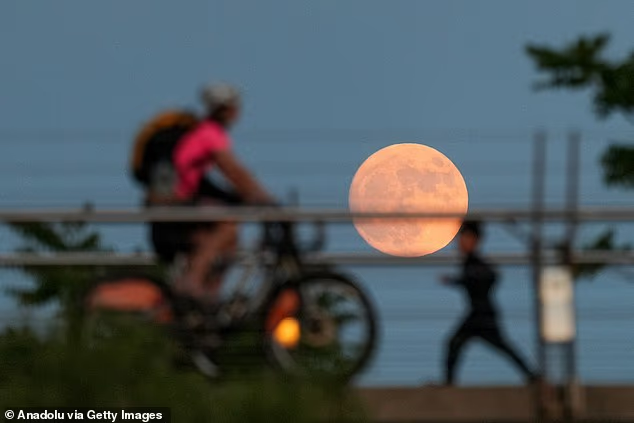
A rare celestial event is about to light up the night sky.
Tonight’s full Strawberry Moon will hang lower than any full moon seen from the Northern Hemisphere in nearly 20 years, creating an unusually large and dramatic display.
The phenomenon is being amplified by a low point in the Moon’s 18.6-year orbital cycle, an event that will not be matched again until 2043.
This Strawberry Moon coincides with the summer solstice for the first time since 1985, and while it will not glow pink or red, skygazers will see it dazzle with a golden hue.
Skywatchers are being urged to head outside at exactly 7.56pm ET, when the moon first rises and appears at its biggest and most colorful. However, the exact moment of fullness will occur before the moon rises in many parts of North America.
Look toward the southeastern horizon to catch the moon emerging low in the sky before it traces a shallow arc overhead.
Because its light must travel through more of Earth’s atmosphere, the moon could glow orange, red or golden as it climbs.
The best views will come from open areas with an unobstructed view of the horizon, away from bright city lights. For anyone hoping to witness a once-in-a-generation lunar spectacle, tonight may be the perfect opportunity.
This Strawberry Moon coincides with the summer solstice for the first time since 1985, and while it will now glow pink or red, skygazers will see it dazzle with a golden hue. Pictured is the Strawberry Moon in Canada on Sunday
No telescope or special equipment is needed to see tonight’s lunar spectacle. In fact, the best views may come with the naked eye, especially if the moon is rising behind trees, buildings or other landmarks that make it appear even larger.
This effect, known as the ‘moon illusion,’ tricks the brain into seeing the low-hanging moon as much bigger than it actually is.
Binoculars can help reveal craters and other features on the lunar surface, while photographers may want to capture the moon alongside a recognizable object for scale.
Since clouds could spoil the show, skywatchers should check their local forecast and moonrise time before heading outside.
The gold hue is because the moon takes a low, shallow path across the sky, but the name ‘Strawberry’ stems from the Native American Algonquin tribes.
The tribes lived in the northeastern region for about 8,000 years before English settlers arrived and used the June full moon to know when strawberries were ripe for harvesting.
And legend has it that if you eat a strawberry under the full moon in June, then any wish you desire will come true.
Ancient Europeans have also coined the moon as the Mead or Honey Moon.

Skywatchers are being urged to head outside at exactly 7.56pm ET, when the moon first rises and appears at its biggest and most colorful. However, the exact moment of fullness will occur before the moon rises in many parts of North America
Mead is a drink created by fermenting honey mixed with water and sometimes fruits, spices, grains, or hops. In some countries, Mead is also called Honey Wine.
Some writings have suggested that the time around the end of June was when honey was ready for harvesting, which made this the ‘sweetest’ Moon.
And the word ‘honeymoon’ traces back to at least the 1500s in Europe.
‘The tradition of calling the first month of marriage the ‘honeymoon’ may be tied to this full Moon because of the custom of marrying in June or because the ‘Honey Moon’ is the ‘sweetest’ Moon of the year,’ according to NASA’s Gordon Johnston.
‘There doesn’t appear to be enough evidence to support a 19th-century theory that the word entered English from the custom of gifting newlyweds mead for their first month of marriage.’
The rare full moon comes a week after the summer solstice has begun, which is the longest day of the year.
This is due to Earth’s position in its orbit around the sun and the way the North Pole is tilted closest to the sun during the summer solstice