
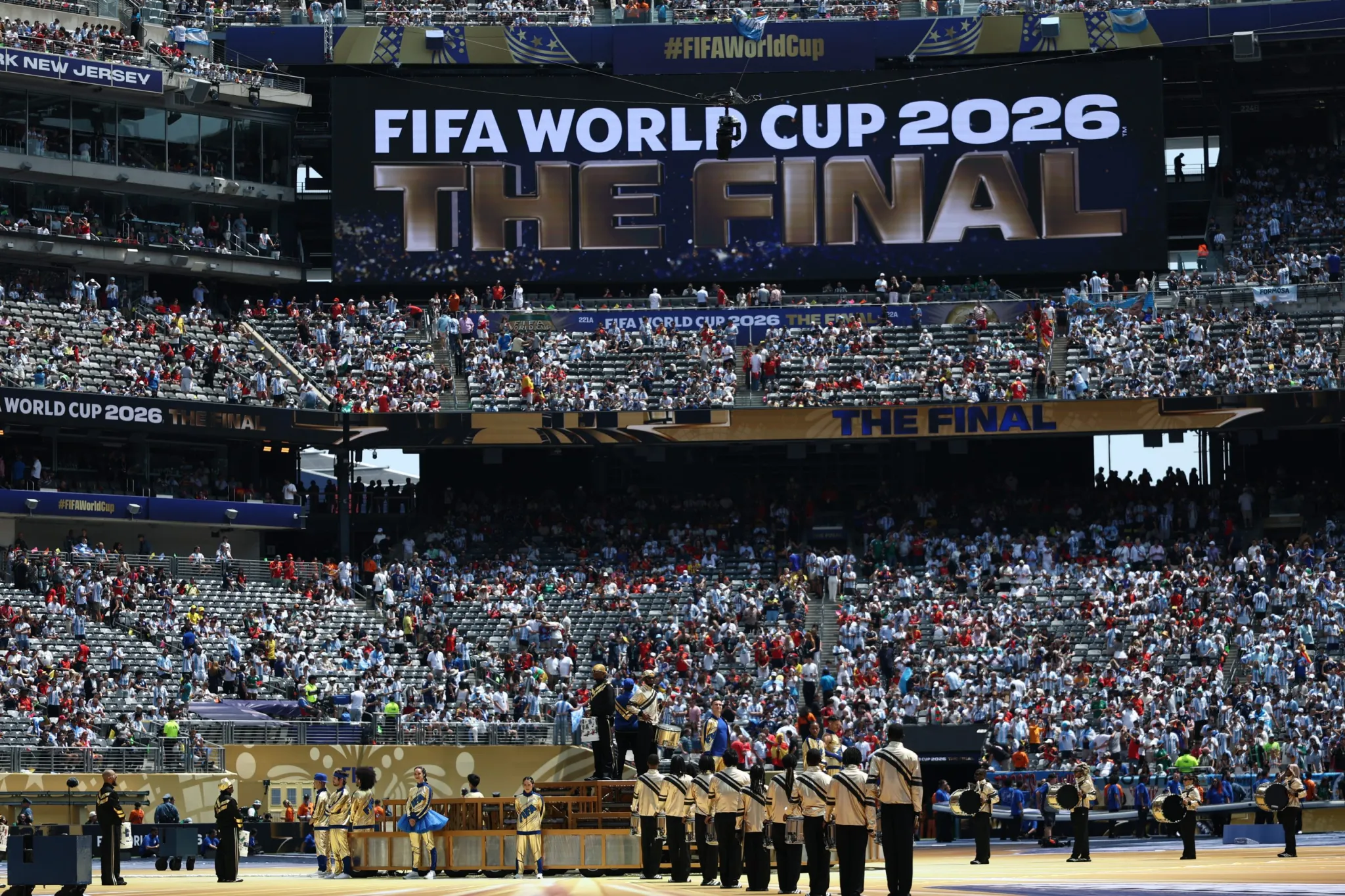
Prediction-market trading has surged during a blowout World Cup, far outpacing the growth at traditional sportsbooks and driving home the competitive threat that companies like Kalshi now pose to the sports-gambling industry.
Kalshi, the biggest player, has repeatedly broken its own trading records during the World Cup, doubling the peak it hit just a week before the tournament began, during the New York Knicks’ dramatic playoff run, and running at nearly 10 times what it was at many points early in the year.
H2 Gambling Capital estimates that prediction-market activity was around 27% of all legal US sports-betting volume during the World Cup, up from 9% at the beginning of the year, based on public data from the tournament’s first month. The comparison is imprecise because prediction markets and gambling companies calculate activity differently, and the sportsbooks have not yet released their recent internal numbers. But it illustrates the speed at which the exchanges are gaining ground.
In a stark sign of how the competitive dynamic has changed, Kalshi had more daily users on its phone app during the tournament than either of the two largest US online sports-gambling apps, DraftKings and FanDuel, according to Apptopia.
Ian Moore, an analyst at Bernstein, said that the growth has “put feet to the fire for these traditional sportsbooks to start offering a similar service.” It is, he said, “a new opportunity for everyone.”
Less than two years ago, prediction markets were not allowed to offer wagers on sports games. Last summer, gambling executives were dismissing prediction markets as fringe upstarts that would be hampered by regulatory uncertainty.
The World Cup gave Kalshi and its main rival, Polymarket, a chance to showcase how their friendly federal regulator, the Commodity Futures Trading Commission, has allowed them to launch an array of competitive betting products and successfully fight back the state regulators who have sought to shut them down in court.
The startups seized the global spotlight by launching aggressive marketing campaigns that made them ubiquitous in the round-the-clock coverage of the tournament. While gambling companies have dominated advertising around previous marquee sports events, it was Kalshi that cut a late deal to appear on the digital boards alongside the playing field in every game during the latter stages of the World Cup.
Read More: Kalshi Picks Up World Cup Sponsorship Deal at a Deep Discount
Kalshi and Polymarket have tried in the past to differentiate themselves from gambling companies, emphasizing that they do not benefit when customers lose, while also making it possible to wager on economically important events like elections and the weather, which sportsbooks don’t offer.
But the tournament underscored the degree to which prediction markets have created financial contracts that mimic the behavior of many traditional gambling products, turning sports into the single largest driving force behind the growth of the nascent industry.
Some of the fastest-growing wagers in recent weeks were so-called combos, a prediction-market version of the parlays that have been hugely lucrative for sportsbooks, making it possible to take risky, low-odds bets on multiple different outcomes happening in sequence.
Federal regulators have also allowed event betting exchanges to serve customers from states where sports gambling is illegal, and to take in anyone over 18, unlike gambling products, which are off limits to people under 21.
The gambling companies have recognized the threat and launched their own prediction market products. Some analysts believe they will ultimately be better placed to take advantage of the new opportunity with their broader distribution channels. FanDuel’s stand-alone prediction market app has so far gained little traction, according to Apptopia data.
The stocks of the two biggest online gambling companies in the US — DraftKings Inc. and FanDuel’s parent company Flutter Entertainment PLC — surged right before the World Cup, in anticipation of the spike in business. But the stocks slumped as the tournament went on and they are both down more than 25% on the year.
DraftKings declined to comment.
A spokesperson for FanDuel said the company could not comment on the broad trends because it is about to release financial results, but noted that the “World Cup has seen record interest from our customers throughout the competition, with the top 10 soccer games by handle in our history all coming during this year’s tournament.”
Ed Birkin, a managing director at H2 Gambling Capital, said that while prediction markets have been growing faster, they are also catering to a different and potentially less lucrative audience than sportsbooks.
“It’s pretty clear that prediction markets have had a very good World Cup,” Birkin said. “I think they are less of a threat than some people make out, but they are definitely eating around the edges and these customers will allow them to continue growing their business.”
Polymarket also grew rapidly during the tournament on both its international exchange and its new US platform. Kalshi, though, has raced far ahead in recent months and has had more than twice as much trading volume during the World Cup, user-compiled data on Dune Analytics shows.
Polymarket used to be the dominant player in the industry, but it has dealt with legal problems and internal strife and has struggled to get its US operation up and running.
Read More: Polymarket Loses Lead as Delays, Apologies and Blowback Mount
Polymarket and Kalshi are now also facing competition from a new prediction market platform backed by Robinhood Markets Inc. and Susquehanna International Group, which was launched recently and attracted significant trading volume during the World Cup.
Even as the final between Spain and Argentina approached, all of the exchanges dealt with the comedown in trading volume from the busiest days of the tournament, which leaves the challenge of maintaining the new customers who may not have as much interest in betting on other events.
But the same questions came up after the Super Bowl and Kalshi quickly bounced back and continued to grow — even before the World Cup began — demonstrating the benefit of having such a wide array of events to bet on.
“It’s clearly a product that resonates with a certain segment of the bettors,” Birkin said. “It’s a headwind for the sportsbooks.”


