This story is from Floodlight, a nonprofit newsroom that investigates the powers stalling climate action. Sign up for Floodlight’s newsletter here.
Omaira Garcia didn’t realize life on her small ranch in Abilene was about to change forever until clouds of dust — kicked up by a mysterious construction next door — began to engulf her home.
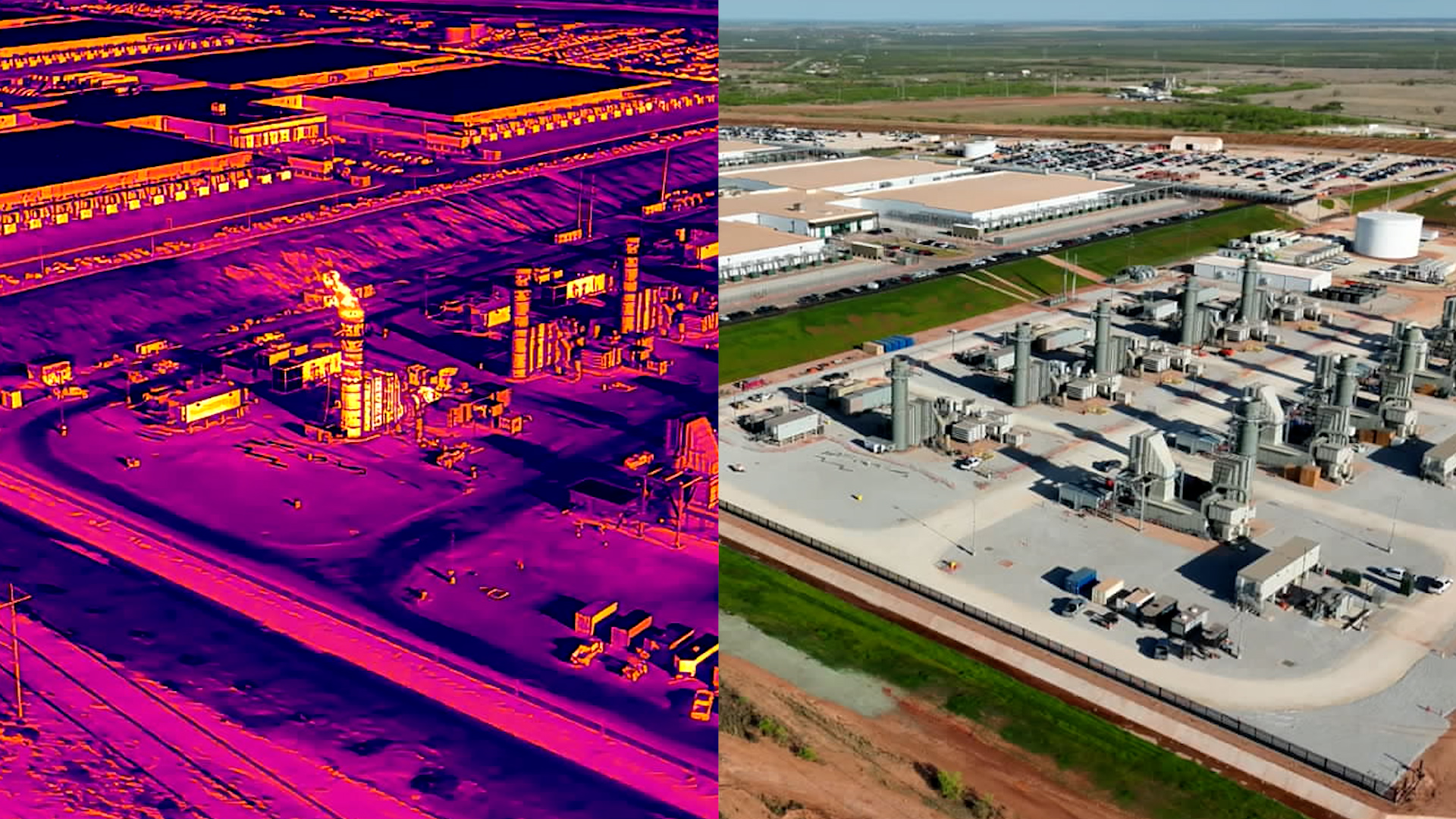
The Air Force veteran said she was never told about OpenAI’s plans to build its flagship “Stargate” data center directly beside her property until well after construction began in the summer of 2024. Now, the site’s large-scale power plant sits roughly 500 yards from her house — the exhaust stacks of gas-powered turbines clearly visible from her kitchen window.
“We weren’t given any time to understand what this impact was going to be on us,” the mother of two said through tears. “We’re trapped here.”
OpenAI did not respond to multiple requests for comment.
A spokesperson for Stargate’s developer, Crusoe, told Floodlight that the data center has “contributed meaningfully to the economic development” of Abilene, and its investments are “funding new fire trucks, school expansions, and road improvements across the city.”
Garcia’s situation isn’t unique: Data centers like Stargate, along with their accompanying power plants, are proliferating across the country, helping to satisfy an immense demand for artificial intelligence.
And despite lofty promises to fuel data centers with renewable energy, data shows AI companies are mostly relying on gas to satisfy their insatiable energy demands. Nationwide, nearly 60 data centers are planning to build their own gas plants to avoid connecting to the grid, according to research by energy analytics firm Cleanview released last month.
Including Stargate’s Abilene campus, at least 15 gas plants tied to data centers are planned for Texas, according to Cleanview. Available permits reviewed by Floodlight show that nine of them combined could emit more than 130 million tons of greenhouse gases every year. That’s the equivalent annual emissions of 35 coal-fired power plants, according to an Environmental Protection Agency calculator.
While actual emissions are usually lower than estimates, the impact on the climate could still be enormous: If completed, these nine plants have the potential to emit more annual greenhouse gases than most countries do — even if emissions end up being half of what’s permitted.
In Abilene, Stargate’s developers have already built 10 gas-powered turbines and 62 backup diesel generators and want to add 41 more turbines and 18 more generators to the sprawling site. If approved, the expansion would make Stargate one of the largest fossil fuel power plants in the state — capable of powering more than 1 million homes and emitting more annual greenhouse gases than nearly 2 million cars.
On paper, Stargate’s Abilene campus started out small, but through a permitting loophole identified by Floodlight, it was able to quietly construct massive power sources with little-to-no public notice.
Dozens of Texas data centers have obtained these minor air permits — which avoid public scrutiny and extensive environmental reviews and are more commonly associated with dry cleaners and auto body shops. In several cases, data centers secured these permits before seeking massive expansions later on, deploying a “small first, big later” strategy that watchdogs say limits public input and creates unstoppable momentum for their projects.
“All of this should have been rolled into one permit,” said Bruce Buckheit, a former air enforcement chief for the EPA who served under multiple Republican administrations, when briefed on Stargate’s expansion plan.
These minor permits — as well as the nondisclosure agreements many developers require in their dealings with local governments and residents — are how communities like Garcia’s are left stunned when exhaust stacks pop up in their backyards.

Texas on track to lead U.S. in data centers
Stargate was first announced in January 2025 as part of a $500 billion joint venture between OpenAI, SoftBank and Oracle to construct hyperscale AI data centers across the country.
“It’s big money and high-quality people,” President Donald Trump said at the time. OpenAI CEO Sam Altman called it “the most important project of this era.”
Construction was already well underway in Abilene. The 1,100-acre campus, along with its 360 megawatt on-site gas plant, were among the first hyperscale AI data centers to break ground in Texas. A wave of similar proposals has since made the state ground zero for the AI-driven build-out of fossil fuel power plants across the US.


(Planet Labs PBC)
With roughly 300 operational data centers and 200 more in development, Texas is expected to surpass Virginia as the nation’s leading data center market by 2030. Lured by prolific gas reserves and an industry-friendly government, AI companies have flocked to Texas in droves and begun erecting a “shadow grid” of custom-built power plants capable of fueling entire cities.
For example: Meta’s data center in El Paso plans to rely on a new 366 MW gas plant; Chevron is planning a 2.5 GW–5 GW natural gas-fired power complex in the Permian Basin exclusively meant to power data centers; and Pacifico’s GW Ranch in Pecos County was recently granted the country’s largest air pollution permit, allowing emissions of up to 33 million tons per year of greenhouse gases — equal to nearly 5% of Canada’s total annual greenhouse gas emissions.
Overall, Texas has put more than 80 GW of new gas power plants into its construction pipeline, more than any country besides China. Roughly half of that capacity will provide power exclusively to data centers according to a report from Global Energy Monitor.
“You haven’t seen anything like that since the fracking boom,” said Jenny Martos, who authored the report. She described the trend as “enormous” and said it risks “locking in fossil fuel for the foreseeable future.”
The “bring your own power” strategy once thought of as a novel approach embodied by Elon Musk’s controversial data centers in Tennessee and Mississippi has now gone mainstream, and nowhere is this more apparent than in Texas.
Minor permits lead to major construction projects
In 2024, Stargate’s developers secured permission to operate 10 gas-powered turbines and 62 backup diesel generators through minor permits known as “permits by rule” and “standard permits.” Under the minor permits, Stargate’s fleet of turbines and generators are currently allowed to emit more than 1.6 million tons of greenhouse gases and 1,000 tons of combined harmful air pollutants every year. Despite being permitted for continuous use, Stargate’s developer, Crusoe, told Floodlight that the turbines will only be used for back up power.
Widely understood to be used by low-level polluters across the country, these permits don’t require environmental studies, public notice or public comment periods, according to experts like Kathryn Guerra, who spent nearly four years at the Texas Commission on Environmental Quality before joining the watchdog group Public Citizen.
“Those lower level permits get granted very quickly and often without the public knowing,” Guerra said — and “that feels pretty intentional.”

Buckheit, the former EPA air enforcement chief, agreed.
State agencies typically use the permit by rule process “for small things that happen a lot,” like gas stations or dry cleaners, so “they don’t have to waste their time reinventing the wheel for common stuff,” Buckheit said.
But Stargate “isn’t common stuff,” he said.
“Normally that permit by rule was conceived of and implemented in a case where an operator wanted a backup generator or three backup generators. When you get to 62, you start thinking, ‘Well, wait a minute, maybe the scale is wrong here,’” Buckheit said.
Since 2024, at least 38 data centers across Texas have received minor permits to operate on-site power sources, according to a Floodlight analysis. As a result, Texas regulators quietly sanctioned the use of more than 2,100 backup diesel generators across the state.
While intended for emergency power, the generators are also routinely operated for testing and maintenance, according to their permits. Operating data center backup diesel generators for less than an hour per week, on average, creates the same public health impact as five large scale gas-fired power plants, according to an analysis by Virginia Commonwealth University and the University of Washington.
Taken together, the thousands of new generators identified by Floodlight in Texas are permitted to emit nearly 2,500 tons of nitrogen oxides into Texas communities every year — more than triple the state’s newest coal-fired power plant. (Nitrogen oxides are highly toxic gasses associated with severe respiratory illness and even premature death.)
In the small town of Whitney, a data center owned by Cyrus One got the permit to operate hundreds of generators that the company estimates will emit 249.1 tons of nitrous oxides every year — just shy of the 250 tons-per-year limit that would have triggered more stringent permitting.
Outside of San Antonio, a Vantage data center received permission to emit 99.8 tons per year of the gas — barely below the area’s 100 ton-per-year threshold.
In fact, more than half of the data centers identified by Floodlight provided regulators with annual nitrogen oxide emission estimates that were just shy of thresholds that would require public input and more detailed environmental reviews.

In several cases, data centers secured minor permits to begin construction before seeking massive expansions later on.
After initially obtaining minor permits for 22 diesel generators at its San Antonio location, Vantage is now seeking to operate more than 80 diesel generators at the data center.
In Abilene, Stargate’s developers applied for a major air permit the year after securing a minor one as they sought to more than quadruple the number of gas powered turbines located on the campus.
Buckheit said Stargate’s staggered permitting approach could violate EPA “aggregation” policies, which are intended to evaluate the whole project. The agency’s own handbooks refer to minor permits that precede major ones as “sham permits.”
“You can’t come in with a permit application for two [turbines], and then three months later, you come in with a permit application for two more,” Buckheit said.

Former TCEQ veteran James Doty suspects the move was likely intentional.
“I sincerely doubt that the company made some last-minute decision to suddenly expand,” said Doty, who spent nearly 30 years at TCEQ. “They’re trying to get their foot in the door.”
The massive emissions estimates associated with Stargate’s expansion have forced its developers to apply for a major permit that requires the additional turbines to be equipped with the most effective emissions reduction technology available and triggers extensive environmental reviews and upcoming public comment periods. But nearly two years after construction began on the project, it may be too late for local residents to do anything.

“If a data center gets its operating permit, it’s too late,” Doty said. “The only chance to stop something like this is to do it at the very, very, very beginning of the process — before the permit is issued — through the public participation process.”
Doty and Guerra, both former TCEQ staffers, recommend concerned residents pay close attention to notices from state environmental agencies to spot incoming projects and request contested case hearings when possible.
Few of those avenues remain viable for Abilene residents. Guerra believes “it’s a foregone conclusion” that the expansion request will be granted.

Can state regulators keep up with data centers?
Even if Stargate secures more appropriate permits, both former TCEQ staffers doubt the agency is properly equipped to enforce them.
“The data center industry is expanding at a rate that is beyond the capability” of TCEQ to sufficiently regulate, Guerra said, adding that the agency’s enforcement backlog consists of more than 1,400 cases.
“This past year, they were able to resolve 39 of those 1,400 cases. At that rate, it’s going to take them 35 years to resolve all of them,” she said.
“Every single permit that this agency issues, in my opinion, is one more than they can effectively regulate,” she added.
An agency spokesperson refuted Guerra’s claims, writing that “industry growth has not compromised TCEQ’s commitment to fulfill its mission of protecting public health and the environment.” The representative wrote that TCEQ had conducted more than 100,000 investigations in 2025 and claimed that the low number of enforcement actions taken by the regulator “reflects high overall compliance rates” rather than “a lack of enforcement activity.”
Guerra said that TCEQ is “full of folks who are very interested in protecting the environment,” but leadership has made the agency notoriously lax on enforcement.
The policies may be drawing investments for the state, but those gains aren’t being felt by some fenceline residents in Abilene.

Evan Simon/Floodlight
Worries about the future
Garcia and her husband spent more than a year looking for their “piece of heaven” in the country.
“We took so much time to get it, and my kids absolutely love it. But under these conditions, we no longer have that,” she said.
In addition to concerns about air pollution, Garcia said the data center has transformed the quality of life on her once-quiet country road. Trash regularly lines the fences and gridlock traffic has sometimes made it difficult to leave her own driveway.

Crusoe wrote that the company takes “quality-of-life concerns seriously” and is committed “to being a responsible neighbor throughout construction and operations.”
Yet despite prominently featuring in a Floodlight/PBS short documentary on the topic — viewed millions of times — Garcia said Stargate’s developers have yet to reach out to her or her family.
Garcia’s nextdoor neighbor, Paul Daniel, said his family has lived in the area for more than 200 years, and he has been living in his current home for 44 years.
“Living here and having to deal with this, you can lose the value of your property,” the 81-year-old retiree said. Like Garcia, he said he didn’t know the data center was coming until it was too late to sell the property.
“We were never advised or anything,” Daniel said. As a result, he said the home he had planned to leave for his children has been seriously devalued.
“I don’t have a legacy,” he said.
Garcia says she wasn’t made aware of Stargate’s recent expansion plans until Floodlight informed her of the pending major air permit applications. Already coping with the presence of 10 gas-powered turbines beside her property, the plan for 41 more came as a gut punch.
“I can’t even begin to understand what kind of impact that’s going to have on me and my health in the future,” she said.

She tried to put the house on the market after learning about what was being built next door, but said she didn’t get a single offer. Realtors suggested she convert it into an Airbnb for Stargate workers but Garcia said she can’t afford to buy another home to live in while keeping the one beside the data center.
“It feels almost impossible unless Stargate purchases it, because what other homeowner is going to want to deal with what we’re dealing with?”
The dilemma has left her feeling helpless.
“I don’t know what the future looks like.”
Disclosure: Floodlight, Meta and Public Citizen have been financial supporters of The Texas Tribune, a nonprofit, nonpartisan news organization that is funded in part by donations from members, foundations and corporate sponsors. Financial supporters play no role in The Texas Tribune’s journalism. Find a complete list of them here.
Source link