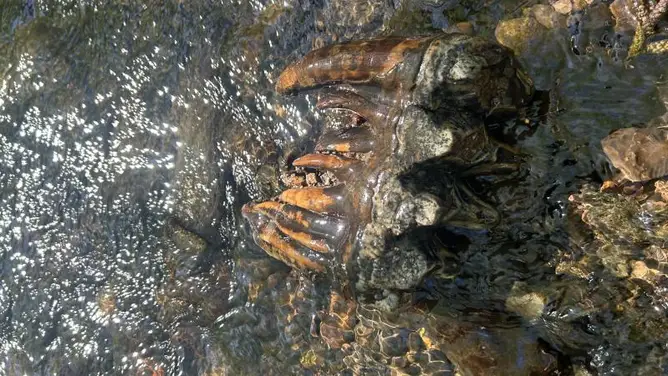
Erosion caused by heavy rains uncovered an
THE TAKEAWAY
- An intact adult Pacific mastodon molar was discovered in a California Midpen preserve.
- Mastodons were massive herbivores that went extinct roughly 11,700 years ago.
- The tooth was donated to Stanford University for carbon dating and research.
SAN MATEO COUNTY, Calif. — A massive fossilized tooth discovered in a California preserve is giving scientists a rare glimpse into the Ice Age and the prehistoric creatures that once roamed the San Francisco Bay Area.
Geomorphologist with Balance Hydrologics Brigid Lynch found the fossil at a Midpeninsula Regional Open Space District preserve while surveying rocks as part of a project to improve habitat for the threatened California red-legged frog.
At first, Lynch thought the unusual object was simply a strangely shaped rock.
Fossilized adult molar of a Pacific mastodon found in California’s Midpen preserve.
(Balance Hydrologics / Midpeninsula Regional Open Space District)
“I was down in the creek bed surveying rocks when I came across it and thought — that one is very weirdly shaped,” Lynch said.
After photographing the object and continuing her work, Lynch discovered the following day that she had actually found an exceptionally preserved adult molar belonging to a Pacific mastodon.
FOSSIL REVEALS ANCIENT GIANT SALAMANDER THAT LIVED 3.5 MILLION YEARS AGO
“As a geologist, I’ve gone out and seen stuff in the field, but definitely nothing as exciting as this,” Lynch said.
The Pacific mastodon is a distinct species that was once thought to be the same as the American mastodon. According to Midpen, genetic and anatomical research revealed differences between the species, including narrower teeth and thicker leg bones.
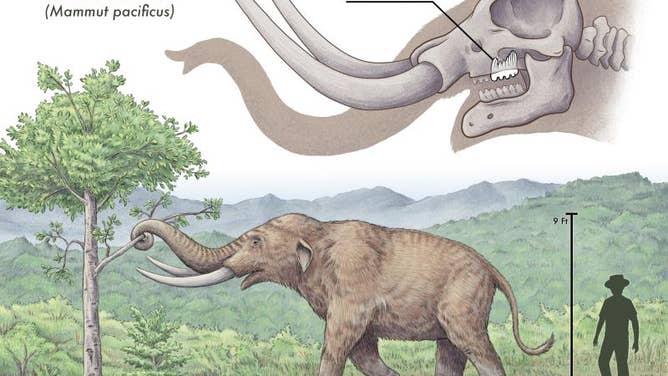
Illustration of a Pacific mastodon.
(Haley Grunloh / Midpeninsula Regional Open Space District)
Paleontologist Wayne Thompson described the newly discovered tooth as being in “immaculate condition” and called it the most complete mastodon molar from the area he has seen.
Mastodons were massive herbivores that lived during the Pleistocene epoch, which stretched from about 2.5 million years ago until their extinction roughly 11,700 years ago.
SCIENTISTS UNCOVER FIRST KNOWN ADULT T. REX TRACKWAY DATING BACK 66.5 MILLION YEARS
Unlike mammoths, which primarily ate grasses, mastodons were browsers that used their trunks to strip leaves, shoots and fruit from trees and other woody plants. Thompson said alder trees were among the mastodons’ favorite foods.
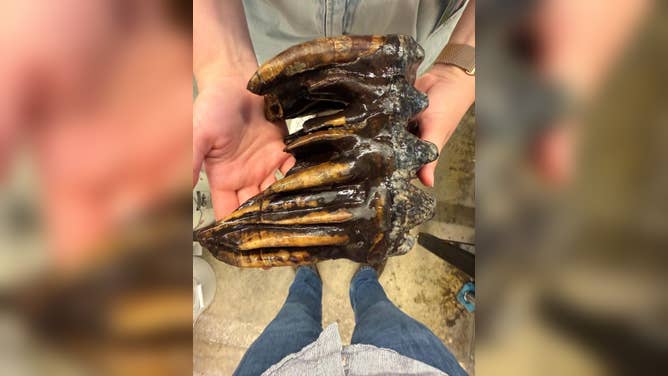
Fossilized adult molar of a Pacific mastodon found in California’s Midpen preserve.
(Midpeninsula Regional Open Space District)
The fossil has been donated to Stanford University’s Doerr School of Sustainability, where researchers plan to use carbon dating to determine when the mastodon lived. Scientists also hope to learn more about its diet and the climate of the region during its lifetime.
Christine Garcia, curator and manager of Stanford’s Geoscience Specimen Collection, said fossils provide an opportunity to study past biodiversity and ecosystems.
“For me, this find is interesting in that a lot of the work that I do at Midpen is associated with trying to keep species from going extinct,” Midpen biologist Matt Sharp Chaney said.