Three strong solar flares erupted from the sun in less than 24 hours. During this series of eruptions, there were reports of multiple radio blackouts that occurred across Earth.
The SOLAR-1 satellite by NOAA is now fully operational after making the million-mile journey into deep space to study space weather.
NOAA said the satellite marks “a major milestone for the nation’s resilience to space weather events.”
Originally named Space Weather Follow On – Lagrange 1 (SWFO-L1), the satellite was renamed to Space Weather Observations at L1 to Advance Readiness – 1 (SOLAR-1) in January.
HOW MANY SPACEX ROCKET LAUNCHES WILL OCCUR BY THE END OF 2026?
It is the first U.S. satellite designed exclusively for continuous, operational space weather observations, NOAA said.
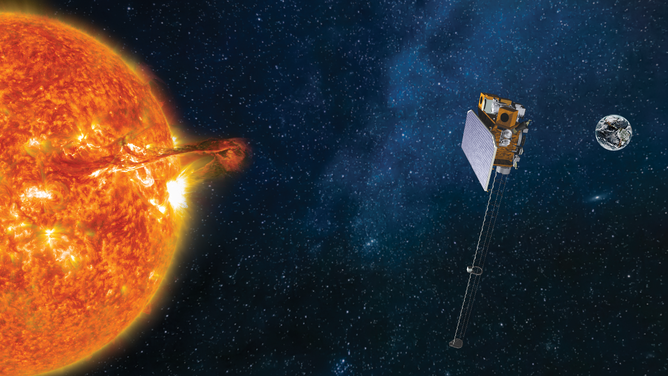
An artist rendering of NOAA’s SOLAR-1 satellite (formerly SWFO-L1) in its final position in space orbit next to an image of the sun producing a coronal mass ejection. Earth is seen 1 million miles away in the far distance on the right of the image.
(NOAA)
Activity on the sun’s surface creates a phenomenon known as space weather.
Despite the sun being 93 million miles from Earth, space weather events can affect Earth and the other planets in our solar system, NASA said.
NASA’S NEW NANCY GRACE ROMAN SPACE TELESCOPE SET TO LAUNCH MONTHS AHEAD OF SCHEDULE
SOLAR-1 launched on Sept. 24, 2025, on a SpaceX Falcon 9 from Kennedy Space Center in Florida.
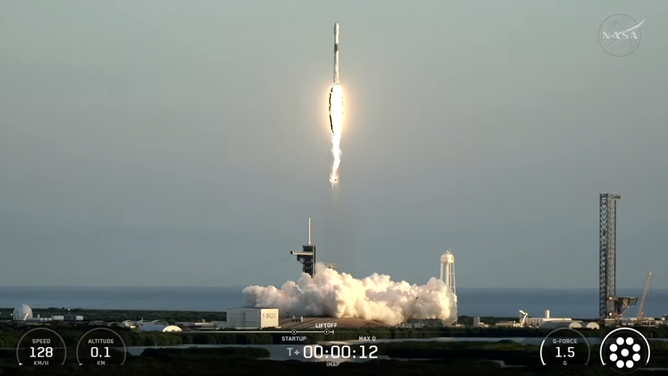
SpaceX Falcon 9 rocket carrying SOLAR-1 and two other instruments into deep space on Sept. 24, 2025.
(NASA)
The spacecraft spent four months traveling nearly one million miles to the Sun-Earth Lagrange point 1 (L1), where it is now parked, NOAA said.
Before reaching its initial operational capability, SOLAR-1 underwent a rigorous, eight-month, post-launch testing and commissioning period.
SEE IT: STRONG SOLAR FLARE CAUGHT ON CAMERA ERUPTING FROM THE SUN
While in this stage, NASA and NOAA together meticulously checked each instrument of the satellite and its primary systems.
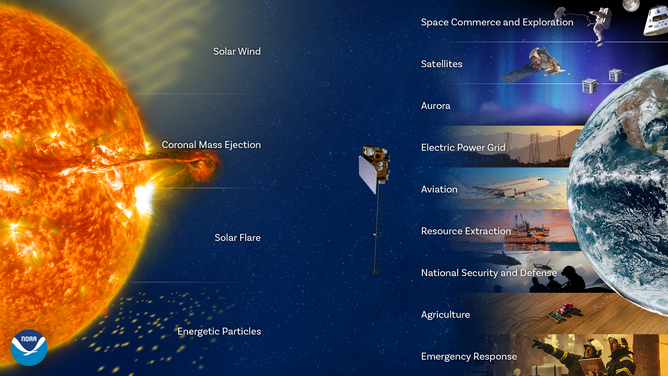
As an operational observatory, SOLAR-1 delivers real-time data to NOAA’s Space Weather Prediction Center (SWPC), enabling faster and more accurate forecasts, watches, and warnings.
(NOAA)
NOAA said now that it’s in place and operational, the satellite observatory will continuously monitor solar wind and observe coronal mass ejections (CME) emitted from the sun.
SOLAR-1 strengthens the U.S.’s ability to protect systems that can be disrupted by space weather, including the electric grid, satellites, communications, aviation, navigation systems, national security operations and human spaceflight, like NASA’s Artemis missions.
NASA ANNOUNCES ARTEMIS III ASTRONAUTS IN NEXT PHASE OF MISSION TO RETURN HUMANS TO THE MOON
For NOAA’s Space Weather Prediction Center (SWPC), SOLAR-1 is a cornerstone of the nation’s space weather early warning system, providing the observations needed to issue timely watches, warnings, alerts and decision support before solar storms impact critical infrastructure and missions, NOAA said.
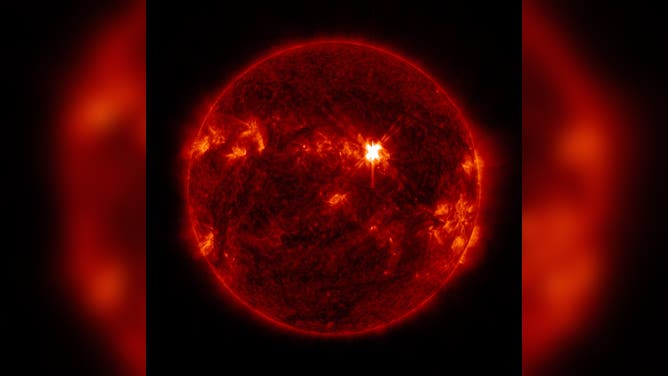
NASA shares an image of a large solar flare event on the morning of June 3, 2026.
(@NASASpaceAlerts / X)
“It means more time to act,” Clinton Wallace, director of NOAA’s Space Weather Prediction Center, said. “It gives time for power grid operators to prepare, more time for satellite operators to protect assets, more time for aviation and national security partners to understand risk, and more time for human spaceflight teams to protect astronauts and missions. SOLAR-1 helps turn observations of the sun into practical decisions that protect lives, infrastructure, the economy and national security.”
SOLAR-1’s data will constantly be streaming to Earth without interruptions or obstructions, meaning improved performance over older instruments and faster delivery of observations to NOAA’s SWPC.
NASA’s Solar Dynamics Observatory captured a strong solar flare released by the Sun on Tuesday, Feb. 3. Following several eruptions in preceding days, this activity could trigger geomagnetic disturbances and enhance the Northern Lights.
“For example, SOLAR-1’s coronagraph will deliver CME imagery to SWPC forecasters/users within 30 minutes of being captured in space, compared to research observatories and instruments,” NOAA said.
NOAA said SOLAR-1 data will be available to the public in real time via the SWPC website.