This NASA animation shows gamma rays (magenta) arise when accelerated particles in the explosion’s shock wave crash into the red giant’s stellar wind.
What happens to Earth when the Sun dies? A groundbreaking study released by Astronomy and Astrophysics reveals a fate far more mind-boggling than the fiery death we always expected.
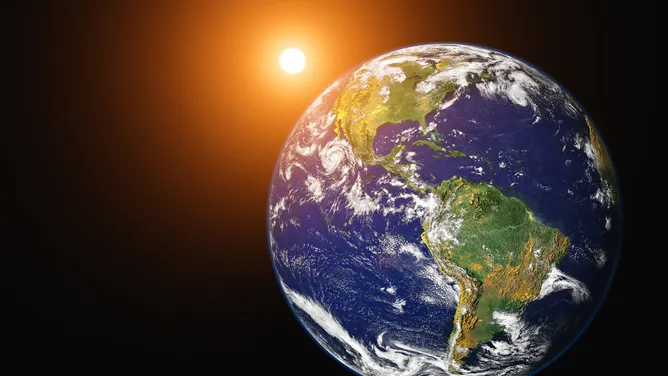
Planet Earth and sunrise. Elements of this image furnished by NASA
(NexTser / Getty Images)
Five billion years from now, the Sun will run out of fuel and expand into a red giant — a massive, dying star.
THE BEST CELESTIAL EVENTS IN 2026 YOU WON’T WANT TO MISS
For decades, we believed this meant the absolute destruction of Mercury, Venus and Earth. But the new study suggests our planet might actually have a chance depending strongly on two scenarios.
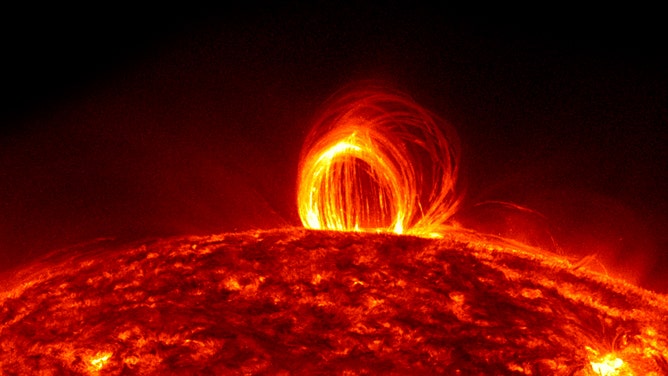
NASA File photo: On July 19, 2012, million-degree plasma in the sun’s atmosphere began to cool and fall to the surface, resulting in a dazzling magnetic display known as coronal rain. (Image source: NASA/GSFC/SDO)
(NASA)
Depending on the strength of the sun’s gravitational tidal interactions and its mass-loss rates, Earth will either be dragged inward and swallowed by the sun or allowed to drift out into wider orbit.
SCIENTISTS DISCOVER NEW METHOD OF DEFENSE AGAINST SOLAR STORMS TO HELP PROTECT EARTH
According to the study, “low AGB mass-loss rates lead to engulfment, while high rates allow Earth to survive.”
AGB stands for Asymptotic Giant Branch, which is the most explosive peak of the red giant phase—essentially when the sun begins its final stages of life.
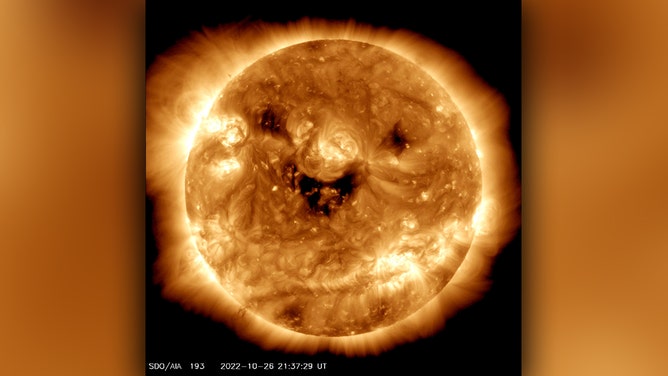
NASA’s Solar File: File: Dynamics Observatory caught the Sun “smiling.”
(@NASASun / Twitter / NASA)
When you add ‘mass loss’ to the equation, AGB mass loss simply means that this dying star is violently blasting its outer layers of gas and dust into deep space using powerful stellar winds.
VIBRANT DISCOVERY: UNIQUE, SALTY CLOUDS FOUND ON ICONIC ‘PINK PLANET’
“Since the AGB mass-loss rates remain observationally uncertain, the final fate of Earth is still unclear,” researchers said.
So how did scientists’ figure this out?
They looked at a nearby dying star called L2 Pup. This star essentially mimics what our Sun will look like in 5 billion years.
By observing L2 Pup with powerful telescopes, researchers were able to measure exactly how much mass the aging star is shedding right now.
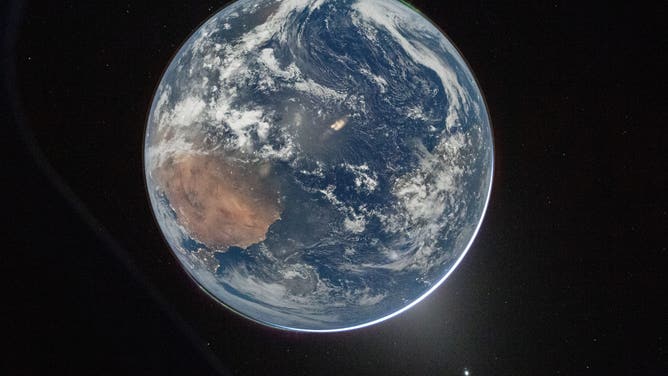
High-resolution photo of Earth viewed from Orion spacecraft.
(NASA/Reid Wiseman / FOX Weather)
They plugged this real-world data to recalculate Earth’s chances of survival.
While this discovery might offer a glimmer of hope, the unfortunate reality is that both scenarios still seal the ultimate demise of humanity.