NASA shared new details about its Moon Base strategy, outlining plans to establish a long-term human presence near the Moon’s south pole. The agency unveiled new lunar rover contracts, upcoming cargo missions, and future infrastructure projects designed to support sustained operations on the lunar surface. NASA officials said the initiative represents a shift from simply visiting the Moon to building permanent systems for long-term lunar exploration.
After a mission to save the Swift telescope experienced a major setback, NASA announced they will take a step back in their efforts to adjust the telescope’s altitude above Earth.
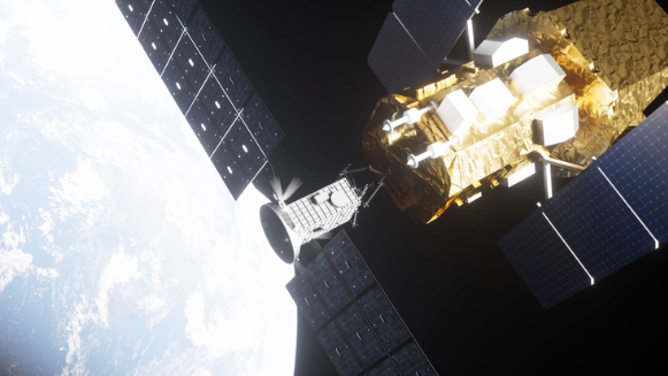
Officials and Katalyst Space had tried to make history by repositioning the Swift observatory higher into space by using a robotic satellite called LINK.
NASA’S MISSION TO SAVE THE SWIFT TELESCOPE EXPERIENCES A MAJOR SETBACK
According to NASA and Katalyst, LINK will not proceed with the original mission due to recent setbacks and has shifted to demonstrating “rendezvous technologies for in-space servicing.”
Photo of NASA’s Swift satellite.
(NASA)
One of LINK’s main issues is that it has developed problems controlling its orientation, which is crucial because drag from Earth’s atmosphere in low orbit would gradually reduce its altitude.
This is similar to the issue with Swift, and it’s why experts are trying to elevate it back higher into space.
SEPTEMBER SKYWATCHING GUIDE: HARVEST MOON, BRIGHT VENUS, FALL EQUINOX AND MORE AHEAD
In light of this, NASA has shifted to low-drag operations, which the agency says has extended the telescope’s time above 185 miles until October.
Below this point, operating the telescope becomes difficult and the spacecraft’s rate of descent rapidly increases, according to NASA.

This picture shows a regions captured by a telescope aboard the Swift satellite of a region 200,00 light years wide.
(NASA/Swift/Stefan Immler (GSFC) and Erin Grand (UMCP))
As a result, NASA is essentially working off borrowed time because of drag, but it’s up and running for now.
This is the maximum time they have to recover or adjust the telescope before it falls below a critical operating altitude.
NASA WILL CONDUCT DARING RESCUE MISSION TO REPOSITION TELESCOPE SINKING INTO EARTH’S ATMOSPHERE
Over the last 21 years, the Swift telescope has been NASA’s multitool for studying the cosmos, the agency said.