NASA‘s Artemis II mission has been given the green light to launch, sending four astronauts to the moon for the first time in over 50 years.
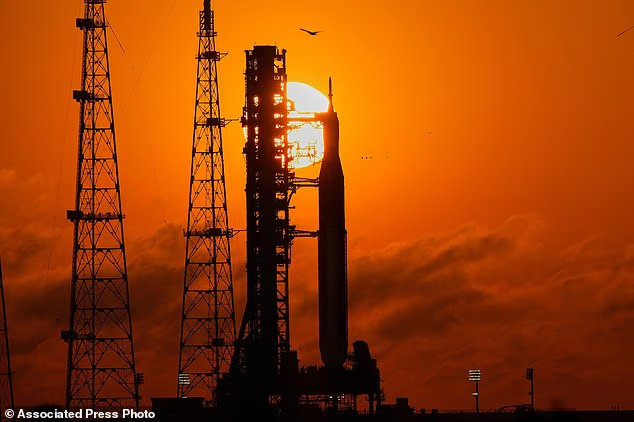
The 32–storey Space Launch System (SLS) rocket is set to blast off from the Kennedy Space Centre in Florida tomorrow.
It will send Reid Wiseman, Victor Glover, Jeremy Hansen and Christina Koch on a mammoth 10–day 685,000–mile (1.1 million km) trip around the moon and back.
At a briefing by NASA yesterday, space agency chiefs said the mission is ‘ready to go’.
‘As we enter the pre–launch phase, the teams are in a strong posture, and the mission remains on track,’ NASA’s associate administrator Amit Kshatriya said.
‘The vehicle is ready. The system is ready. The crew is ready.
‘I have complete confidence in this team. 53 years ago humanity left the Moon and did not return. Now we go back.’
Here, the Daily Mail’s step–by–step graphic reveals exactly what will happen during the mission.
NASA has said the launch window opens on April 1, with multiple backup opportunities available over the following days depending on weather, technical readiness and range availability.
The SLS rocket itself consists of several parts, including a launch system and the Orion capsule that sits atop it.
During take–off, four RS–25 engines will fire non–stop for 8.5 minutes.
Along with two boosters, this will produce 8.8 million pounds of thrust – more than any rocket in history.
After launch, the Orion crew capsule will separate from the rocket’s upper stage and enter a highly elliptical orbit around Earth.
The crew will then spend the first few days conducting extensive systems checks.
These include testing Orion’s life–support, propulsion, navigation and communications systems to ensure the spacecraft is ready to head into deep space.
Once checkouts are complete, Orion’s propulsion system will perform a critical engine burn known as translunar injection, sending the spacecraft out of Earth orbit and onto a trajectory toward the moon.
NASA’s SLS rocket with the Orion spacecraft sits on its launch pad at the Kennedy Space Center

NASA astronauts Reid Wiseman (left), Victor Glover (second left), Christina Koch (second right) and Canadian Space Agency astronaut Jeremy Hansen (right)
Orion will pass behind the moon on a ‘free–return’ trajectory — a path that naturally swings the spacecraft back toward Earth without requiring additional propulsion.
It will reach its greatest distance from Earth during this phase.
After the lunar flyby – during which the crew will photograph and analyse the lunar surface – the spacecraft will spend several days heading home.
As Orion approaches Earth, it will separate key components before plunging into the atmosphere at speeds of about 25,000 miles per hour (40,233 kph).
Testing the capsule’s heat shield during high–energy re–entry is one of the mission’s primary objectives – as well as one of its most dangerous.
The spacecraft is expected to splash down in the Pacific Ocean, where recovery teams will retrieve the crew.
‘Our team has worked extremely hard to get us to this moment’, said launch director Charlie Blackwell–Thompson.
‘Certainly all indications are right now we are in excellent, excellent shape.’

The rocket itself consists of several parts, including a launch system and the Orion capsule (pictured) that sits atop it

Crew members will strap sleeping bags to the wall to catch some shut–eye, as shown in this mock–up image
NASA’s Artemis II mission should have launched in February, but was grounded by hydrogen fuel leaks.
The leaks were fixed, but then a helium pressurization line became clogged, forcing a return to the hangar late last month.
NASA has the first six days of April to launch Artemis II before standing down until the end of the month.
Tomorrow’s launch window opens at 6:24pm EDT (11:24pm BST).
‘Our teams in mission control and our crew members have been spent the last two years dedicated to training for this particular mission, developing all of the products associated with this flight, and they are ready to go,’ chief flight director Emily Nelson said.
‘The opportunity is immense for us to finally send our crew farther than anyone’s gone before.’
While the astronauts will not actually touch down on the lunar surface, it will still mark the first time humans will return to the vicinity of the moon since the Apollo 17 mission in 1972.
During the lunar flyby, the Orion spacecraft will travel around 4,700 miles (7,500 km) beyond the far side of Earth’s natural satellite, setting a new record.

In this photo provided by NASA, astronaut Charles M. Duke Jr. collects lunar samples during the first Apollo 16 extravehicular activity at the Descartes landing site on April 21 1972
NASA says the mission paves the way for a future lunar landing – planned for 2028 – and will also inform planning for longer missions such as to Mars.
It is also historically significant because it will send the first woman and the first Black person on a lunar mission.
British astronaut Major Tim Peake has said Europe, including the UK, is heavily involved in the Artemis programme.
‘We were there on Artemis I… we built the European service module which powers the Orion spacecraft that provides all the electrical power, the life support systems, the propellant,’ he said.
He hopes the mission can help inspire young people in the UK to consider a career related to space.
Goonhilly Earth Station, near Helston, Cornwall, will also help to track the capsule on its epic celestial voyage.