Asteroid 2026 JH2 was recently discovered by scientists and it’s making an extremely close approach to Earth on Monday, May 18. The asteroid will pass just 56,000 miles from Earth, that’s about a quarter of the distance between Earth and the moon. To talk more about it is RIchard Binzel, professor of planetary science at Massachusetts Institute of Technolology.
A NASA-led study revealed that a near-Earth object long mistaken for an asteroid, named 1998 SH2, is actually a hidden comet. This discovery could prove vital for predicting future threats to Earth.
For nearly three decades, astronomers tracked 1998 SH2 as a routine asteroid wandering through space. But during its close pass to Earth in August 2025, the object missed its predicted location, suggesting to scientists that its true identity could be a comet.
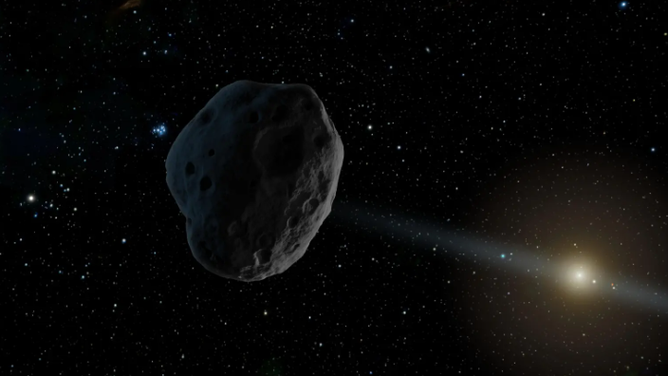
Artist’s concept of a near-Earth space rock.
(NASA/JPL-Caltech)
“After we measured the nongravitational perturbations affecting the motion of 1998 SH2 and recognized they weren’t compatible with the object being an asteroid, we suspected the object could be an active comet,” said Davide Farnocchia, a navigation engineer at NASA’s Center for Near-Earth Object Studies and lead author of the study.
THE PERSEID METEOR SHOWER IS HERE AND SKYWATCHERS COULD SEE UP TO 100 SHOOTING STARS PER HOUR
In simpler terms, this means research found that gravity from the Earth and sun was not the only driving force acting on the object.
During the August 2025 close approach, scientists were able to test this hypothesis with the help of global tracking telescopes.
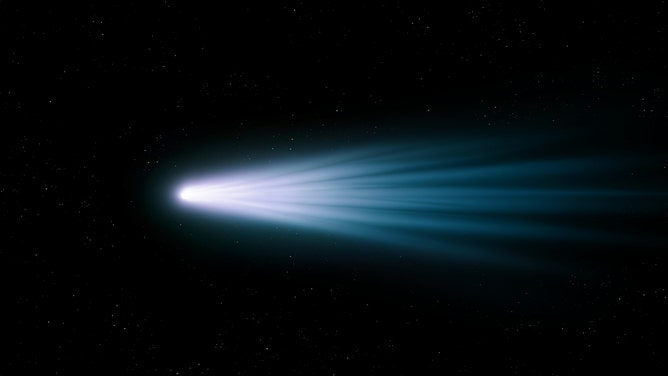
Beautiful bright comet tail in the sky. Large comet against a backdrop of stars. Falling star, astrophotography.
(Nazarii Neshcherenskyi / Getty Images)
Images captured by the telescopes revealed a faint but visible tail, confirming their suspicions.
“That’s how science works — you form a hypothesis, and you set out to test it. This data is exactly what was needed to confirm our hypothesis that 1998 SH2 was a comet,” said Olivier Hainaut, an astronomer with the European Southern Observatory and coauthor of the study.
Following the discovery, astronomers officially reclassified the object as comet P/1998 SH2.
HOW OFTEN DO METEORITES CRASH IN THE US?
Additionally, scientists said the findings will aid planetary defense by allowing them to better calculate the flight paths of near-Earth objects that push themselves off course.
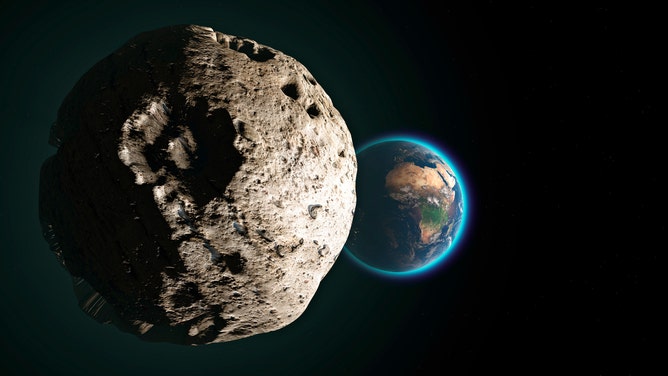
Meteorite approaching Earth, collision course. Asteroid. Possible collision with the earth’s atmosphere. 3d rendering. Elements of this image are furnished by NASA URL: https://visibleearth.nasa.gov/collection/1484/blue-marble Blender app
(Naeblys / Getty Images)
Because its outgassing was so faint, the object was initially suspected to be a “dark comet”—a space rock that vents gas without showing a tail. However, the deep-space imaging ultimately revealed a faint tail, proving it is actually an active comet in disguise.
SCIENTISTS DISCOVER THE SAME SUGAR FOUND IN RASPBERRIES DEEP IN SPACE FOR THE FIRST TIME
This breakthrough alerts researchers that other supposed asteroids or dark comets near Earth could be hiding faint activity, giving astronomers a way to spot and track their erratic shifts before they pose a threat.
WILL SPACEX LAND ANYTHING ON MARS BEFORE 2030?
“Detecting these perturbations can be an important diagnostic tool for planetary defense that will help understand which objects may be comets rather than asteroids, how their orbits evolve, and how that influences their Earth impact risks,” Farnocchia stated.