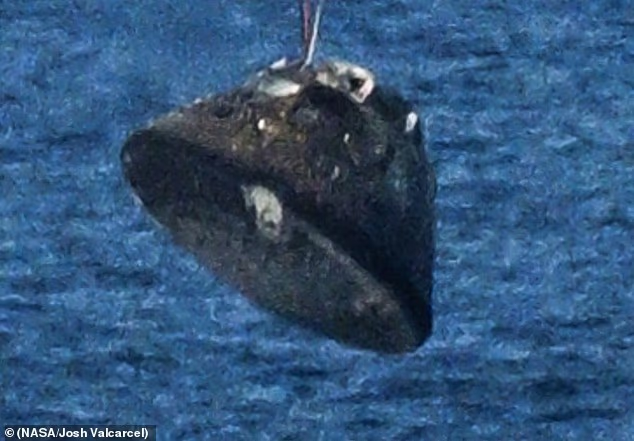
As the world watched the Artemis II capsule burn its way back to Earth, eagle–eyed social media users spotted a worrying detail.
Fans noticed what appeared to be a large patch of damaged or missing material on the Orion crew capsule’s heat shield.
This came after experts raised concerns that the three–inch–thick layer of insulating material could fall apart during re–entry.
Taking to X, one concerned commenter wrote: ‘It appears Orion was missing a fairly large chunk of its heat shield. Am I seeing things?’
Now, NASA has responded, reassuring that there’s no cause for concern.
According to the space agency, the discoloured ptach is really nothing more than a smudge of burned material.
‘As you would expect, engineers were eager to inspect the heat shield, starting with diver imagery shortly after splashdown and continuing with the review aboard the ship, NASA administrator, Jared Isaacman confirmed on X.
‘No unexpected conditions were observed. I suspect when the images are released, it will be pretty obvious the stark difference between Artemis I and Artemis II head shield performance.’
As the world watched the Artemis II capsule burn its way back to Earth, eagle–eyed social media users spotted a worrying detail. Fans noticed what appeared to be a large patch of damaged or missing material on the Orion crew capsule’s heat shield
The Orion crew capsule used for Artemis II has what is known as an ‘ablative’ heat shield made of a material called Avcoat.
The shield is designed to burn and crumble away as it is exposed to the heat of re–entry, redistributing the energy like the crumple zone of a car.
During Artemis I, this same heat shield material cracked far faster than NASA had expected, with large chunks breaking off during re–entry.
In response, NASA adjusted the re–entry trajectory for Artemis II, making a single steep dive rather than skipping like a stone along the edge of the atmosphere.
But there were still major concerns that NASA’s testing was insufficient, and that the crew could be exposed to dangerously high temperatures if the heat shield failed.
So, when the Orion crew capsule appeared to have a large patch of discoloured material, space enthusiasts leapt to the conclusion that a chunk had broken off.
On X, one commenter confidently predicted: ‘It is the ablative cover for the edge. It is designed to peel away.’
Another suggested: ‘The heat shield breaks off to take the heat with it, that’s what it was designed to do and that’s what it did. It worked perfectly.’

On social media, fans speculated that the white patch seen during splashdown could be a ‘fairly large chunk’ of missing heat shield

This speculation came amidst concerns about the heat shield’s integrity, after the same material lost large chunks during the Artemis I uncrewed test
As speculation gathered online, Mr Isaacman stepped in to lay the rumours to rest.
The NASA administrator wrote: ‘I am hesitant to get ahead of a proper data review, but I understand the space community’s curiosity, especially when imagery can give the impression of a problem.’
Mr Isaacman then confirmed that ‘the discoloration was not liberated material.’
‘The white color observed corresponds to the compression pad area and is consistent with the local geometry, AVCOAT byproducts, and transitional heating environments,’ he said.
‘We observed this behavior in arc jet testing and expected it in this compression pad area.’
While the heat shield looks solid, it actually has several holes that contain explosive bolts connecting Orion to the European Service Module during flight.
When the craft starts re–entry, the compression pad separates, leaving the titanium bolts exposed.
The titanium bolts are surrounded by an extra layer of heat shield, but they can still be eroded by the intense heat experienced during re–entry.

NASA Administrator Jared Isaacman took to social media to dispel any speculation, saying that ‘no unexpected conditions were observed’

As the Artemis II mission begins its return journey to Earth, experts have raised concerns over the safety of the Orion crew capsule’s heat shield. Pictured: the heat shield from the uncrewed Artemis I test
This could mean that the apparent discolouration is actually a patch of white titanium oxide, left behind by the burning bolts rather than damage to the heat shield.
Likewise, a freelance photographer named Matt Hartman, who was onboard the USS John P. Murtha when Orion was recovered, wrote on X: ‘The discoloration was exactly that ….discoloration……. no holes.’
If true, this would mean that the Orion heat shield didn’t crack or break up as some experts had feared.
Mr Isaacman continued: ‘We will complete a full data review across all systems, including the thermal protection system, and make the results publicly available.’
The NASA administrator did not comment on when those images or the report would be released to the public.
The Daily Mail has contacted NASA for comment.