NASA’s Chandra X-ray Observatory turns x-rays and data into sounds of planets around our solar system. These sonifications include x-rays from Chandra and data from Hubble, Cassini, and Keck telescopes.
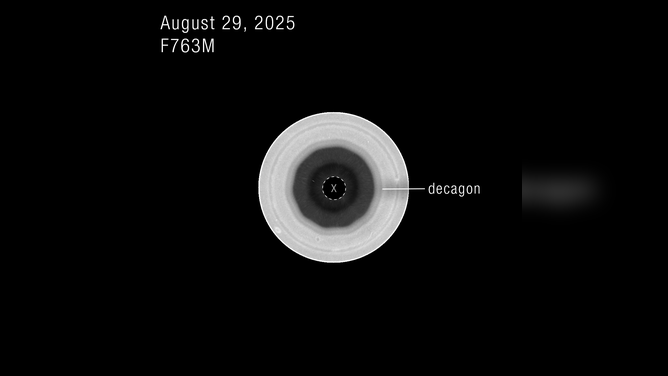
Recent observations discovered by NASA’s Hubble Space Telescope revealed a giant, evolving, 10-sided atmospheric wave encircling Saturn’s South Pole.
NASA said this discovery, called a decagon, is the first time a large regular-sided jet pattern has ever been seen in Saturn’s Southern Hemisphere.
Scientists said it’s very similar to the famous hexagon in Saturn’s Northern Hemisphere, but it’s different enough for them to believe that they are witnessing a new phenomenon in the atmosphere.
SEPTEMBER SKYWATCHING GUIDE: HARVEST MOON, BRIGHT VENUS, FALL EQUINOX AND MORE AHEAD
NASA said the wave sits within one of Saturn’s powerful jet streams and extends through multiple layers of the atmosphere, indicating it is not just a cloud-level feature, but a vertically extended atmospheric structure.
A single wavelength of light from NASA’s Hubble Space Telescope’s Wide Field Camera 3 provides a particularly clear view of the 10-sided atmospheric wave discovered encircling Saturn’s south pole.
(Image: NASA, ESA, STScI, Agustin Sánchez-Lavega (UPV), Amy Simon (NASA-GSFC), Michael Wong (UC Berkeley); Image Processing: Alyssa Pagan / NASA)
Researchers pieced together images from Hubble dating back to 2023 and noticed subtle signs that the structure was beginning to emerge before it became a clear pattern.
NASA said the observations were taken as part of Hubble’s Outer Planet Atmospheres Legacy (OPAL) program, which has photographed the outer planets every year for more than a decade.
NASA’S PANDORA MISSION AIMS TO UNCOVER ATMOSPHERIC SECRETS OF MORE THAN 20 ALIEN WORLDS
Their findings were published in the Journal Science Advances.
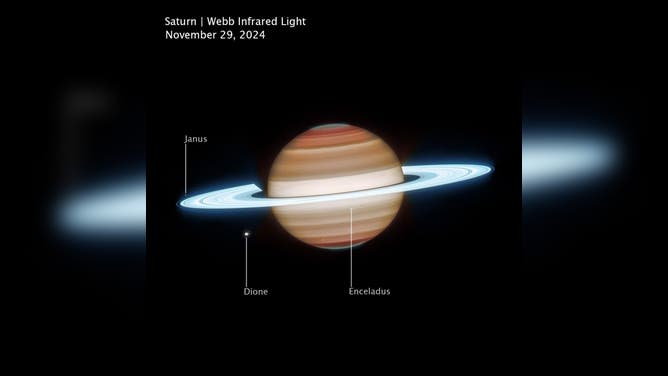
This infrared view of Saturn was captured Nov. 29, 2024, by NASA’s James Webb Space Telescope.
(Image: NASA, ESA, CSA, STScI; Image Processing: Joseph DePasquale (STScI) / NASA)
“We’ve never seen anything quite like this in Saturn’s Southern Hemisphere,” Amy Simon, study co-author and OPAL principal investigator, NASA’s Goddard Space Flight Center in Greenbelt, Maryland, said.
NASA’S SWIFT TELESCOPE IS RUNNING OUT OF TIME AS CRITICAL OCTOBER DEADLINE APPROACHES
“The northern hexagon has been there every time we’ve looked for more than 40 years. This feature is different — it appears to be strengthening, giving us the rare opportunity to watch a giant atmospheric pattern develop,” Simon continued.
Saturn’s changing seasons gradually brought the view of the South Pole back into view from Earth, where astronomers who collectively analyzed images of Saturn from ground-based observatories first identified it, NASA said.
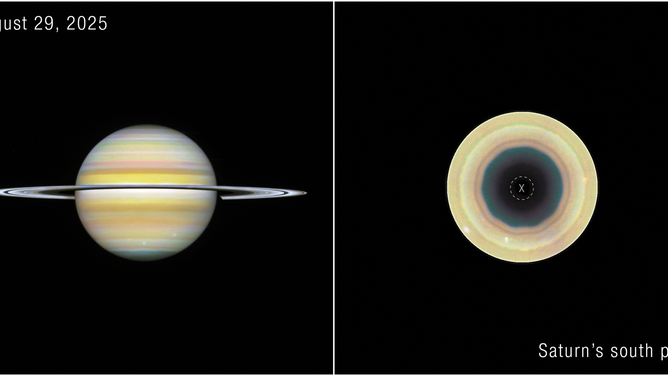
Two views of Saturn from NASA’s Hubble Space Telescope reveal a giant, evolving 10-sided atmospheric wave encircling the planet’s south pole
(Image: NASA, ESA, STScI, Agustin Sánchez-Lavega (UPV), Amy Simon (NASA-GSFC), Michael Wong (UC Berkeley); Image Processing: Alyssa Pagan / NASA)
After that, Hubble observations came into the picture. Hubble’s view from space offered unmatched image sharpness and spatial resolution over the full rotation of Saturn, without smearing by Earth’s atmosphere, according to NASA.
“Given Saturn’s symmetry in its north-south jet stream system, we have been searching for a counterpart to Saturn’s northern hexagon on the South Pole in Hubble images since 1990,” Agustín Sánchez-Lavega, lead author of the new study, said.
“Images from NASA’s Cassini spacecraft, which orbited Saturn between 2004 and 2017, showed no inkling of a long-lived formation, either. The Hubble data confirmed the feature’s presence back to 2023,” Sánchez-Lavega continued.
Scientists believe the wave formed somewhat recently, but further study is needed from Hubble and NASA’s James Webb Space Telescope, as well as analysis of computer models, are needed to help learn when it was formed.