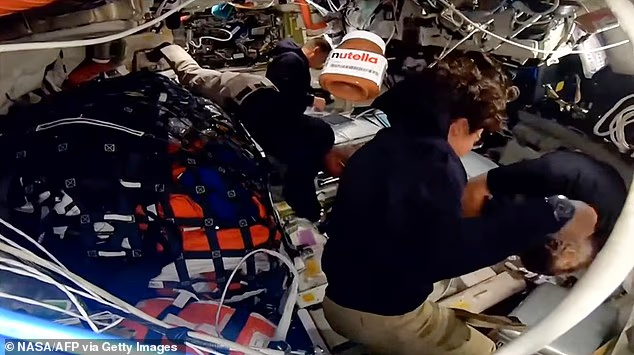
A video of a pot of Nutella floating around the Orion capsule has been dubbed the ‘greatest free advert in history’.
The hilarious footage was inadvertedly captured by NASA as its four Artemis II astronauts slingshotted around the moon.
A huge pot of the chocolate spread can be seen floating past Christina Koch, with the label perfectly displayed to the camera.
‘I never thought my daily childhood spread would be floating in a space craft around the moon,’ one shocked viewer tweeted.
Another added: ‘Nutella got to the moon before most countries did.’
And one joked: ‘Zero gravity, maximum brand exposure!’
Now, even Nutella has joined in on the fun.
Taking to X, it said: ‘Honored to have traveled further than any spread in history. Taking spreading smiles to new heights.’
A video of a pot of Nutella floating around the Orion capsule has been dubbed the ‘greatest free advert in history’
The hilarious moment took place just three minutes and 55 seconds before the Artemis II crew topped Apollo’s record to become the humans who have travelled the farthest from our planet.
The footage has garnered huge interest across X, with many viewers shocked that a jar of Nutella had made it to the moon’s orbit.
‘Bit risky taking a jar! Couldn’t it break if it hits the side??’ one user asked, before others pointed out that the jar is likely made from plastic instead of glass.
Another joked: ‘floating nutella cameo in the middle of a pivotal moment in the artemis II mission is FRYING me.’
And one quipped: ‘What an advert for Nutella!! 252000 miles away in space!’
Believe it or not, Nutella is just one of nine condiments on board the Orion capsule.
Ahead of the mission, NASA released the crew’s menu, confirming they’d have access to maple syrup, peanut butter, hot sauce, spicy mustard, strawberry jam, honey, cinnamon, and almond butter – as well as chocolate spread.
In addition, more than 10 types of beverages are available, including mango–peach smoothies, lemonade, apple cider and hot chocolate, as well as enough coffee for 43 cups.

The hilarious moment took place just three minutes and 55 seconds before the Artemis II crew topped Apollo’s record to become the humans who have travelled the farthest from our planet

Ahead of the mission, NASA released the crew’s menu, confirming they’d have access to maple syrup, peanut butter, hot sauce, spicy mustard, strawberry jam, honey, cinnamon, and almond butter – as well as chocolate spread
For breakfast, the team has been tucking into sausages, granola with blueberries or a tropical fruit salad.
Meanwhile, lunch and dinner items include vegetable quiche, BBQ beef brisket, spicy green beans, broccoli au gratin and macaroni and cheese – alongside the 58 tortillas that have been loaded for the journey.
Having swung around the moon, the crew – Reid Wiseman, Victor Glover and Christina Koch, and Jeremy Hansen – have set a new record for traveling 252,756 miles from Earth.
The astronauts completed the six–hour flyby after flying behind the moon, becoming the first humans in more than half a century to witness the distant hemisphere with the naked eye.
Communication was cut off at 6.43pm ET as the Orion spacecraft slipped behind the moon, triggering a planned blackout caused by the lunar surface blocking radio signals between the spacecraft and antennas on Earth.
Inside the capsule, the astronauts continued along their pre–programmed flight path without real–time guidance from Mission Control.
Instead, they relied entirely on onboard systems during one of the mission’s most dramatic phases.
Known as a loss of signal, the blackout is a routine part of lunar missions, but it remains one of the most tense moments as crews move completely out of Earth’s reach while hidden behind the moon.
‘We will see you on the other side,’ Mr Glover said moments after referencing the teachings of Jesus, including the message to love your neighbour as yourself, just before communication with the ground team was lost.
Thankfully, contact was restored roughly 40 minutes later as Orion reappeared from behind the moon, officially ending the flyby.
The astronauts have now started their journey back to Earth, with splashdown expected Friday.