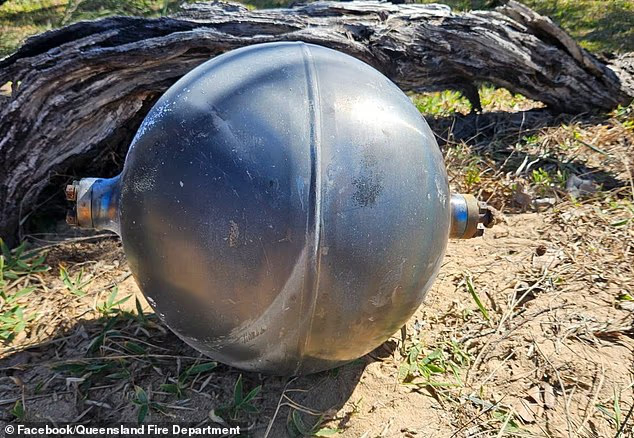
Six mysterious metal balls that washed up on an Australian beach this weekend are from a space launch vehicle, experts have confirmed.
On Friday, emergency services were alerted to the strange discovery of three bizarre spheres on Forrest Beach in Queensland.
A fourth was found on Saturday and two more on Sunday, prompting a 50-metre exclusion zone and urgent warnings to members of the public not to approach or touch the ‘potentially hazardous objects’.
The Australian Space Agency (ASA) has now revealed the unusual spheres are likely from a ‘foreign rocket body’ that had recently re-entered the atmosphere after being in orbit.
The objects are probably pressurised vessels used to store rocket fuel or gases and are among the most common pieces of space debris to survive re-entry, experts revealed.
‘The recovered objects appear to be pressure vessels from a space launch vehicle,’ the ASA said in a statement.
‘The Agency has identified the likely source. The objects’ location and characteristics are consistent with debris from a foreign rocket body that recently re-entered the atmosphere from orbit.
‘The Agency is continuing to engage with international authorities to formally confirm the launch vehicle and launching state. Queensland emergency responders have assessed and recovered the objects and determined them to be safe.’
On Friday, emergency services were alerted to the strange discovery of three bizarre spheres on Forrest Beach in Queensland

This prompted a 50-metre exclusion zone and urgent warnings to members of the public not to approach or touch the ‘potentially hazardous objects’
Pressure vessels on a space launch vehicle are specialised, highly engineered containers designed to hold liquid gases at extreme pressures.
Their primary functions include storing cryogenic propellants such as liquid oxygen and holding pressurant gases such as helium to feed the engines.
More than 36,000 pieces of space junk larger than 10cm are currently tracked in orbit by international agencies, while millions of smaller fragments also circle the Earth.
Most eventually burn up harmlessly in the atmosphere, but dense components such as pressure vessels can sometimes survive the fiery descent because they are designed to withstand enormous internal pressures.
Their spherical shape and thick metal walls also help them endure the extreme temperatures experienced as spacecraft plunge back through Earth’s atmosphere.
Flinders University Associate Professor Alice Gorman is a space archaeologist who researches space junk and orbital debris.
She said the spherical pressure vessels were one of the most commonly discovered pieces of space junk and are nicknamed ‘space balls’.
‘This is a classic example of what is known as “space balls”,’ she told ABC News. ‘Many rockets and spacecraft have liquid fuel systems that involve fuels under high pressure that are in these pressure vessels made of robust material.’

The spheres are likely pressurised vessels used to store rocket fuel or gases, and are among the most common pieces of space debris to survive re-entry
The ASA has warned that further potentially hazardous debris may be found.
‘Never touch, move, or recover suspected space debris and assume it to be hazardous — move away and contact emergency services,’ it said.
This is not the first time that mysterious objects have been spotted on Australia’s shoreline.
In 2023, India confirmed that a giant metal dome that washed up on a Western Australian beach near Perth was from one of its rockets.
A spherical object similar to those discovered this weekend was also found in remote grassland in Namibia, southern Africa, in 2011.
Experts at the time said they believed it was most likely a fuel tank or bladder tank containing hydrazine – a highly volatile propellant – from an unmanned rocket.