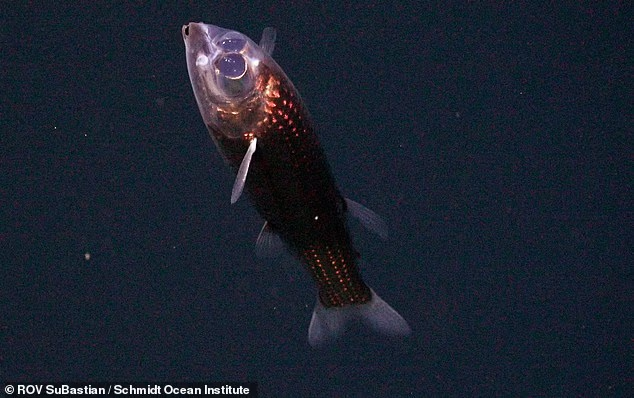
One of the ocean’s eeriest creatures has emerged from the darkness.
Scientists have captured the first ever footage of a rare species of barreleye fish alive in its natural habitat.
The bizarre animal, called Winteria telescopa, was filmed during a month-long expedition to the Doldrums Megatransform and Fracture Zone, one of the least-explored parts of the Atlantic Ocean.
Researchers at the Schmidt Ocean Institute spotted the fish swimming at a depth of around 2,300 feet (710 metres) using the remotely operated vehicle SuBastian.
At that depth, sunlight is little more than a faint glow, creating an eerie twilight world unlike anywhere closer to the surface.
Barreleye fish are famous for their extraordinary transparent heads, which allow scientists to see their unusual eyes inside the skull.
Instead of facing sideways like most fish, their tube-shaped eyes point upwards to detect the faintest traces of light filtering down from above.
Their specialised eyes also help the fish spot flashes of bioluminescence produced by prey in the darkness.
Scientists have captured the first ever footage of a rare species of barreleye fish alive in its natural habitat


Barreleye fish are famous for their extraordinary transparent heads, which allow scientists to see their unusual eyes inside the skull. Those specialised eyes also help the fish spot flashes of bioluminescence produced by prey in the darkness
Scientists say the delicate, transparent dome over the fish’s head often collapses when specimens are brought to the surface in nets.
As a result, almost everything we know about them has come from damaged specimens rather than living animals.
Seeing Winteria telescopa alive gives experts a rare chance to observe how it behaves in its natural environment.
Most barreleyes live between 600 and 1,000 metres below the surface, in the mesopelagic or ‘twilight zone’ where only a tiny fraction of sunlight penetrates.
Rather than scanning horizontally like most fish, barreleyes spend much of their time looking upwards.
This helps them spot the silhouettes of jellyfish, squid and other prey swimming above them against the faint light filtering down.
Scientists think barreleyes are opportunistic feeders that sometimes pluck small animals trapped in the tentacles of siphonophores and jellyfish.
Their transparent shield may even protect their eyes from stinging cells while they raid these floating predators.

The team also discovered two previously unknown hydrothermal vent fields hidden deep within the fracture zone

Researchers also encountered two elusive bigfin squid, another rarely seen deep-sea species with incredibly long, thread-like tentacles
Despite their alien appearance, most barreleye fish are only around four to six inches (10 to 15 centimetres) long – about the size of a banana.
The barreleye fish was just one of several remarkable discoveries made during the expedition.
The team also discovered two previously unknown hydrothermal vent fields hidden deep within the fracture zone.
These vents release hot, mineral-rich fluids that support thriving ecosystems without any sunlight.
Researchers also encountered two elusive bigfin squid, another rarely seen deep-sea species with incredibly long, thread-like tentacles.
‘We arrived searching for vents, faults, and seamounts,’ said Dr. Paula Zapata Ramirez, assistant professor at the Universidad Pontificia Bolivariana.
‘We leave with something even more valuable: a deeper understanding of ecosystems in one of the least explored regions of the Atlantic Ocean.
‘Every sample, every image, and every discovery brings us one step closer to understanding the hidden parts of our planet.’