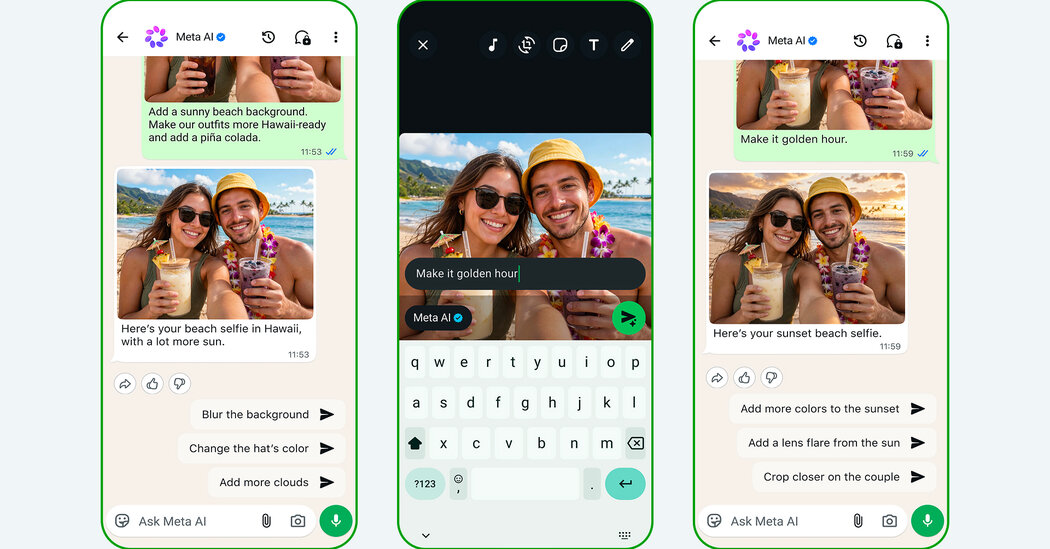
Meta on Tuesday released an artificial intelligence tool that can generate images, the company’s latest push to integrate the technology into more aspects of its social media business and catch up with rivals in a global A.I. race.
The new A.I. image model, Muse Image, is available on Instagram and WhatsApp, the company said. Users can generate A.I. photos similar to those they would normally post, including vacation selfies from a beach or a reel from a photo booth.
“Muse Image acts as the creative partner that knows your world, making it easy to turn your ideas into high-quality visuals,” the company said in a blog post. It added, “One tap restores an old family photo, lets you see yourself with trending hairstyles, or reimagines you as a claymation character.”
The company also previewed an A.I. video generator, Muse Video. It will become available to the public in the coming months in the Meta AI app, the stand-alone platform for Meta’s A.I. chatbot.
Muse Image is the first A.I. image generator created under the company’s new A.I. division, Meta Superintelligence Labs. After Meta fell behind in the A.I. race last spring, Mark Zuckerberg, the chief executive, spent billions of dollars revamping the division in an attempt to compete with Google, Anthropic, OpenAI and others.
In the last year, Meta has slowly narrowed the gap. But Muse Spark, its top chatbot model, released in April, still lags rivals.
Meta’s release of new A.I. image and video tools follows the rest of the industry’s shift to tools that can write code. OpenAI shut down Sora, which made A.I. videos, in March as the company said it would focus its resources elsewhere.
Meta, which owns Facebook and Threads in addition to Instagram and WhatsApp, plans to invest up to $145 billion in A.I. this year as part of its efforts to transform itself into an A.I. company. Meta is also increasingly relying on A.I. to moderate content on its social media platforms, as well as to offer customer service.
The company is also asking employees to use A.I. tools to speed up their work as it lays off thousands to help offset spending on the technology.
Meta’s embrace of A.I. has not always been smooth. Last month, a bug in the company’s A.I. customer service software let hackers attack more than 34,000 Instagram accounts. Internal A.I. tracking software has also hurt morale among Meta’s rank-and-file employees.
Muse Image will replace technology from Midjourney, an A.I. start-up that Meta previously worked with to generate A.I. images, in the Meta AI app.
Users can tag friends in the app to create “personalized birthday cards, group trip memes or playful edits” based on their friends’ Instagram accounts, the company said. In the coming weeks, advertisers will be able to use the new A.I. model to make ads.
Alexandr Wang, Meta’s chief A.I. officer, has said publicly that his A.I. division is planning to release a new cutting-edge model, called Watermelon internally, in the coming months. Watermelon is on track to perform as well as OpenAI’s latest model, Mr. Wang said at a staff meeting last week.