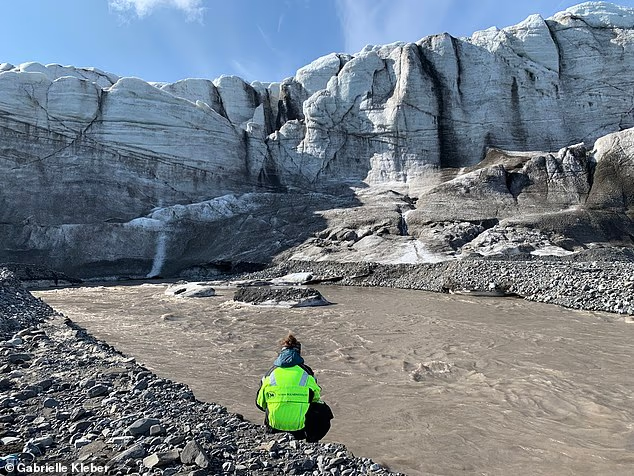
Melting Arctic glaciers are creating a ‘doom loop’ by flushing ancient methane out from the rocks beneath the ice, a study has found.
Researchers collected 148 water samples from 19 glacier–fed rivers across Svalbard, a remote Norwegian archipelago in the Arctic Ocean.
Every single river tested had more methane than would be expected from contact with the air alone.
Shockingly, the most contaminated waterways contained up to 425 times the level of methane that would normally be expected.
Methane is a powerful greenhouse gas which escapes from rivers into the atmosphere, where it contributes to global warming.
As the planet warms and glaciers melt faster, more methane will be released, leading to yet faster warming and even greater melting.
Lead author Dr Gabrielle Kleber, a researcher with the iC3 Polar Research Hub, says: ‘The amounts reported here are small compared with human–caused emissions from fossil fuels, farming and waste.
‘But they matter because they reveal a natural feedback loop that is not confined to Svalbard, and that may grow as the Arctic warms.’
Melting Arctic glaciers are creating a ‘doom loop’ by flushing methane out into rivers. Pictured: A glacial river on Svalbard
Importantly, the researchers found that this methane is not being created by microbes under the ice, as has been found to be the case in Greenland.
The teamanalysed the types of carbon found in the water, revealing that many contained propane and ethane in addition to methane.
This is exactly what you would expect to find if the methane has a geological source, rather than a biological one.
Many parts of the Svalbard archipelago contain layers of old shale rock that is rich in organic carbon.
Over millions of years, heat and pressure beneath the ground can transform this carbon into methane as well as other gases like propane and ethane.
Dr Kleber says: These glaciers are mostly melting on their surfaces, but this meltwater finds its way to the bottom of the glaciers through crevasses and holes.
‘This means that it interacts with the rocks underneath, and where those rocks contain ancient gas, the water can flush methane out into rivers.’
The researchers estimate that land–terminating glaciers across Svalbard may transport roughly 182 to 368 tonnes of methane per year in meltwater.

Scientists used water samples and ground–penetrating radar measurements (pictured) to show that water from melting glaciers is flushing out ancient methane from the rocks below
This is particularly worrying for the Arctic because methane is an especially powerful greenhouse gas.
Over 100 years, a kilogram of methane is 21 times more effective than a kilogram of CO2 at trapping heat in the Earth’s atmosphere.
That is in addition to previous, much higher estimates for the amount of methane being released by groundwater springs in front of glaciers.
Using ground–penetrating radar, the researchers also mapped the ice conditions in some of the glaciers to see which factors led to the highest methane emissions.
The most methane–rich waters tended to come from glaciers resting on rich seams of shale, but the state of the glacier itself also played a major role.
Co–author Leonard Magerl, from UiT The Arctic University of Norway, says: ‘The temperature at the base of glaciers is an important piece of the puzzle.
‘We found that the biggest methane releases happened where the right rocks and the right glacier conditions came together.’
The big concern is that this additional boost of greenhouse gases will accelerate the already rapid melting of Arctic glaciers and cause yet more methane to be released.

Some rivers had up to 425 times the levels of methane that would be expected if they were simply absorbing the greenhouse gas from the atmosphere. Pictured: Scientists take a sample from a glacial river on Svalbard

Previous studies have shown that Arctic glaciers like the Geikie Plateau in eastern Greenland (pictured) contain almost twice as much ice as previously estimated, creating a significant risk that rapid melting will raise sea levels significantly
As glaciers retreat and thin, more meltwater may reach their beds and come into contact with fractured rock, sediment and groundwater, flushing out more methane.
If that does lead to accelerated melting in the Arctic, the resulting sea level rise could trigger severe consequences for the rest of the world.
The Greenland Ice Sheet, which sits within the Arctic Circle, contains enough fresh water to raise sea levels by 23 feet (7.4m) if it were to melt entirely.
With recent research estimating that more than 100 million people currently live below sea level, this could cause a catastrophic displacement of people from coastal regions.
However, the researchers aren’t yet totally sure whether this cycle will keep on accelerating into the future.
Some Svalbard glaciers are actually getting colder at their bases as they shrink and melt at the surface.
If a glacier becomes frozen to the bedrock, its ability to flush methane out into rivers could diminish.
Dr Kleber adds: ‘Our results show that future methane release will depend on both geology and glacier change. That makes it important to know what lies beneath the ice, not only how fast the ice is melting.’