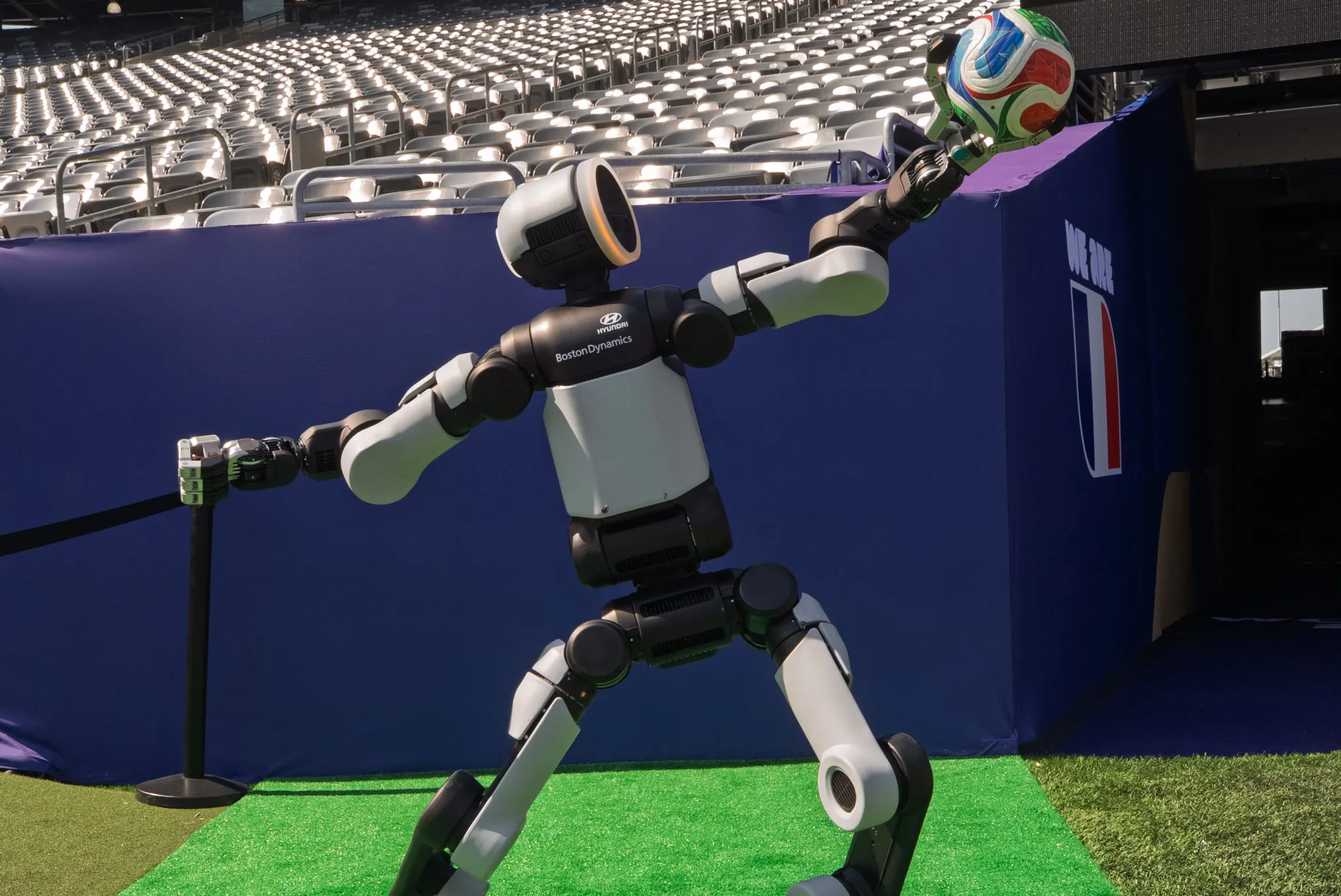
Before Brazil and Norway retook the pitch at New York/New Jersey Stadium for their Round of 16 match on Saturday, something happened at halftime that had never occurred in FIFA World Cup history. A five-foot humanoid robot walked pitchside, performed goal celebrations in the style of Harry Kane, Erling Haaland, Matheus Cunha, and Son Heung-min, then turned to the referee and handed over the match ball.
The robot’s name is Atlas. Built by Boston Dynamics, its appearance at the World Cup—in front of 80,000 people in the stadium and a global television audience—was a process five years in the making.
“By placing Atlas at the heart of football’s most sacred ritual, we made a statement no commercial ever could,” Sungwon Jee, Hyundai Motor Company’s executive vice president and global chief marketing officer, told Fortune. Hyundai Motor Company, which owns Boston Dynamics, has sponsored FIFA for 27 years. “The ball delivery,” Jee said, is “the moment Atlas enters public consciousness for the first time—the beginning of that journey toward becoming a partner that supports people in meaningful ways.”
A robot that isn’t programmed but trained
Atlas is a fifth-generation humanoid robot: fully electric, roughly human-sized, and designed from the ground up for what Boston Dynamics calls the most taxing industrial work. It has 56 degrees of freedom—meaning 56 independent points of articulation across its body—a 2.3-meter reach, and can lift up to 110 pounds. It can swap its own batteries autonomously, so it doesn’t need to stop working when it runs low. But here’s where the soccer training comes in: Atlas isn’t programmed, but rather, is trained and learns how to act.
“It used to be programmed,” Alberto Rodriguez, Boston Dynamics’ director of robot behavior, told Fortune. “Now it’s no longer programmed—it’s learned,” he said, explaining how the robot operates closer to how LLMs learn than how a factory robot arm is programmed. A programmed robot executes a fixed sequence of instructions, but a trained robot develops behaviors after learning to adapt to variables.
Before Atlas ever touched a ball, it watched film. The robot was shown footage of professional footballers performing drills and movements, studying the mechanics of the sport the way a player might review game tape. In addition, human motion-capture data, including recordings of Boston Dynamics’ own engineers suited up and running through the moves themselves, was fed into a physics-based simulation. That enabled Atlas to run through the same actions millions of times in parallel across cloud GPUs, learning to adapt to imperfect conditions until the behavior held up reliably. What would take a human athlete roughly a year of physical trial and error to develop, Atlas worked through in about 24 hours.
Preparing Atlas for the World Cup required solving problems that had never come up in a factory or a lab, like the pitch.
“Grass has that interesting property where sometimes you slip, but sometimes your feet can get caught on it,” Rodriguez said. “We’ve had to change the training regime for how Atlas learns to walk and run to make sure that it can do it well on concrete, but also on complex surfaces like grass.”
Engineers start with a human demonstration that is sometimes recorded via motion capture of the movement they want Atlas to learn. It becomes a guiding reference, and Atlas is then put through simulated repetitions of the task under deliberately hostile conditions: the ground friction changes without warning, the ball appears in the wrong position, Atlas is told its own feet are a different size than they actually are. The system has to figure out how to execute the task anyway.
“We keep pushing it around, or lying to it about where the ball is, or putting obstacles on the ground, or changing the friction with the ground,” Rodriguez said. “It kind of has to not just learn to do something, but learn to adapt to whatever conditions it’s actually going to encounter in the real world.”
The result is what Rodriguez calls “muscle memory,” simple behaviors that are too fast to reason about in the moment and executed from trained instinct rather than real-time calculation.
“We’ve shown that this brand-new humanoid hardware can perform in the most extreme environments, operating reliably in record high temperatures, performing exciting and engaging athletic feats,” Rodriguez said. “The more the public sees robotics doing things they never thought possible, in person, the more prepared they will be as these robots become more and more a part of our daily lives.”
A motor company takes on robotics
Hyundai Motor Group acquired a controlling stake in Boston Dynamics from SoftBank in 2021. Since then, the company’s ambitions for the robotics arm have grown substantially more concrete. Hyundai has committed to a $26 billion investment in the United States over four years, including a dedicated robotics manufacturing facility near Savannah, Georgia, capable of producing 30,000 Atlas units annually by 2028. Atlas is already being tested in Hyundai factory settings, with an initial focus on part sequencing in automotive manufacturing.
“We see robotics not as a side venture, but as a strategic capability that will shape how we compete,” Jee said. “Mobility isn’t just about cars anymore. It’s about autonomous systems, robotics, and smart infrastructure.”
“The World Cup marks a pivot point where we move from internal exploration to public demonstration,” Jee said.