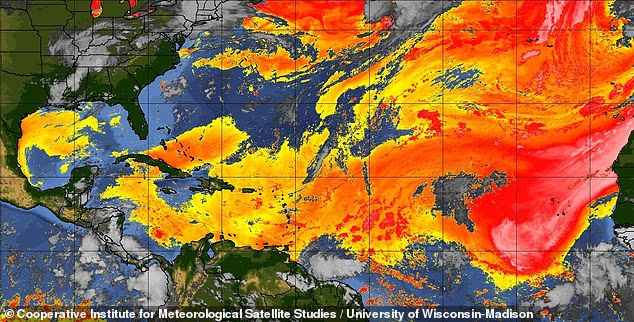
A massive plume of Saharan dust is making its way across the Atlantic and is expected to reach parts of the southeastern US in the coming days.
The vast cloud consists of extremely dry, dust-filled air that forms over the Sahara Desert before being carried thousands of miles westward by strong winds.
Light to moderate Saharan dust has already begun drifting into South Florida, including the Miami area, creating hazy skies, suppressing thunderstorm activity and contributing to hotter, drier conditions.
Forecasters said a drier air mass, fueled by an approaching plume of Saharan dust, will move into the region beginning Tuesday.
The dust is expected to continue filtering across the state through the week, with its effects becoming increasingly noticeable by midweek.
Saharan dust contains fine particles, PM10 and especially PM2.5, minerals like quartz and feldspar, and sometimes microbes or pollutants picked up during transport.
These can be inhaled deep into the lungs or enter the bloodstream, causing respiratory and cardiovascular issues.
Other impacts include eye, nose, skin and throat irritation, headaches, fatigue and allergic reactions.
Forecasters said a drier air mass, fueled by an approaching plume of Saharan dust, will move into the region beginning Tuesday
The Miami-Dade County Department of Environmental Resources Management has issued an Air Quality Alert for fine particulate pollution that will remain in effect until 3pm ET Tuesday.
The alert covers inland, metropolitan, coastal and far southern portions of Miami-Dade County, including Miami, Hialeah, Kendall, Kendale Lakes, Carol City, Florida City, Redland, Fortymile Bend, Shark Valley Observation Tower, Pa-Hay Okee Overlook, Mahogany Hammock and Royal Palm Ranger Station.
Officials warned that concentrations of fine particulate matter may approach or exceed levels considered unhealthy, potentially affecting air quality across the region.
The greatest impacts of the Sahara dust are forecast from the middle of the week into the weekend as high pressure builds and additional dust arrives from the Atlantic.
Conditions are expected to gradually improve later in the week as moisture returns, although Saharan dust outbreaks are common across the southeastern US during the summer months.
Forecasters warned the plume could worsen conditions during an ongoing heat wave.
The NWS said temperatures will continue to climb into the mid-90s, while heat index values could reach between 105 and 110 degrees.
The arrival of the plume also means quiet hurricane activity.

Pictured is a scene on Crete Island when dust from the Sahara engulfed the region in April
As the dust travels toward the US, a dry pocket of air forms thousands of feet above sea level, bringing drier air and hotter conditions, suppressing tropical developments like hurricanes by removing the moisture they need to form.
Each summer, seasonal weather patterns like the West African Monsoon and high-pressure systems create strong winds that sweep across the Sahara.
These winds pick up tiny particles known as aeolian dust and lift them into the atmosphere.
Meanwhile, the Bermuda-Azores High, a high-pressure system over the Atlantic Ocean, produces steady east-to-west winds that help carry the dust across the ocean.
Another pattern, the African Easterly Jet, helps push the dust higher into the air and even farther west.
Together, these wind systems can transport Saharan dust over 5,000 miles, often reaching the Caribbean, Florida, and the Gulf Coast.
Dust activity usually peaks between June and mid-August, though the amount of dust varies from year to year.