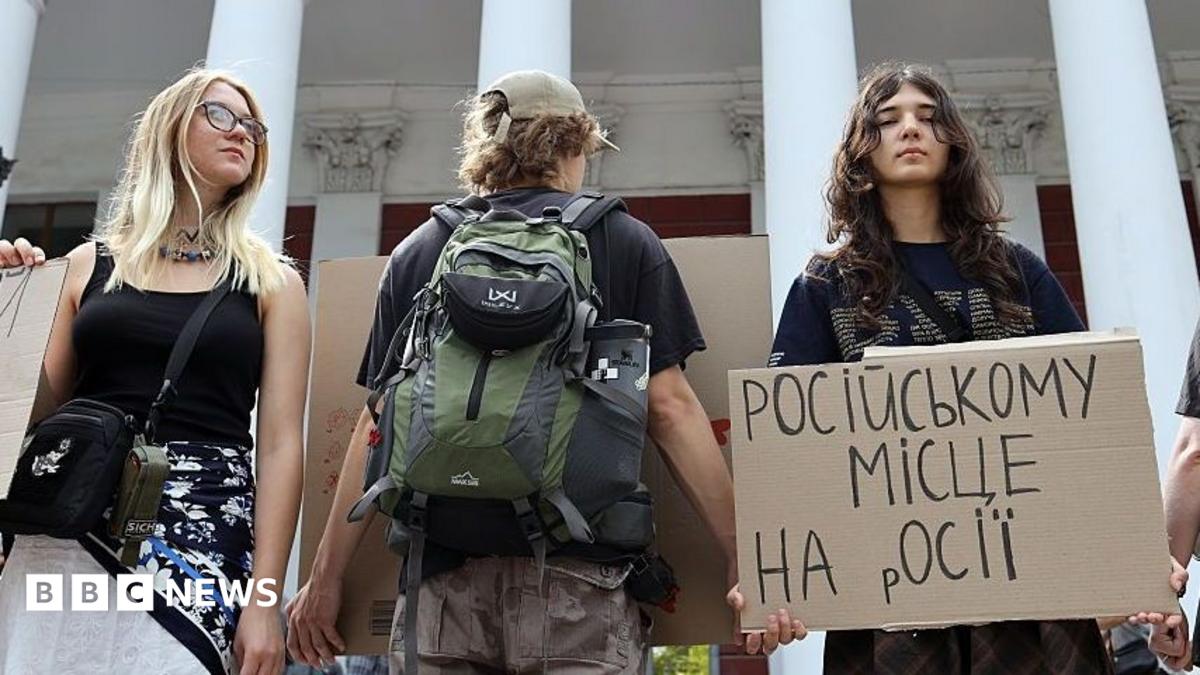
Public playing of songs by Russian citizens is already illegal across Ukraine, with exceptions for some artists who have publicly condemned the war, but Russian-language songs composed or performed by Ukrainians are still allowed.
Under the proposals they would also be banned in public places.
Anna Nerush said it would not affect someone celebrating their birthday in Russian in a private room in a restaurant, as it could not be heard outside.
“But on the streets, [hearing] the Russian language can be a real trigger, for example to [former] prisoners of war and people who’ve come from occupied territories,” she said.
Many native Russian-speakers in Ukraine have switched to Ukrainian in recent years, particularly since Russia’s full-scale invasion in 2022.
Photographer Natalia Mykhailenko switched even earlier. She has led tours of Odesa highlighting non-Russian elements of its history.
These include landmarks such as a Cossack cemetery that dates back to before 1794. That is the year Russian empress Catherine the Great is said to have founded the city, although it has been widely questioned in recent years.
A statue of Catherine was removed from a central Odesa square after a council vote in 2022, and streets have been renamed to commemorate some Ukrainian writers and activists.
“We must understand we were a colony,” said Mykhailenko. “And these [language] laws are very important. I understand it’s maybe sometimes not democratic. But without it, there will be no normal Ukraine in the future.”
Anthropologist Anastasia Piliavsky, part of a group called Ukrainian Cosmopolis which aims to defend freedom of thought and speech, believes Russian-speakers are being made to feel like second-class citizens who are deprived of their heritage.
“In Ukraine, the vast majority of people understand both Russian and Ukrainian. So the question is not really one of language, it’s one of liberty,” she said.
“Ukraine has been fighting for freedom. The point of this war is not to be under authoritarian rule. That’s what Russia has to offer. So when fines, or the threat of being fired [for breaking language laws] arrives, then people start wondering: what are we fighting for?”