Geoff Bennett:
There were several developments today in the ongoing redistricting battle. Missouri’s Supreme Court cleared the way for a new map supported by President Trump that could net the GOP an additional seat in Congress.
But, in South Carolina, efforts to redraw that state’s map stalled after that state’s Senate failed to reach the required two-thirds majority. Five Republicans joined Democrats in opposing the proposal.
And, in Louisiana, lawmakers there are pressing ahead with a new redistricting plan just days before the state’s now-delayed House primary elections. All of it comes as the U.S. Supreme Court has continued to narrow key protections in the Voting Rights Act.
As Liz Landers reports for our Race Matters series, once the lines are finalized in Louisiana, the political consequences will be measured not only in red and blue, but also in black and white.
Protesters:
Whose house?
Protesters:
Our house!
Protesters:
Whose house?
Protesters:
Our house!
Liz Landers:
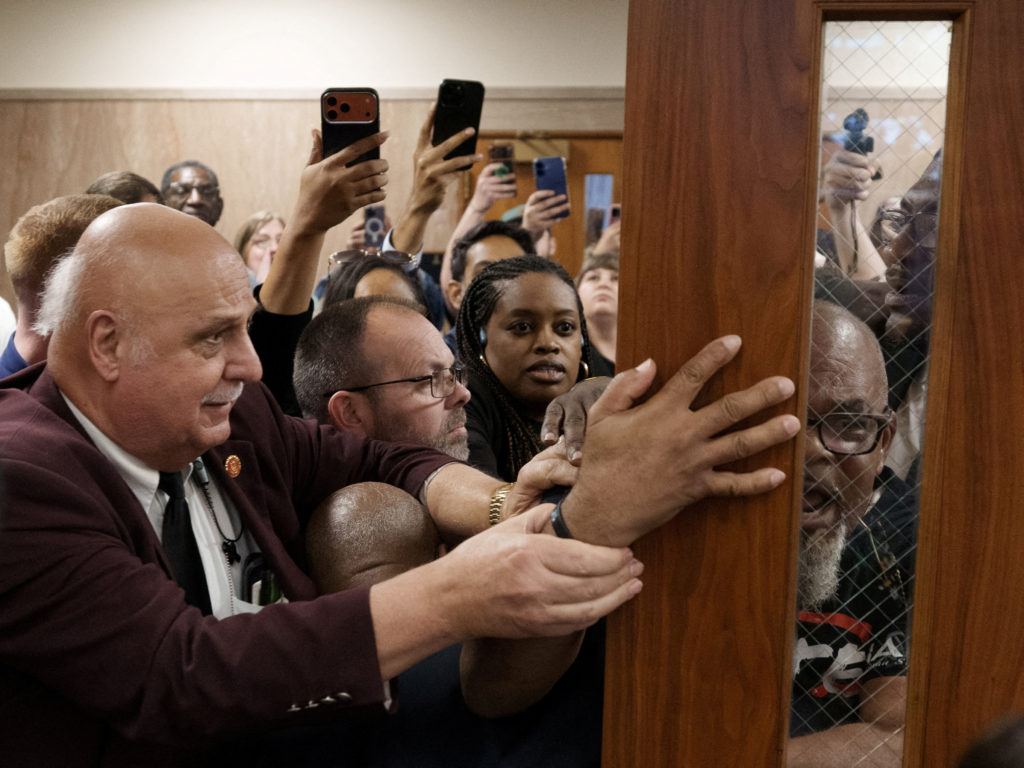
Protests outside the state capitol echo the heated debate inside, as lawmakers deliberate over how political dividing lines are drawn.
Protesters:
Shut it down!
Liz Landers:
This is the Louisiana Statehouse. The Senate and the Governmental Affairs Committee here has started the process of redrawing the congressional maps in this state. Hundreds of people have shown up for the public testimony.
Just a couple weeks ago, the U.S. Supreme Court struck down Louisiana’s congressional map, the conservative justices narrowing the Voting Rights Act and a provision protecting minority voting power when states draw district lines, as Louisiana did when it carved out a second majority-minority district in 2024.
That sent state lawmakers back to the drawing board, where they may eliminate one or both of the seats, both held by Black Democrats. A map like this would give U.S. House Speaker Mike Johnson, whose Louisiana seat they will protect, a better chance of holding on to his Republican majority and gavel next year.
Rep. Mike Johnson (R-LA):
And I think all states who have unconstitutional maps should look at that very carefully. And I think they should do it before the midterm.
Liz Landers:
The fallout from the Supreme Court’s decision isn’t limited to Louisiana. In the days that followed, Republicans in Alabama, Mississippi, South Carolina and Tennessee began the process of shifting districts in their political favor, joining an unparalleled mid-decade redistricting fight that has the potential to net 10 or more seats for the GOP in November.
Back in the bayou, the state’s primary elections were already under way when Republican Governor Jeff Landry declared a state of emergency, suspending the House races so new boundaries could be drawn. In the past, new maps would often take effect for the next election.
But Landry told “60 Minutes” Louisiana couldn’t wait.
Gov. Jeff Landry (R-LA):
The highest court in the land says the map that you have is unconstitutional, so we don’t have a map under which our voters can vote on. If anybody has a grievance, take it to the United States Supreme Court.
Liz Landers:
Just outside the crowd of protesters, Jonathan Davis, a small business owner involved in Republican politics, says the race cancellation is weird, but the court’s decision was overdue.
Jonathan Davis, Republican Voter:
I would look at that as this was supposed to happen previously. We should have gotten rid of the racist districts a long time ago and made sure that people could have equal representation among the voters.
Liz Landers:
On the other side of the political aisle, Democratic Congressman Troy Carter is waiting to see if a new map will erase his base of support.
Are you worried that you’re going to lose your seat?
Rep. Troy Carter (D-LA):
No, I’m not worried about me at all. I’m worried about us. This is not a singular battle. This is about the people. African Americans have the right to choose the person of their choice to represent them. But that means you can’t just come in and summarily crack us up, break us up.
Leona Tate, Civil Rights Activist:
So now we move backwards with the Supreme Court decision that will go down as one of the most racist rulings in our nation’s history.
Liz Landers:
For voter Leona Tate, the civil rights movement isn’t just history; it’s memory. She was 6 years old when she enrolled in what had been an all-white school in New Orleans. She and several other young Black students became the first to desegregate a New Orleans school.
Leona Tate:
I had no idea what racism was at that time, but I knew by third grade that it was the color of my skin that made a difference. I just can’t believe that it’s still happening 66 years later. It’s cheating, to me. That’s how I feel. It’s really cheating. And it’s really illegal.
It does bring back that feeling from a long time ago, and it’s not a good feeling.
Liz Landers:
The state’s congressional map has been challenged and changed several times recently. After the 2020 census, legal battles ultimately led to the creation of a new majority-minority district, District Six.
Democratic Congressman Cleo Fields was elected to that seat in 2020.
You have been hosting a number of town halls here in your district. What are you hearing from voters?
Rep. Cleo Fields (D-LA):
I mean, voters, first of all, they are confused. The election had already started, and ballots had already been cast. Over 100,000 early vote ballots had been cast. Over 40,000 had already turned their ballots in.
That’s the number one thing I try to deal with. Is the election on? Is it off? All these lawsuits, what does it mean?
Liz Landers:
Fields told us he’s not interested in running against Carter if Statehouse mapmakers draw them into the same district. He places blame for the redistricting arms race squarely on President Trump and argues Republicans are twisting the Supreme Court’s ruling for their political gain.
Rep. Cleo Fields:
It didn’t say you had to suspend the elections. That’s for sure. And it didn’t say you — Representative Carter’s district had any problems. And the third thing it did not say, it didn’t say you could not draw a second majority-Black district.
Liz Landers:
Fields has seen this show before. In the 1990s, he was a congressman for Louisiana’s Fourth Congressional District. That was also redrawn and he lost his seat in 1997.
Jim Engster:
For him, it’s Groundhog Day 32 years later. He’s facing the same thing he did in the mid-’90s. But the more things change, the more they stay the same.
This is Jim Engster and welcome to “Talk Louisiana.”
Liz Landers:
Jim Engster has spent his career covering Louisiana politics.
What have you heard from callers and people that you speak to in Louisiana? Are people supportive of this decision or do they think that it is confusing or potentially unfair or even racist?
Jim Engster:
All of the above.
Liz Landers:
Engster walked us through Republican leaders’ calculus as they draw new maps. He says the GOP can safely create a 5-1 map; 6-0 would be a bit riskier. The Supreme Court’s ruling prevents dividing districts by race, but party is fair game, and, here, blue and red can functionally produce the same map as black and white.
Jim Engster:
In Louisiana about 80 percent of the white people are voting Republican and about 90 percent of the Black people are voting Democratic. So it is nearly impossible to separate race from partisanship.
Liz Landers:
Governor Landry defends the Supreme Court’s decision and distinction.
Gov. Jeff Landry:
You cannot say that we are all created equal and that states must treat everyone equal under the law and then allow a law to sort people based upon race.
Liz Landers:
He’s hoping the Supreme Court’s decision will mark the end of a decades’ worth of near constant legal fights over political maps.
Leona Tate doesn’t see the fight of her lifetime ending any time soon.
You have been fighting this fight for a long time. Is that tiring?
Leona Tate:
It can, but it has to be done. It has to be done. And I feel like I was chosen to do this, you know? So I can’t give up. I can never give up.
Liz Landers:
The new map hasn’t been drawn yet. The suspended elections don’t have a new date. But if history is any guide, there are likely more political and legal fights to come.
For the “PBS News Hour,” I’m Liz Landers in Baton Rouge, Louisiana.