
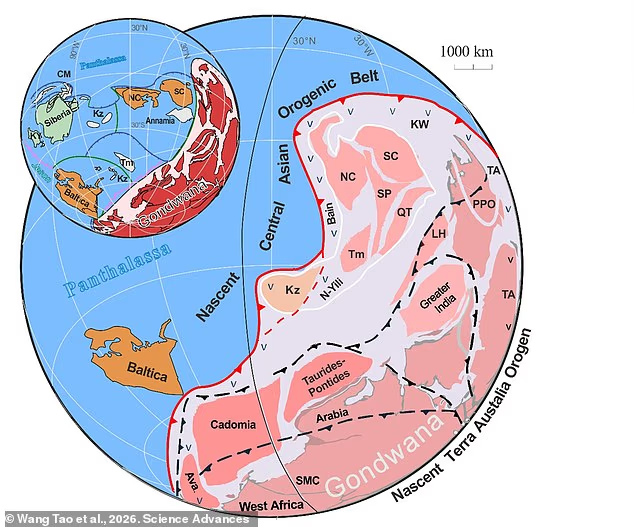
The long-lost supercontinent Gondwana has finally been pieced together after 550 million years.
For years, scientists have known that the ancient landmass included present-day South America, Africa, Arabia, Madagascar, India, Australia, and Antarctica.
However, a new study suggests that Gondwana was actually even more extensive than this.
Researchers from the Chinese Academy of Geological Sciences have discovered hidden fragments in the Precambrian terranes – ancient blocks of the Earth’s crust that formed before the Cambrian period.
The discovery suggests that Gondwana may have represented a staggering 80 per cent of Earth’s landmass at the time.
‘While Earth’s history records at least three well–recognized supercontinents (Columbia, Rodinia, and Pangaea), Gondwana’s supercontinent status has long been contentious,’ the researchers explained.
‘This study provides robust evidence that Gondwana fully qualifies as “Greater Gondwana,” a supercontinent.’
The long–lost supercontinent Gondwana has finally been pieced together after 550 million years

The analysis uncovered deeply buried fragments in southeastern Asia, central Europe, and southeastern North America that once belonged to Gondwana
Today, Earth has seven continents – Asia, Africa, North America, South America, Oceania, Antarctica, and Europe.
However, in the past, these continents were fused together to form ‘supercontinents’.
Previous studies have estimated that the ancient continent of Gondwana made up 64 per cent of Earth’s landmass, and 19 per cent the total Earth surface.
In their new study, the team set out to understand if this was really the case.
Writing in their study, published in Science Advances, the researchers, led by Tao Wang, explained: ‘This estimate, however, necessarily excluded poorly preserved peripheral fragments, as these terranes are now deeply embedded within younger orogenic belts, making their identification, correlation, and areal quantification traditionally difficult.’
To get to the bottom of it, the team analysed data from hundreds of geochemists around the world – totalling data on 25,346 igneous rocks.
Their analysis uncovered deeply buried fragments in southeastern Asia, central Europe, and southeastern North America that once belonged to Gondwana.
These additions bring Gondwana’s landmass coverage to roughly 80 per cent, according to the researchers.

The additions bring Gondwana’s landmass coverage to roughly 80 per cent, according to the researchers. Pictured: a comparative analysis of surface geology and deep-seated crustal compositional across Asia
‘This estimate remains conservative, as several components are still omitted,’ they said.
Importantly, 75 per cent has generally been accepted as the threshold for supercontinent status.
According to the researchers, at this size, Gondwana would have been large enough to have impacted the Cambrian explosion of life.
This crucial event happened around 541 million years ago, and sparked the evolution of most of the basic body forms that we observe in modern animals today.
‘The metazoan radiation that took place at the Ediacaran–Cambrian transition 550 to 500 million years ago is thought to have been driven by supercontinent cycles that impacted sea level, mantle convection, and levels of atmospheric volatile gases,’ the team explained.
‘Gondwana, the major landmass at the time, was previously considered too small to create these types of cycles.’


