
In one of the funniest images ever uploaded to the internet, Larry David and his daughter Cazzie stand in a grassy field. His left hand rests atop an antique cannon; his legs are spread wide, with knees bent as though ready to spring into action. Even in profile, you can see the mix of concentration and wonder on his face. In front of him is a college-aged Cazzie, staring into the camera with arms crossed and lips pouting, looking just as weary as he is thrilled. The caption on her since-deleted Instagram post: “He’s making us tour every Civil War battlefield.”
It’s hilarious because David’s exhilaration feels so familiar to anyone who knows an extremely common type of boomer male. He combines that history-dad energy with his relentlessly inappropriate “TV Larry” alter ego, as perfected in Curb Your Enthusiasm, in HBO’s Life, Larry, and the Pursuit of Unhappiness: An Almost History of America. Premiering June 26, in anticipation of July’s semiquincentennial, the 7-episode sketch comedy series comes with the presidential imprimatur of executive producers Barack and Michelle Obama. As co-creator (with series director Jeff Schaffer, a Curb and Seinfeld alum) and star, David casts himself as the fly in many historical ointments. The show is safer and less inventive than his best work. Still, there’s fun to be had in this time machine whose ultimate destination is dad-joke heaven.
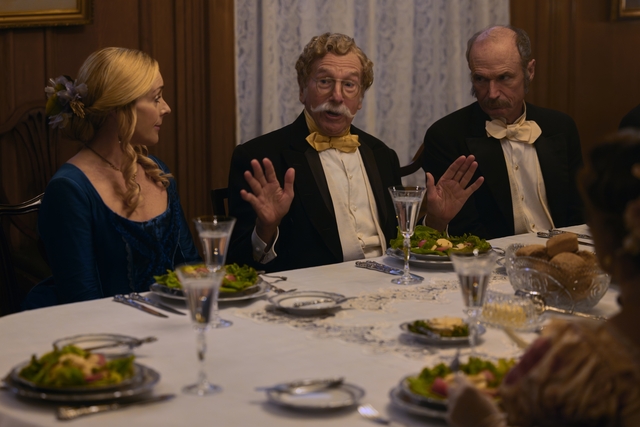
Each episode comprises four sketches that drop David—sometimes portraying a historical figure but always behaving like the schlemiel we know and mostly love—into different, non-chronological defining moments from our nation’s past. You can imagine him and Schaffer writing with an American history textbook on the table, opening to random pages and riffing on what role TV Larry might play in that chapter. What if nobody invited Larry to the Boston Tea Party? What if Larry took the first stab at writing the Declaration of Independence? What if Larry were Deep Throat, wasting Bob Woodward’s time with random Pat Nixon gossip? Usually, the answer is that Larry will get much angrier than the situation merits, piss off the people around him, and often both. In a wry preface to the premiere, Obama situates him within a long line of “irascible, petty, selfish, cheap” complainers and assures us, with his signature optimism, that America has always overcome “deeply unpleasant people who stood in the way of progress.”
As in Curb, the list of guest stars is long, distinguished, and smartly deployed. Core citizens of Davidworld (Jerry Seinfeld, Susie Essman, J.B. Smoove, Vince Vaughn) mingle with comedy virtuosos (Kathryn Hahn, Bill Hader, Jane Krakowski) and celebrity history buffs like Lin-Manuel Miranda. (I’ve been asked not to reveal some of the other big names who appear.) Most of the premises are iterations on familiar Davidian scenarios: Larry selfishly capitalizes on a tragedy. Larry and a male friend scheme their way out from under a rightfully wary woman’s gaze. In one sketch, he’s Meriwether Lewis spuriously assuring his wife that it’s going to be all business on a westward expedition with his good-for-nothing pal Clark. There are amusing lines and casting choices in these segments, but four consecutive “Larry being annoying” skits can get repetitive. Occasional callbacks to actual Curb bits only draw attention to the material’s staleness.
When sketches fall flat, it’s a reminder that there is more to David’s genius than his persona. He is the rare voice in 21st century comedy who can poke at pieties without coming off as pandering or bigoted or hacky. Yet in Life, maybe in deference to the Obamas’ we-go-high ethos, he seems to be pulling punches. With one notable but in no way subversive exception, he avoids setting sketches in the last few decades of American history and only briefly mocks the erosion of democracy under an administration whose leader he called a “little baby,” a “sociopath,” and a “sick man” on CNN. (David does get in a creative jab, so to speak, at his Curb co-star Cheryl Hines’ husband, Robert F. Kennedy Jr., in a series highlight. How strange it is that one of the country’s two major political factions is now so closely aligned with the mastermind of a show about nothing and the other with the woman who spent a quarter-century playing his wife and eventual ex.)
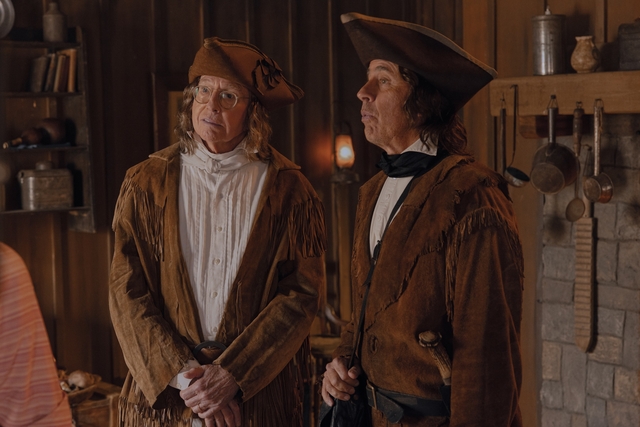
David also has a flair for funneling characters’ bad behaviors into storylines that, over the course of a half-hour episode, braid together until they’re knots of miscommunication and offense that must be exploded because they’re impossible to untie. Most of Life’s sketches are too short and simple to facilitate such plot maneuvers. The few that do veer off in unexpected directions—including a delightfully silly take on the Alamo—are some of the show’s best, using the Larry character as a springboard rather than an end in himself.
A different format might have helped. An episodic anthology would’ve cut down on the repetition within each installment and given David more space to craft storylines. A feature-length special could have distilled the project to its best, least redundant ideas or introduced an interstitial narrative. Life, Larry, and the Pursuit of Unhappiness is destined to go down in history as minor Larry David. But for a certain kind of dad—and, perhaps, the family members who love him enough to tolerate his geeky excesses—it will surely still be a pretty, pretty, pretty good time.