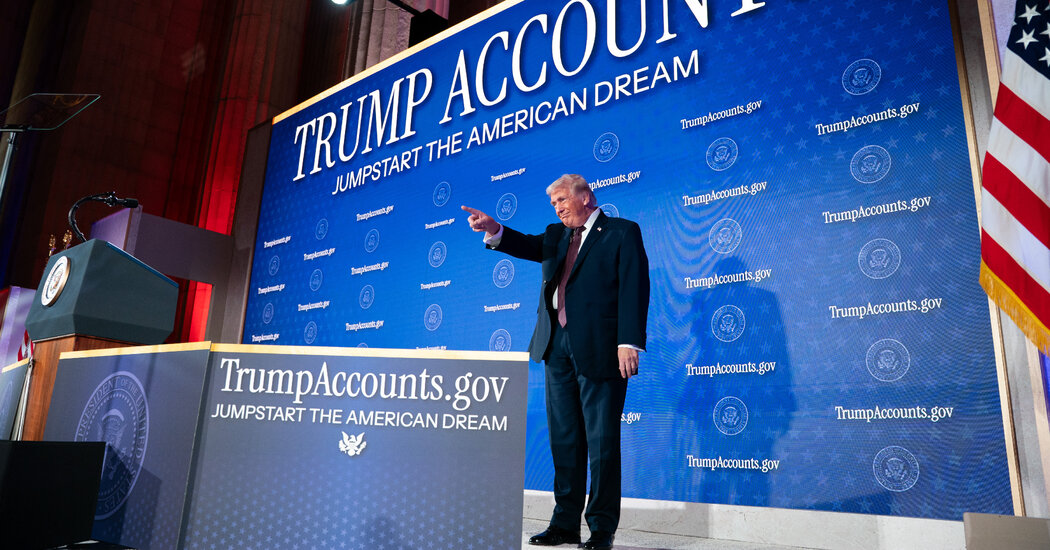
Trump accounts, the investment accounts for children created in last year’s tax bill, officially open for contributions Saturday. So far, more than six million American children have been signed up, according to a Treasury Department spokeswoman — less than 10 percent of those under 18 who are eligible.
Babies born during a four-year period starting Jan. 1, 2025 — effectively covering the second Trump term — will receive a $1,000 deposit from the federal government in their account. So far, only 1.4 million children in that age range have been signed up, or about one-quarter of the children born so far who qualify.
The Trump administration has heralded the number of accounts opened. Researchers who study child savings accounts said they were pleased that millions of families opened accounts, but pointed to several barriers to recruiting more families. Many don’t know about the accounts. Some have been turned off by the name and its affiliation with President Trump.
And importantly, researchers say, many more children would have accounts if they were automatically enrolled, rather than requiring parents to sign up on a tax form.
The concern — shared by people across the political spectrum — is that the accounts will disproportionately be used by families who are already investing in the stock market (including on behalf of their children, like in 529 college savings plans), rather than granting access to the markets to children who otherwise wouldn’t have it.
Still, despite the relatively low uptake, families across the economic spectrum have opened Trump accounts. H&R Block said it helped open more than two million accounts for its tax preparation clients this year, accounting for about a third of all accounts opened. Thirty percent of clients with eligible children opened accounts, and the uptake was 99 percent for those qualifying for the free $1,000.
“It’s an indicator that investing in your kid’s future and getting some free money is a strong motivator,” said Jason Ewas of the Aspen Institute Financial Security Program.
A $1,000 investment at birth could be worth $6,000 at age 18, the Trump administration has estimated. Charities and governments can contribute to the accounts, in the form of money or public company stock, as can family, friends and employers. So far, donors include Michael and Susan Dell, the billionaire philanthropists who have pledged $250 each for millions of children, and the state of Oklahoma, which is contributing $250 to children’s accounts there. Micron said this week it would deposit $250 for as many as one million children.
About six in 10 Americans own stock, and those who do are likelier to be white, with college degrees and high incomes. The stock market is now the biggest driver of the racial wealth gap, research shows. The wealth gap (in assets like investments, savings and homes) is bigger than the income gap.
“Families who do not file taxes, have limited digital access, or are less comfortable navigating financial systems are therefore more likely to be left out,” said Stephen Roll, research director at the Center for Social Development at Washington University in St. Louis. “Those are likely to be the families with the lowest incomes and the highest need for programs like this.”
All these factors — in addition to a greater mistrust of Mr. Trump by nonwhite Americans and the fact that high earners will have more money to contribute to accounts — suggest that the accounts could end up growing the racial wealth gap and the wealth gap in general.
“I admit that I think they will increase inequality,” said Ray Boshara, a senior policy adviser at Washington University and the Aspen Institute who has helped policymakers in both parties develop plans for children’s savings accounts. “However, I say it’s worth it because that’s the price you pay for getting all families in, low-wealth families in.”
The Trump administration has said it’s a top priority to reach low-income families. Melania Trump, the first lady, recently announced a way for foster children to get accounts.
The accounts “will ensure that every American child can benefit from private ownership and compound growth; that every American baby, in short, is born a shareholder,” Treasury Secretary Scott Bessent said last month.
According to the law, money in Trump accounts will be invested in low-cost index funds. The accounts become I.R.A.s when children turn 18, which means that money can be withdrawn for specific purposes like paying for college, buying a home or retiring (otherwise there is a penalty).
One challenge in reaching more people is awareness. In an online survey of U.S. adults conducted in June and released Thursday by Public First, a polling firm, only about 20 percent of respondents said they knew what Trump accounts were, and another 30 percent said they had heard of them but couldn’t explain what they were.
Those earning less than $25,000 were the least likely to know what Trump accounts were — just 11 percent did.
The Trump administration has outreach plans, including partnering with community groups and putting up billboards in areas that are underrepresented. There was a Super Bowl ad, and some states, including Oklahoma, are incorporating Trump accounts into their financial literacy curriculums.
Another challenge is the name (they were originally called Invest America accounts). Though the policy idea has bipartisan support, naming the accounts after Mr. Trump has turned away some participants, research has found. (The tax form to sign up is 4547, almost certainly a nod to Mr. Trump’s presidencies.)
In interviews by Commonwealth, a nonprofit that aims to help low-income people build wealth, respondents have said the name is polarizing, with some expressing hesitation or mistrust because of it. Parents were more likely to sign up if their children were eligible for the $1,000, Commonwealth found.
In the Public First survey, a majority said they supported child savings accounts, whether they said they had voted for Mr. Trump or for Kamala Harris. But when the same question was asked with the name Trump accounts, just 37 percent of Harris voters supported them, compared with 69 percent of Trump voters.
Perhaps most important to reaching the most children, many researchers say, is automatic enrollment, as happens with many employer-sponsored retirement savings plans.
Now, parents have to fill out a form or check a box on their tax returns to open a Trump account. Past experiments with similar children’s savings accounts, in Maine and Oklahoma, have found that when they require parents to sign up, a minority do, and poor families are least likely to. But when children are automatically enrolled, with parents given the chance to opt out, almost none do.
“Without auto-enrollment, you’re going to miss a lot of low-income kids,” Mr. Boshara said.
The Trump administration has considered auto-enrollment, according to a Treasury Department official who was not permitted to speak publicly. But there are hurdles, including privacy laws restricting sharing identifying information across government agencies.
The program for foster children — which enables states to open accounts on their behalf — could provide a template.
Another consideration, the Treasury official said, is that because there are administrative costs for the government to open accounts, it would be inefficient to auto-enroll children whose families may never add private contributions, or who are older and stand to benefit less from compounding returns.