Forget pre–workout shakes – all you might need to smash your next gym session is a whiff of chocolate.
Scientists have discovered that simply smelling dark chocolate before lifting weights can help people squeeze out significantly more repetitions without making the workout feel any harder.
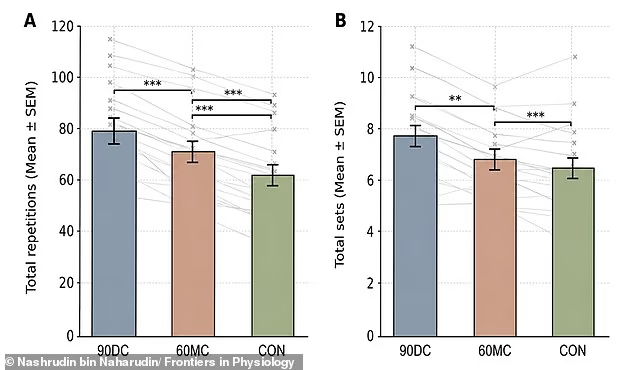
In the study, volunteers who sniffed dark chocolate before tackling leg extensions completed around 18 extra repetitions than those who smelled nothing at all.
Researchers believe the aroma tricks the brain into feeling fuller, allowing people to focus more on exercise and less on hunger.
The effect was so pronounced that even milk chocolate provided a performance boost, although not as much as its darker counterpart.
Experts say the findings highlight the surprising power of smell to influence both body and mind.
Senior author Dr Mohamed Nashrudin bin Naharudin, from the University of Malaya in Kuala Lumpur, said: ‘Exposing moderately trained men to chocolate odours right before and between sets of resistance exercise significantly increased their overall training volume without increasing their perceived exertion.
‘Seeing a substantial increase in repetitions without the athletes feeling like they were exerting themselves any harder is a fascinating psychobiological outcome.’
These graphs show how the dark chocolate (90DC) group carried out more sets and repetitions compared to the milk chocolate (60MC) and control (CON) groups

Simply smelling dark chocolate before lifting weights can help people squeeze out significantly more repetitions, the researchers found (file image)
For their study, published in the journal Frontiers in Physiology, the researchers recruited 23 healthy men in their early to mid–20s and divided them into three groups.
Each group sniffed one of three odour samples – liquified dark chocolate containing 90 per cent cocoa, liquified milk chocolate containing 60 per cent cocoa, or a water sample that acted as a control for the study.
None of the gym–goers had eaten for the previous 10 hours.
For the research, they all performed leg extensions – which involves sitting down and extending the lower legs to lift a weight – in sets of 10 with 3.5 minute rest intervals.
‘Sniffing a 90 per cent dark chocolate odour added about 18 more repetitions to participants’ leg extensions,’ Dr Nashrudin bin Naharudin said.
‘A 60 per cent milk chocolate odour added about nine repetitions compared to the water control.’
Levels of hunger, fullness, desire to eat, and plans to eat in the near future were assessed before the study and 30 seconds after the odour sample had been sniffed.
Overall, sniffing dark chocolate consistently led to people reporting less hunger, reduced desire and intention to eat and greater fullness before exercise.

Sniffing dark chocolate (90DC) consistently led to people reporting less hunger compared to those who sniffed milk chocolate (60MC) or water (CON)
Across both types of chocolate, people also did not feel as though they were training harder but managed more exercise repetitions.
The researchers suggested the changes in appetite perception could be related to what people learn about smells from a young age.
Anticipating a food might have similar effects to when it is actually eaten, they suggested.
‘The dark chocolate scent serves as a learned cue for a rich, bitter and highly satiating food, which essentially tricks the system into an anticipatory state of fullness,’ Dr Nashrudin bin Naharudin added.
‘Conversely, the sweeter milk chocolate scent acts more like a hedonic reward cue, enhancing training volume by creating a highly pleasant sensory environment rather than by shifting basic metabolic hunger signals.’
Although it has not been tested yet, other appealing foods could also have an effect, the team believes.
‘We don’t think chocolate is entirely unique, though it is a food cue with incredibly strong, universally recognized reward associations,’ Dr Nashrudin bin Naharudin concluded.
‘Although this hasn’t been tested yet, other foods strongly linked to satiety could show similar effects. A person likely needs to find the odour familiar and appealing – or at least not repulsive – to trigger the psychological shift in appetite that’s needed to see a performance boost.’
Last month, scientists finally put an end to the ‘cupboard or fridge’ chocolate debate.
According to Professor Charles Spence, Professor of Experimental Psychology at the University of Oxford, chocolate tastes better from the fridge.
Chilling chocolate not only boosts its flavour but also its texture, according to the expert.
‘We like foods when they make some noise. One of the benefits of putting chocolate in the fridge is that you get a better snap when you break a fridge–cold bar,’ he explained.