Last month was officially the second hottest June on record, experts have revealed.
The average global temperature hit a balmy 16.54°C (61.77°F), which is second only to the June of 2024 (16.66°C/61.98°F).
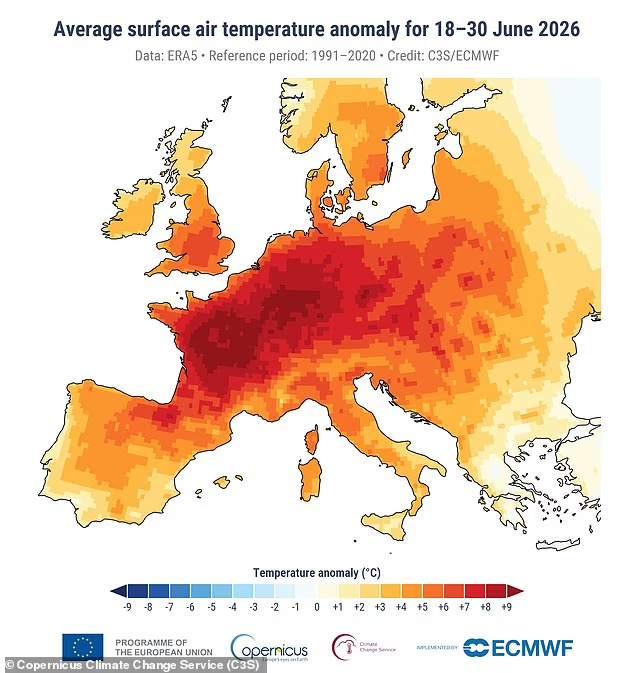
However, last month was the hottest June ever recorded for western Europe, thanks the record–breaking heatwave during the second half of the month.
According to experts from the Copernicus Climate Change Service (C3S), the findings partly reflect the ongoing development of a devastating Super El Niño.
Samantha Burgess, Strategic Lead for Climate at ECMWF, said: ‘June 2026 underscored how profoundly the climate is changing.
‘Western Europe recorded its warmest June on record, and continued record warmth in the global ocean.
‘Together, these records reflect a climate system continuing to accumulate heat.
‘The result is increasingly intense heatwaves, a persistently warm ocean, and growing risks for people, ecosystems and infrastructure across Europe and beyond.’
Last month was the hottest June ever recorded for western Europe, thanks the record–breaking heatwave during the second half of the month

Western Europe was particularly hot, with the average temperature hitting 20.74°C – a staggering 3.05°C above the 1991–2020 average
Across the entire globe, the average surface air temperature was 0.56°C (1.0°F) above the 1991–2020 average, and 1.39°C (2.5°F) above the estimated pre–industrial 1850–1900 average.
However, western Europe was particularly hot, with the average temperature hitting 20.74°C (69.33°F) – a staggering 3.05°C (5.49°F) above the 1991–2020 average.
‘The heatwave that hit much of Europe during the second half of June came only a few weeks after a particularly intense heatwave in May, with another heatwave emerging in early July,’ CS3 explained.
‘The June heatwave broke monthly and all–time temperature records across several European countries and contributed to severe health impacts, including heat–related deaths.
‘The succession of heatwaves illustrates the growing challenge posed by increasingly frequent and intense heat extremes across Europe and the globe.’
Looking at sea surface temperatures, the researchers found that the extra–polar oceans were at their hottest on record, reaching 20.86°C (69.54°F).
Across a large portion of the tropical Pacific – where El Niño conditions are present – sea surface temperatures were also ‘exceptionally high’.
The researchers expect these temperatures will inch even higher in the coming months as El Niño strengthens.

Looking at sea surface temperatures, the researchers found that the extra–polar oceans were at their hottest on record, reaching 20.86°C (69.54°F). Across a large portion of the tropical Pacific – where El Nino conditions are present – sea surface temperatures were also ‘exceptionally high’

The news comes shortly after the Met Office confirmed that England sweltered through its hottest June ever
The news comes shortly after the Met Office confirmed that England sweltered through its hottest June ever.
Provisional figures reveal that across the country, the average temperature was 17.1°C last month, surpassing the previous record of 16.9°C set in 2025.
The exceptional warmth was driven by an intense and record–breaking heatwave at the end of the month, the Met Office said.
It was also bolstered by a slew of ‘tropical nights’, when the temperature did not drop below 20°C.
For the UK, June 2026 provisionally ranks as the second warmest June on record, behind only June 2023.
Wales recorded its second warmest, while Scotland and Northern Ireland both saw their joint fourth warmest June since 1884.
Professor Stephen Belcher, Met Office Chief Scientist, said: ‘To see temperatures like this in the UK in June is sobering.
‘Events like this bring home the implications of climate change, with very high temperatures and humidity bringing significant health implications from heat stress, as well as impacts to a range of sectors such as transport, energy and water supply.’