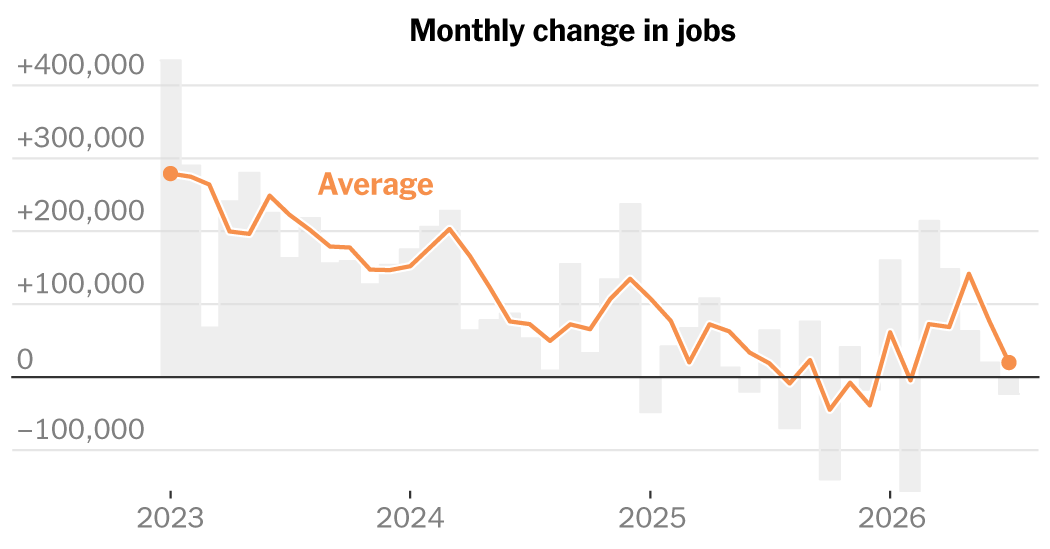
The labor market posted a modest loss in July, as businesses shed jobs in the face of renewed tariffs and higher costs driven by war in the Middle East.
Employers cut 23,000 positions on a seasonally adjusted basis last month, the Labor Department reported on Friday, and the unemployment rate dropped slightly to 4.1 percent as hundreds of thousands of people left the labor force.
The lower-than-expected reading comes after what had appeared to be a surge in job creation in March and April, born of optimism around tax cuts, a respite from new tariffs, easing interest rates and lower inflation.
Since then, costs have jumped as oil shipments from the Persian Gulf have remained stalled, while the Trump administration has renewed its battle against imports. Job gains for April and May were revised down by 103,000, bringing the monthly average for 2026 to 60,000.
“We have a labor market that’s stable but stuck in second gear,” said Lydia Boussour, a senior economist at the consulting firm EY-Parthenon. “We still have an environment where those supply shocks are working their way through the economy, and a lot of uncertainty, and that will keep businesses cautious in hiring.”
The slack hiring comes while layoffs have remained consistently low, corporate profits are high and consumer spending has held up remarkably well even as expensive gasoline weighs on wallets. Job openings, the rate of hiring and the share of people quitting their jobs have stopped falling. Those indicators suggest that companies are not looking to slash payrolls at the moment.
But they have been investing heavily in artificial intelligence, which has subdued hiring for certain roles and weakened workers’ leverage to bargain for higher wages. Hourly earnings grew 3.2 percent over the year, the slowest pace since May 2021 and likely less than the rise in prices over the same period. July’s Consumer Price Index reading will be released on Aug. 12.
July’s data may disrupt the Federal Reserve’s relative comfort with the state of the labor market, as committee members weigh raising interest rates to combat war-driven inflation. The Fed will get another jobs report before meeting again in September.
The hiring slump is especially pronounced in the collection of occupations that make up the technology sector, which have shrunk 3.8 percent since peaking in 2022, according to an analysis by the employer review website Glassdoor.
“It’s a sharp reversal from what we’ve seen in the past,” said Glassdoor chief economist Daniel Zhao. “It’s also coming at a time when there’s an incredible amount of hype in the tech industry around data centers, and it’s just not showing up in the employment numbers.”
Glassdoor’s measure of employee confidence reached its lowest level on record in July, and the share of consumers who judged that jobs were “hard to get” rose to its highest level since January 2021, according to surveys by the Conference Board.
One place data centers are showing up: the construction industry, which added 22,000 jobs. Nearly all of them are on commercial projects, as home building remains pressured by high interest rates. Massive data center building sites in states like Texas, Ohio and Virginia are creating stiff competition for other contractors, especially as demand for new industrial space starts to recover.
For Neely Sadowski, the president of construction at the Missner Group, a Chicago-area developer, it has meant committing to hire workers far in advance for the new projects they’re starting to envision. She’s having a hard time finding site superintendents, and relying more heavily on recruiters.
“There are really no electricians in the union hall right now,” Ms. Sadowski said. “A lot of them are traveling to go work on data centers because of the money that is being offered. So it’s a challenge for sure.”
The other remaining source of new employment is health care, which has powered nearly all of the growth over the past few years. The sector added 22,000 positions in July, a markedly slower rate than the prior 12 months.
Hiring in temporary help services, which represents people staffed to employers in a variety of industries, has also been steadily rising after a long downward slide that reversed course over the winter.
“While employers have tamped down on hiring, they still have work that they need people to do,” said the American Staffing Association’s chief economist, Noah Yusif. Companies are turning to fixed employment contracts for specific assignments, he noted, which allows them to accommodate higher orders without committing to full-time employees.
The weakest spots in the report came from leisure and hospitality, which has shed 80,000 jobs over the past two months despite excitement around the World Cup boosting labor markets in host cities. Local government education also shrank by 50,000 positions, which may be a seasonal quirk having to do with the timing of schools getting out for the summer.
The White House seized on the weakness in public sector hiring and a small gain in manufacturing employment. “The Trump industrial resurgence is on schedule,” said Kush Desai, a White House spokesman, in a statement. “The Trump administration is focused on unleashing more private-sector job growth through President Trump’s proven economic agenda of tax cuts, deregulation and energy abundance.”
But rather than strong demand for labor, the drop in the unemployment rate resulted from a contraction in the number of people looking for work. The labor force participation rate for people in their prime working years, between ages 25 and 54, recovered only slightly from a large drop in June. For all ages, the participation rate sank to its lowest level outside the pandemic recession since 1976, when women were just starting to work in large numbers.
Aside from retirements, the most obvious cause of the declining work force is the White House’s ongoing campaign to expel immigrants, who tend to hold jobs at higher rates than native-born Americans. That effort was aided in June by Supreme Court, which allowed temporary protected status to lapse for hundreds of thousands of people from Haiti and other countries. The resulting shrinkage has kept unemployment low, even amid tepid demand for workers.
“All our fears were misplaced from a year ago when we were entering the fall and realizing ‘wait a second, is joblessness about to pick up?’” said Andrew Flowers, chief economist with the recruitment advertising firm Appcast. “Actually no, it’s the opposite; it’s the immigration restrictions are starting to bite.”
Fewer people coming in to the labor force is little comfort for those who have been on the job market for months. The median number of weeks of unemployment, which stood at 10.5 in July, has been gradually rising since 2022.
Matthew Glidden lost his job as a program manager at the audio hardware company Sonos in 2023. He’s been job hunting since then, but has gotten less personal outreach from hiring managers as the ranks of the unemployed tech workers grew.
Lately, he’s leaned into his passion, sports history, and started freelancing. He’s been marketing his writing and research skills to hobby groups and auction houses, where interest in custom collectible card sets has been booming. It’s generating a small income as he hopes for his original profession to recover, which, he recognizes, may not.
“I’ve been the last paperboy. I’ve been one of the last people in a phone center. I’ve been now maybe the last major wave for program managers,” said Mr. Glidden, 54. “Seeing those kinds of transitions makes me think that this is more of a natural transition, as unnatural as it seems.”
Tony Romm contributed reporting.