It’s not just humans who are right or left–handed, as a study shows that some pooches have a preferred paw.
While the preference isn’t always as strong as it is for humans, many dogs tend to favour their left or right front paws for manipulating objects and staying balanced.
Scientists have known about these tendencies for a while, but Italian researchers have now created a test that shows just how much of a leftie or righty a dog really is.
Named the ‘Doginburgh Inventory’ after the ‘Edinburgh Handedness Inventory’ used in humans, the test involves four distinct tasks.
The first two tests look at which paw your dog tends to use when trying to snag treats from various hiding places.
Meanwhile, the third and fourth tasks measure which paw your pet tends to use when it has to take a big step.
Together, these tests will not only reveal if your dog is left or right–pawed but also how strongly they favour one side or the other.
Co–author Dr Sevim Isparta, of the University of Bari, told the Daily Mail: ‘Be patient. Not every dog is keen on paw–based tasks like reaching for food, and some dogs take a little longer than others to get involved. That’s perfectly normal.’
Just like humans, dogs can also be left or right–handed. Now, scientists have created a test to reveal your pet’s paw preference
Co–author Professor Marcello Siniscalchi, of the University of Bari, told the Daily Mail: ‘Unlike humans, in whom a clear population–level laterality is observed – with approximately 90% of individuals being right–handed – such a pronounced bias has not been demonstrated in dogs.
‘Nevertheless, dogs do exhibit “paw preference” at the individual level, meaning that a substantial proportion of individuals consistently prefer to use either the right or the left paw when performing specific tasks.’
Figuring out which side an animal actually prefers can be tricky since questionnaires or tests designed for human hands don’t apply.
To solve this issue, the researchers took four of the most important tests for laterality and combined them into a single measurement called the ‘Doginburgh Inventory’.
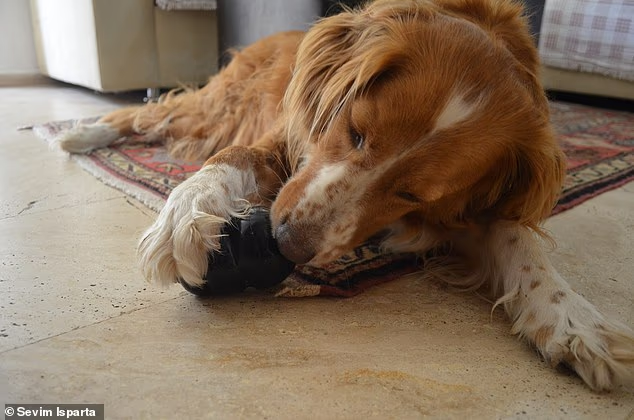
The first test, known as the Kong Test, involves placing a treat inside a rubber ‘Kong’ toy and seeing which paw your dog uses to hold it steady.
To try it, have someone hold your dog on their lead on the other side of the room while you place a food they love inside the toy.
Release your dog and watch carefully as it tries to get the treat out, taking note of which paw it uses to pin the Kong in place.
The second experiment is the ‘Food Reaching’ test, which uses a similar method to see which paw your dog uses to grab food.

The first two tests examine how your dogs try to reach for food. The first test (left) looks at which paw they use to stabilise a Kong treat toy, and the second (right) examines which paw they use to fish out a stuck treat
While your dog is watching, place a treat beneath a piece of slightly elevated furniture such as a sofa.
The gap between the floor and the furniture should be big enough that your dog can comfortably reach under with its paw, but not so big that it can reach the treat with its mouth.
Step out of the way and let your dog try to retrieve the treat with their paws, noting down which they use.
For the next mobility tests, you will need a space with a step and the help of a willing assistant.
The first trial is the ‘stationary first stepping test on stairs’, which involves looking at which paw your pet uses to step down a ledge.
In their paper, the researchers explain: ‘The dog was kindly guided by its carer to a “sit” position on the top step of the stairs using a treat.
‘Once the dog reached the correct position, which required the frontal paws to be aligned and the spine of the animal to be straight (no side sitting), the dog was called by the experimenter standing 2 m away from the bottom of the stairs, directly facing the dog.’
As the dog walks away, all you need to do is take note of which paw they use to take that first step down.

In the mobility tests, you allow your dog to walk down some steps, noting which paw they put down first each time

When the researchers carried out these tests with 47 dogs they found that no male dogs had a strong right paw preference, and were more likely than female dogs to be left–pawed
The final test, named the ‘dynamic first stepping test on a transition platform’, is much the same except that the dog is already moving when it reaches the stairs.
Simply walk with your dog on a loose lead towards a set of stairs and make your way down at a normal pace, noting which paw they use first.
To avoid accidentally biasing your dog’s choice, pay close attention to where you are standing and try to keep things as neutral as possible.
The researchers say that even small changes in how the task is presented could affect which paw your dog uses.
Dr Isparta says: ‘The good news is that you don’t need to run lots of trials to get an idea of your dog’s paw preference.
‘We found that the first paw a dog uses is often a surprisingly good indicator of its overall preference. So even watching a few paw uses can give you a pretty good idea of whether your dog tends to favour the left or right paw.’