
For years, the conventional wisdom about young workers has gone something like this: Gen Z doesn’t want a traditional career. They’d rather freelance, day-trade, chase side hustles, and treat a 9-to-5 as something like a relic that their parents clung to. Some were even “financial nihilists” who gave up on an old-fashioned career.
Paul Osterman, professor emeritus at the MIT Sloan School of Management, has spent decades testing that kind of assumption against hard labor-market data, and in his new book, he says the evidence points in the opposite direction. “Is that rhetoric really reflected in the attitudes of younger people?” Osterman asked. “The evidence is that it’s absolutely not.”
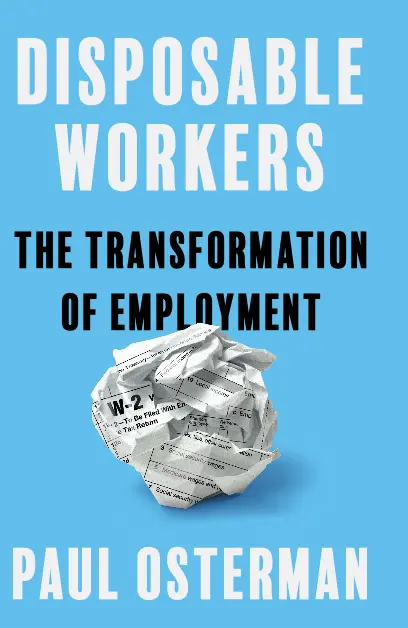
The labor economist has built his career studying job quality, from long-term care workers to middle managers to what makes some employers create “good jobs” and others not. His book, Disposable Workers: The Transformation of Employment, is his latest attempt to quantify a shift he believes has been building since the postwar era: what employers are willing to offer.
The 35% number
Drawing on an original survey of more than 6,000 U.S. adults aged 24 and up, plus nearly 100 interviews with workers, employers, and staffing agencies, Osterman calculates that 35% of the American workforce, more than 55 million people, now falls into what he categorizes as “disposable” work: freelancers, contractors, gig workers, and a group he named “marginal workers.”
Marginal workers are W-2 employees of an organization who are not treated as real members of it—hired with an implicit understanding that they won’t stick around or advance. “They’re not really attached to the organization,” Osterman told Fortune. “No one has job security anymore, but these folks are hired with that expectation and are not going to be around for long.”
The category spans a surprisingly wide swath of the economy, from adjunct faculty and staff attorneys hired for single cases, to high-turnover retail and service jobs, to even contract employees embedded for years inside big tech companies without ever being on a path to full-time status. The point, Osterman added, is that they are all hired with the expectation of high turnover: that they’ll be disposable, in other words.
Gig work is a rounding error by comparison. “Gig jobs are not really the story,” Osterman said. “They’re about 2% of the workforce.” Contracting and marginal employment, he argues, are the much larger and more consequential trend hiding in plain sight. Osterman said he was surprised by the “magnitude” of what he found. “I mean, 35% is a big number.”
Debunking the generational narrative
Osterman said he specifically tested the idea that younger workers are voluntarily opting out of traditional careers in favor of entrepreneurial reinvention, financial risk-taking, or gig flexibility.
“The only shift in the attitudes of young people is towards work-family issues,” he said. “Those are more salient for younger people than for older people. But the desire to get a real job and have a career? That’s stable.”
“We’re in a different social strata,” he said. “And we kind of generalize our social strata to the world. That’s not actually accurate.” A survey of young workers in Ohio or Indiana, he argued, would tell a very different story than one drawn from Manhattan or Brooklyn.
Osterman’s finding lands as a key, complicating datapoint to the narrative that Gen Z has embraced “career minimalism,” or trading “the rigid career ladder for the career lily pad,” per the findings of Glassdoor and chief economist Daniel Zhao, who told Fortune that his findings actually agree with what Osterman discovered. “We are still in a job market where hiring is very sluggish and workers feel stuck in their careers.”
Zhao pointed to one concrete sign the strain is intensifying rather than easing: mentions of burnout in Glassdoor reviews were up 43% in May compared with a year earlier, a trend he attributes to accumulated pressure from layoffs, leadership demands, and AI-driven anxiety, with little relief in sight. He rejected the idea that any of this reflects diminished ambition on the part of Gen Z: “It’s not because of a lack of ambition or laziness or that sort of thing. In fact, it’s the opposite… they are just as committed to growing their career as their peers from previous generations were at the same age.”
“I don’t think that attitudes are very different between Gen Z and previous generations,” Zhao added. “The work that is available… [has] changed more than people’s attitudes towards work.”
A 25-year arc, not a new trend
Osterman traced the roots of this transformation back to the breakdown of the postwar labor “accord”—a period of high unionization, employer caution about provoking unions, and political support for long-term, stable employment that began fraying decades ago. He pointed to a famous, familiar inflection point: President Reagan’s 1981 firing of striking air traffic controllers, which Osterman called a signal that it was “open season on post-World War II employment systems.”
From there, he traced a longer, also familiar arc: the financialization of corporate strategy, rising competitive pressure, the legal fights over whether staffing agencies counted as the “employer of record,” and a shift in management ideology toward “core competency” thinking—the idea that most workers simply aren’t essential to a firm’s core business and can be treated accordingly.
He also pointed to attitude, not just economics, as a driver. Osterman cited a McKinsey report claiming 95% of a firm’s value is delivered by just 5% of its workforce as telling evidence of how corporate America has come to see the majority of its employees. “That says something about the attitude towards the rest of the workers,” he said.
Where AI fits and doesn’t
Osterman was careful to separate his findings from the current AI panic. “This trend preceded AI,” he said. “I think it’ll be exacerbated by AI, but it’s not an AI story.” He argues that AI’s primary effect so far has been to inject uncertainty into employer staffing decisions—and that uncertainty itself pushes companies further toward disposable labor arrangements, regardless of whether AI ultimately displaces large numbers of jobs. “No one has any idea what the overall impact of AI will be,” he said. “But I’m pretty confident it will exacerbate the move towards disposability because of the uncertainty it introduces.”
Zhao’s data adds a wrinkle worth noting alongside Osterman’s caution: Glassdoor research from his colleague Chris Martin found Gen Z workers are the most critical of AI in workplace reviews, ahead of millennials and Gen X. “I think they are positioned well to benefit from it in the long run, but understandably, they are very skeptical of AI right now.”
The apparent contradiction has a structural explanation. Goldman Sachs research, Zhao noted, suggests mid-career workers tend to struggle most during technological transitions: they’ve built up experience and skills that may no longer be as relevant, with 10 to 20 years of working life still ahead of them. Younger workers, by contrast, adapt quickly and move toward opportunity. “There is a lot of disruption,” Zhao said, “but they tend to adapt very quickly.”
What makes Gen Z’s relationship to AI different from prior generations’ relationship to new technology, Zhao argued, is that the ambivalence is partly a function of familiarity. The same quality that makes them most critical of it also makes them most likely to use it and redirect it toward their own ends. He pointed to the sustained explosion of new business applications tracked by Census Bureau data since 2020 as one concrete signal: entrepreneurship has kept accelerating well past the pandemic, and AI may be a partial driver. “Is it being partially driven by AI right now?” Zhao said. “I think the answer is probably yes.”
Osterman, for his part, hears something simpler in all the AI anxiety: “People are freaked out. There’s no question about that.” But the mechanism he’s confident about isn’t mass displacement, it’s that uncertainty becomes a management tool. Employers who don’t know how their staffing needs will change in an AI-driven world will default to arrangements that preserve maximum flexibility, which means more disposable workers. “Maybe you’re going to need more people or different people, but you don’t know,” he said. The rage about AI is really rage about a long-fraying workplace contract.
But those bright spots are the exception. Pay is lower across every disposable category compared with standard employment, and Osterman found contractors and marginal workers report substantially lower job satisfaction than freelancers or traditional employees—the group bearing the brunt of a labor market redesigned, in his telling, around cost control and flexibility rather than long-term investment in people.
For this story, Fortune journalists used generative AI as a research tool. An editor verified the accuracy of the information before publishing.


