Children who eat school lunches fall into five distinct groups – and only two per cent are healthy, according to a new study.
Researchers from the University of Leeds analysed more than a quarter of a million choices made by 800 11–18–year–olds in a secondary school.
By looking at what the children chose over one academic year, they were able to develop a profile for each student.
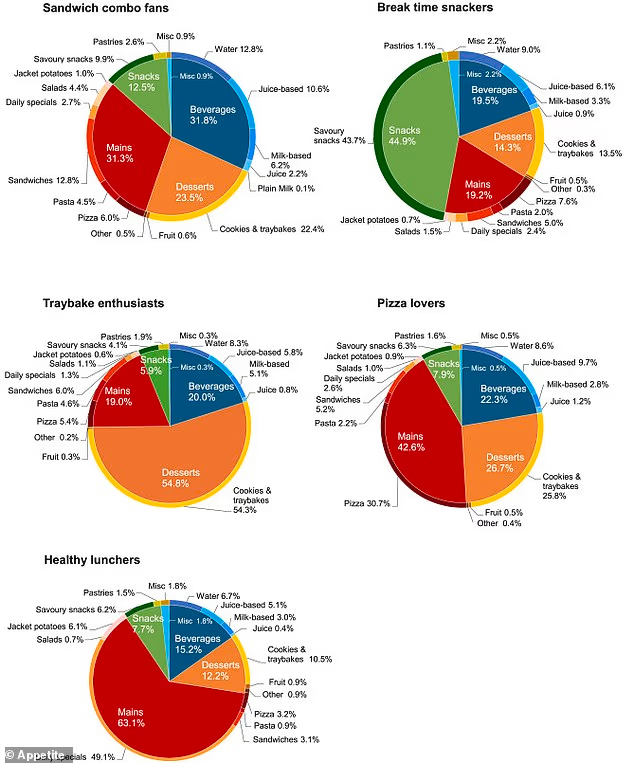
Overall, they say that all students fall into five groups.
These are: ‘sandwich combo fans’, ‘break time snackers’, ‘traybake enthusiasts’, ‘pizza lovers’, and ‘healthy lunchers’.
‘What our study clearly showed was that students consistently gravitated towards certain foods,’ the researchers explained in an article for The Conversation.
‘Cookies, traybakes and pizza were very popular, and daily specials and fruit were not.
‘Ultimately, students didn’t tend to opt for food with more preferable nutritional composition.’
Overall, researchers say that all students fall into five groups. These are: ‘sandwich combo fans’, ‘break time snackers’, ‘traybake enthusiasts’, ‘pizza lovers’, and ‘healthy lunchers’

To understand the impact this could have on children’s diets, the researchers analysed the food choices of 857 children at a secondary school in the north of England across a school year (stock image)
While many children have school lunches, the UK government has recently proposed new regulations on what schools can serve.
‘The changes are aimed at increasing fibre and reducing fat, sugar and salt in school food,’ researchers Dr Hannah Ensaff, Dr Mel Holmes, and Patrice Mwithaga explained.
‘These will, for example, remove deep fried foods and fruit juice from school menus, while also limiting how often options such as pizza can be offered.’
To understand the impact this could have on children’s diets, the researchers analysed the food choices of 857 children at a secondary school in the north of England across a school year.
They explained: ‘We found that students fell into one of five groups, which we named according to the foods and drinks that dominated.’
With 40 per cent of students, the largest group was dubbed the ‘sandwich combo fans’.
These children tend to choose a combination of drinks, sandwiches, cookies and traybakes.
The next biggest group (23 per cent of students) was the ‘break time snackers’, whose diets are mostly made up of savoury snacks.

The researchers also looked at trends by age. They found that, as students got older, there was a shift towards more breaktime snacking
Nineteen per cent of students were ‘traybake enthusiasts’ whose selections were dominated by cookies and traybakes.
Meanwhile 17 per cent were ‘pizza lovers’, who regularly chose pizza as their main.
Finally, the smallest cluster was ‘healthy lunchers’ (1.5 per cent), who usually picked the healthy daily special.
As part of the study, the researchers also looked at trends by age.
They found that, as students got older, there was a shift towards more breaktime snacking.
‘Students here predominantly selected savoury snacks, such as bacon rolls, potato wedges and toast,’ they explained.
According to the experts, this shift may be related to older students moving away from a conventional lunch in the canteen.
So, what do these results mean for the proposed changes to school lunches? It’s hard to say, according to the experts.
‘The impact of the proposed changes to the school food standards is difficult to predict,’ they said.
‘For example, the updates restrict the availability of traybakes and pizza, highlighted as important choices for students.
‘How young people respond to this – and if they opt for alternatives beyond the school menu – may depend upon how caterers respond to the updates and how school food changes.’