As Britain braces for temperatures of up to 40°C this week, one key question is being asked: what can be done to tackle future heatwaves?
Now, scientists from Arizona State University think they have the answer.
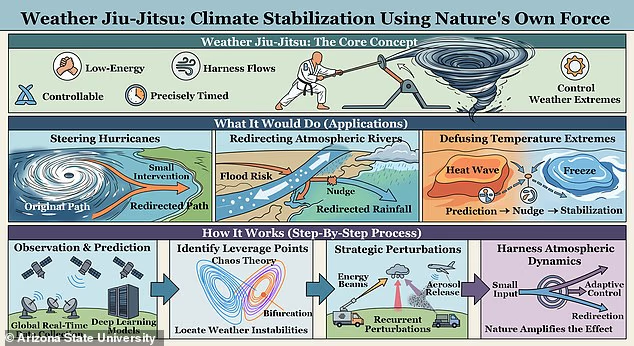
In a new study, researchers claim that a technique called ‘Weather Jiu–Jitsu’ could be used to ‘nudge’ weather systems away from harmful trajectories.
This would involve applying small, carefully–timed cloud seeding operations in the days before the peak of an extreme weather event.
According to the researchers, this method could not only defuse heatwaves, but could also be used to steer hurricanes and redirect atmospheric rivers.
However, cloud seeding is not without its controversy. Scientists have warned that the technique might pose risks since little is known about its effects.
Johan Jaques, Senior Meteorologist at KISTERS, previously told the Daily Mail: ‘Interference with the weather raises all kinds of ethical questions, as changing the weather in one country could lead to catastrophic impacts in another, after all, the weather does not recognise intentional borders.
‘If we’re not careful, unrestrained use of this technology could end up causing diplomatic instabilities with neighbouring countries engaging in tit–for–tat “weather wars”.’
In a new study, researchers claim that a technique called ‘Weather Jiu–Jitsu’ could be used to ‘nudge’ weather systems away from harmful trajectories
Cloud seeding is a geoengineering technique that can be used to trigger rain to fall where there might otherwise be none.
Silver iodide or table salt is injected into the clouds, causing the water vapour to rapidly form ice crystals.
As the ice crystals grow, they eventually become so large that they fall out of the cloud as snow or rain depending on the weather.
This is either done by releasing chemicals from the ground, injecting them directly from planes, or shooting them into the clouds using missiles or shells.
Cloud seeding is already being used in more than 50 countries, including the US and UAE.
However, most operations are done on a small scale, and are simply used to improve precipitation locally.
Instead, the Arizona State University researchers suggest that cloud seeding could be used to avert entire weather disasters.
In their study, the team conducted simulations using a large–scale AI model called Aurora, which is designed to predict weather at high resolution.

Cloud seeding is a geoengineering technique that can be used to trigger rain to fall where there might otherwise be none

Cloud seeding is either done by releasing chemicals from the ground, injecting them directly from planes, or shooting them into the clouds using missiles or shells (pictured in China’s Shanxi province)
Amazingly, their model suggests that carefully–time cloud seeding operations applied days before the peak could have subverted several devastating events.
According to the team, the technique could have shifted the track of the 2012 Hurricane Sandy by about 300 miles to miss New York City.
In addition, it could have raised the low temperature of the 2021 Texas freeze by about 18°F.
What’s more, it could have reduced the amount of precipitation carried by a 2022 atmospheric river that caused flooding in California by about five per cent.
Of course, these are simply simulations at these stage.
However, the researchers say the findings raise the tantalising possibility that Weather Jiu–Jitsu could be used to tackle potentially devastating weather events in the near–future.
In their study, published in PLOS Water, the team explained: ‘The growing impact of weather extremes on society highlights that traditional approaches such as dams, levees, and insurance alone may not be sufficient to address the widespread consequences of these hazards.
‘Weather Jiu–Jitsu proposes a new paradigm: using carefully timed and placed small interventions to leverage the atmosphere’s own dynamics, potentially steering or defusing extreme events before they cause harm.

According to the team, the technique could have shifted the track of the 2012 Hurricane Sandy by about 300 miles to miss New York City

In addition, it could have raised the low temperature of the 2021 Texas freeze by about 18°F
‘It is a 21st–century approach to living with nature rather than simply reacting to it.
‘If such an approach to control and redirect weather extremes using nature’s power could be made operational, it would be transformative, especially for the most vulnerable who do not have recourse to other protections from weather extremes.’
The news comes shortly after another controversial geoengineering technique hit the headlines – dimming the sun.
The controversial method, known as stratospheric aerosol injection, involves pumping vast clouds of tiny sulphur–based particles into the air.
These aerosol particles hang in the upper atmosphere for years, reflecting some of the sun’s energy back out into space.
According to computer simulations, this could keep global warming within safe levels and dramatically cut the severity and length of marine heatwaves.
However, this extreme geoengineering technique is highly controversial, and even the researchers aren’t sure what the consequences would be.
Co–author Professor Phoebe Zarnetske, of Michigan State University, warns: ‘There’s very little known about the ecological impacts.’
WHAT ARE THE SIDE EFFECTS OF GEOENGINEERING STRATEGIES?
Scientists have proposed all sorts of solutions to fight climate change, including a number of controversial geoengineering strategies.
Among the many include:
Afforestation: This technique would irrigate deserts, such as those in Australia and North Africa, to plant millions of trees that could absorb carbon dioxide.
Drawback: This vegetation would also draw in sunlight that the deserts currently reflect back into space, and so contribute to global warming.
Scientists have proposed all sorts of solutions to fight climate change. File photo
Artificial ocean upwelling: Engineers would use long pipes to pump cold, nutrient-rich water upward to cool ocean-surface waters.
Drawback: If this process ever stopped it could cause oceans to rebalance their heat levels and rapidly change the climate.
Ocean alkalinisation: This involves heaping lime into the ocean to chemically increase the absorption of carbon dioxide.
Drawback: Study suggests it will have of little use in reducing global temperatures.
Ocean iron fertilisation: The method involves dumping iron into the oceans to improve the growth of photosynthetic organisms that can absorb carbon dioxide.
Drawback: Study suggests it will have of little use in reducing global temperatures.
Solar radiation management: This would reduce the amount of sunlight Earth receives, by shooting reflective sulphate-based aerosols into the atmosphere.
Drawback: Carbon dioxide would still build up in the atmosphere.